The church can be visited
Marien Church
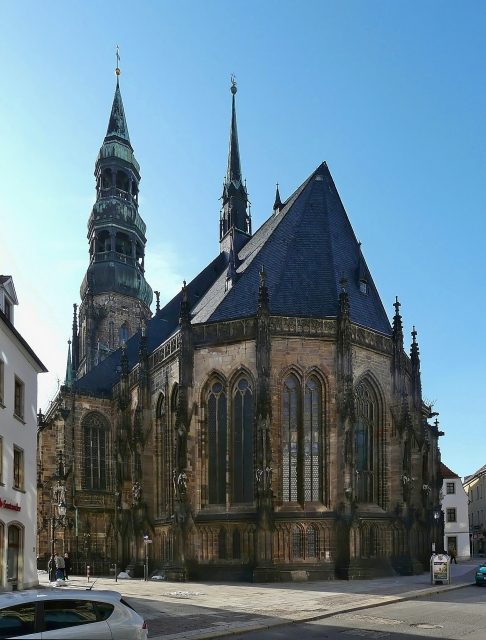
The Evangelical Lutheran Church of St. Mary in Zwickau, regionally known as the "Zwickau Cathedral" since this title was officially bestowed in 1935, is located in the city center and is its most important sacred monument. The building originated around 1180 as a Romanesque hall church but was converted into a three-aisled hall church in the late Gothic style between 1453 and 1563. The church tower (87 m), which dominates the cityscape, is, however, a Baroque bell tower from 1672, which replaced the original spire damaged by lightning. From 1501, the church was the workplace of Hieronymus Dungersheim, and in 1520, Thomas Müntzer preached here. Opposite the main portal are the priests' houses, which are presumably the oldest preserved urban residential buildings in Eastern Germany.
Spire+
The Baroque spire was created by Joachim Marquardt, master carpenter from Plauen. His brother Peter Marquardt created the Baroque tower structure of St. Catherine's in Hamburg. An identical Baroque church tower from the Marquardt workshop is located in Riga: St. Peter's Church. The identical construction was one of the reasons for the family of the painter Tatjana Lietz, who grew up in Riga, to adopt Zwickau as their future home after 1945.
Restoration+
From 1885 to 1891, St. Mary's Church was restored under the direction of the Leipzig building councilor Oskar Mothes in the spirit of Historicism. Style elements belonging to the originally Gothic church were reinserted and added. For example, the Baroque roof turret on the roof of the central nave was replaced by a Gothic one. Another striking change was made to the exterior of the church by adding numerous sculptures of prophets (choir), apostles (south side), and reformers (north side), made of French limestone, under the pinnacles of the buttresses.
External Influences+
On March 19, 1945, the south side of St. Mary's Church was particularly damaged during a bombing raid on the city center when an aerial mine exploded in the southern cathedral courtyard. The spiral staircase on the nave was destroyed, the exterior architecture of the south side was significantly damaged, especially the figural decoration on the southern nave, the roof covering and stained-glass windows, and inside, the gallery including the balustrade, as well as epitaphs in the south aisle. Repairs to the church roof and emergency glazing were carried out as early as 1945, followed by the reconstruction of the late Gothic architecture and the staircase from 1951 to 1956, with further work in subsequent years.
Even today, the historic building fabric of St. Mary's Church is threatened: the Cainsdorf sandstone of St. Mary's Church is permeated with many organic substances, highly porous, and severely attacked by air pollution, especially in the 20th century.
Due to coal mining in Zwickau in the 19th and 20th centuries, St. Mary's Church sank by more than 3.50 meters towards the main market. The effect was caused by the dewatering of the coal mining pits and tunnels. The Rotliegend rock layers under Zwickau subsided. The same effect occurred throughout the city area of Zwickau. The entire city center sank below the water level of the Zwickauer Mulde.
Today, this effect is reversing due to the flooding of the former shafts, so that St. Mary's Church is rising again, under constant tensile and compressive forces from the earth's interior.
To secure the structure, massive tie rods were installed between the pillars inside the church. The position of the structure is monitored by means of a laser plumb bob.
Art Treasures+
In addition to the historically interesting statues of prophets and apostles on the exterior facade, St. Mary's Church also houses significant art treasures inside. These include in particular Peter Breuer's Pietà (Vesperbild), exhibited here since 1502, which is considered his main work.
The Holy Sepulchre is a work by Michael Heuffner from 1507.
The six-winged altarpiece (shrine with martyr figures and Madonna; Christmas cycle; Passion cycle) is a late Gothic high altar by the Nuremberg master Michael Wolgemut (created around 1479), while the pulpit and baptismal font from around 1538 are by Paul Speck.
Particularly noteworthy are also the net-ribbed vault (approx. 1536 to 1565), the double spiral staircase, the Baroque Evangelical confessionals from around 1632, as well as numerous sculptures and epitaphs from various epochs.
Organs+
The main organ in the gallery was built in 1966 by the organ building company Hermann Eule Bautzen. The instrument has 77 stops (5400 pipes) on four manuals and pedal. The organ is the largest church organ ever built in the GDR and thus one of the largest organs in Germany. Its design resembles a dove.
Furthermore, there is a choir organ in the church, which was also built in 1979 by the Eule / Bautzen company.
Bells+
Since 1328, the cathedral had a peal of bells. It was destroyed in the city fire of 1403. Nothing more is known about the first peal, not even the number of bells.
In 1424, a large bell was cast, weighing 59 centners (2950 kg). In 1475, the Römerglocke, which is still preserved today, was cast. The Zwickau patrician Martin Römer donated it, which is why it bears this name. The Römerglocke is the oldest bell in Zwickau and one of the oldest in Saxony. It survived all fires because it hung in the roof turret until 1985. The St. Osanna bell from 1482 also remained preserved. It has a diameter of 1693 mm and a weight of 56 centners (2800 kg). Today, the Osannaglocke is located in Zwickau's St. Catherine's Church.
On July 12, 1512, the large bell cast in 1424 cracked during a thunderstorm ringing. The cause is said to have been an excessively large clapper made by the blacksmith Hans Ficke from Cologne. On September 27, 1513, the bell founder Oswald Hilliger, together with his sons Martin and Andreas, recast the cracked bell and cast a second smaller one named Anna. Furthermore, in the same year, he cast the Salva bell.
- The new large bell, whose name is unknown, bore the following inscription: Est in honore piae fas hoc fusumque Mariae annus bis duo ecce vigintique mille vas Deus hoc signa plebs salva sit aura benigna Sit tempestatum per me genus omne fugatum. (Cast in honor of pious Mary, devoutly proclaiming the divine promise that until the year two times two twenty thousand God testifies to bless the thirsty multitude of the saved, even if my sound fades in the wind.)
- The bell named Anna bore the following inscription: Ad laudem gloriosissimae matris genitrieis Annae, ejusdem nomen datum est huic campanae. (To the praise of Anna, the glorious mother of the divine lineage, in her name I call daily from the tower.)
- The bell named Salva bore the following inscription: Vas Deus hoc signa plebs salva sit aura benigna Sit tempestatum per me genus omne fugatum. (God testifies to bless the thirsty multitude of the saved, even if my sound fades in the wind.)
On April 17, 1650, the tower of St. Mary's Church, along with its bells, was destroyed by a lightning strike. Already in August, two new bells were cast. However, they could only take their place in the 25 m high bell chamber above the tower shaft in August 1658. These two bells are still preserved today and are among the oldest bells in the city of Zwickau and all of Saxony.
In 1683, the current large Seigerglocke (clock striking bell) was cast and hoisted. It is rigidly mounted in the second lantern and is only struck by a striking mechanism according to the time.
In 1890, another bronze bell was cast by G. A. Jauck in Leipzig. It weighed 1675 kg, had a height of 1.20 m, a diameter of 1.41 m, and was adorned with a bust of Luther. Its inscription read: God's word and Luther's teaching will never pass away. G. A. Jauck cast me in the year of the Lord 1890. This bell had to be delivered for melting down in 1943 during World War II.
In 1900, G. A. Jauck cast another small Seigerglocke weighing 600 kg and with a diameter of 100 cm. This had to be delivered in 1913, even before the beginning of World War I.
In 1957, the current third-largest bell of the cathedral was cast by Franz Schilling & Söhne in Apolda.
Take Mobile History with you
You are reading this text for free. Premium adds what matters on the road: descriptions read aloud, sites found through your camera, whole regions taken offline.
- Every description, including the ~17,700 Premium sites
- Audio guide: have descriptions read to you on location
- AR finder: see sites through your camera, with distance and bearing
- Unlimited saved sites
14 days free, then from €2.99 a month. Cancel anytime.
Source: Wikipedia · Licence: CC BY-SA 4.0 · Image: Thomas Eichler
This description draws on the facts documented in the linked Wikipedia article; Wikipedia content is licensed under CC BY-SA 4.0. Wording and editing: Mobile History.
Location: 50.7178, 12.4950