ResidenceStralsund

Meyerfeldtsches Palace
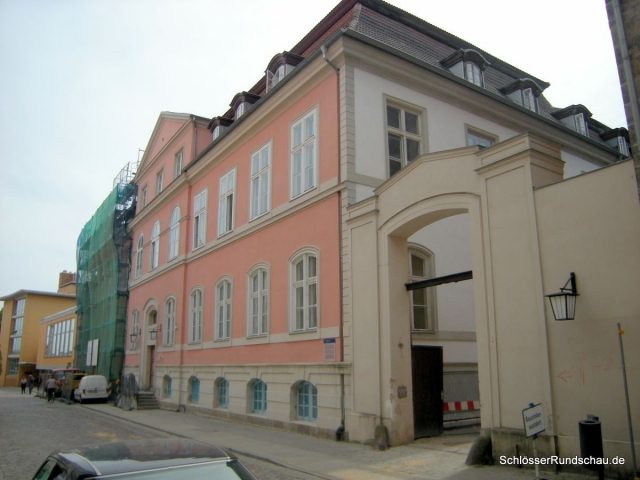
Meyerfeldtsches Palace

Local Authorities

The Meyerfeldt Palace, also known as the Swedish Government Palace, is a building dating from 1730 in the Hanseatic city of Stralsund, at Badenstraße No. 17.

The building was constructed between 1726 and 1730. Previously, four gabled houses stood on the now merged plot, which were destroyed during the siege of Stralsund by the "Great Elector" Frederick William in 1678.

After five years of belonging to Denmark, Stralsund returned to the Kingdom of Sweden through the Peace of Frederiksborg in 1720. However, since the Swedes now only owned Vorpommern and Rügen, they had to re-determine their seat of government, which had previously been in Stettin. The choice fell on Stralsund.

Cornelius Loos, a Swedish architect who had also been entrusted with the expansion of Stralsund's city fortifications, was commissioned by Count Johann August Meyerfeldt, who had been serving as Swedish Governor-General since 1713, to construct the building. Meyerfeldt paid for the construction from his own fortune. In 1730, the building was opened as the official residence and home of the Governor-General. A leather-bound house book written by the architect, containing three floor plans of the house and a detailed description of the building, is now kept in the Stralsund City Archives.

Of the 49 rooms in the building, eight were used for residential purposes by the Meyerfeldt family. The remaining rooms served official purposes, as well as for representation and as living quarters for the servants. There was a bakehouse with a confectionery, a brewery, a large kitchen, and two magazine vaults, as well as several pantries. The house was the first building in Stralsund with a mansard roof.

In 1734, Governor-General Axel von Löwen moved his residence from the "Meyerfeldt Palace," which continued to be used as an official residence, to his house called "Löwen Palace."

Many high-ranking visitors to the city were accommodated in the house. On October 6, 1797, the celebration after the wedding of Princess Friederike Dorothea of Baden to the Swedish King Gustav IV Adolf took place here. The king himself was represented by Baron von Taube, who spoke the "yes" for his king at the wedding in St. Nicholas Church. Afterwards, the wedding procession proceeded through Badenstraße, covered with boards draped in blue cloth, to the Swedish Government Palace for the celebration.

The Swedish king acquired the building in 1802 for 12,300 thalers from the heirs of the deceased Count Meyerfeldt. In 1835, at the request of the city council, the very generous entrance staircase, which protruded into the street, was reduced to its current size.

The building was damaged during the bombing of Stralsund on October 6, 1944, and repaired in 1956. The music school had already moved into the basement rooms in 1952. Today, the renovated building is the seat of the municipal building authority. The house, which is a protected monument, is part of the Sweden Road, a holiday route in Mecklenburg-Vorpommern. It is located in the core area of the UNESCO World Heritage "Historic Old Towns of Stralsund and Wismar."

Take Mobile History with you

You are reading this text for free. Premium adds what matters on the road: descriptions read aloud, sites found through your camera, whole regions taken offline.

  • Every description, including the ~17,700 Premium sites
  • Audio guide: have descriptions read to you on location
  • AR finder: see sites through your camera, with distance and bearing
  • Unlimited saved sites

14 days free, then from €2.99 a month. Cancel anytime.

Source: Wikipedia · Licence: CC BY-SA 4.0 · Image: http://schloesserrundschau.de/meckpomm/schloesser/ruegen002.html

This description draws on the facts documented in the linked Wikipedia article; Wikipedia content is licensed under CC BY-SA 4.0. Wording and editing: Mobile History.

Location: 54.3146, 13.0937