To be privately owned
Minoriten Castle

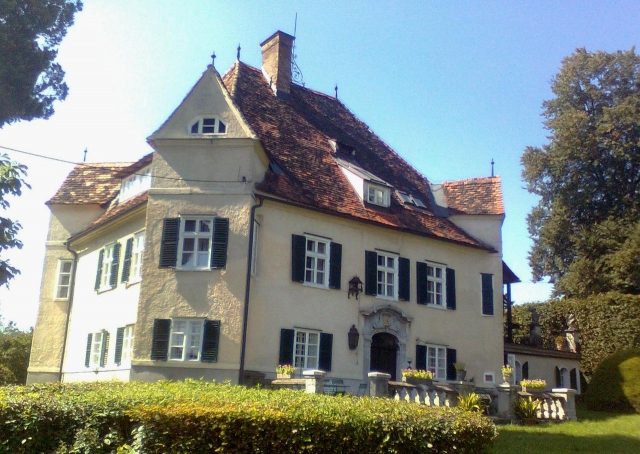
The Minoriten-Schlössl, also known as Speidlsegg, Luschinschlössl, or Rosegg, is a small castle in Quellengasse in the third district of Graz, Geidorf. It stands above the city on Graz's Rosenberg hill.
The regional secretary Stephan Speidel zu Vatersdorf had the small castle built on his land in 1596/97. After its completion in 1603, it was named "Speidelsegg" after its owner. In the same year, the Bishop of Lavant, Georg Stobäus von Palmburg, visited the complex. Construction work was continued by Speidl's brother Sebastian. From 1618, the property was named "Rosegg". From 1637 to 1789, it was owned by the Graz Minorite convent before passing into private ownership. In the mid-19th century, the Minoriten-Schlössl housed a coffee house. The renowned legal historian Arnold Luschin-Ebengreuth took over the building and arranged for the castle's embellishment. He had structural elements from demolished Graz townhouses integrated into the building. Today, the Minoriten-Schlössl is privately owned.
Architecture and Design+
Two diagonally placed corner turrets are attached to the square, two-story building block. Originally, a wooden gallery was attached to it. The Minoriten-Schlössl also features a steep hipped roof and a courtyard facade with a late Baroque stone portal (around 1770), attributed to Josef Hueber. A terrace with balustrade ornamentation is attached to the north side. The wrought-iron basket railings contain four sandstone busts of philosophers and emperors and date from the first half of the 18th century.
Inside the castle, in the hallway, there is a stone late Renaissance door frame with tendril relief from the 16th century. The wooden beam ceilings on the ground and upper floors date from the construction period. A marble figure of Fortuna can be seen in the Universalmuseum Joanneum. To the right of the portal on the outer wall, a plaque with the name "Rosegg" and the construction period is affixed.
In the garden stand Neoclassical sandstone figures of Fortuna, Mercury, and Vulcan, created around 1806. A Josephine-Neoclassical stone portal from 1780/90 is embedded in the garden's enclosing wall. It features a wrought-iron transom grille.
Take Mobile History with you
You are reading this text for free. Premium adds what matters on the road: descriptions read aloud, sites found through your camera, whole regions taken offline.
- Every description, including the ~17,700 Premium sites
- Audio guide: have descriptions read to you on location
- AR finder: see sites through your camera, with distance and bearing
- Unlimited saved sites
14 days free, then from €2.99 a month. Cancel anytime.
Source: Wikipedia · Licence: CC BY-SA 4.0 · Image: http://commons.wikimedia.org/wiki/File:Minoriten-Schl%C3%B6ssl_Graz.jpg
This description draws on the facts documented in the linked Wikipedia article; Wikipedia content is licensed under CC BY-SA 4.0. Wording and editing: Mobile History.
Location: 47.0908, 15.4468