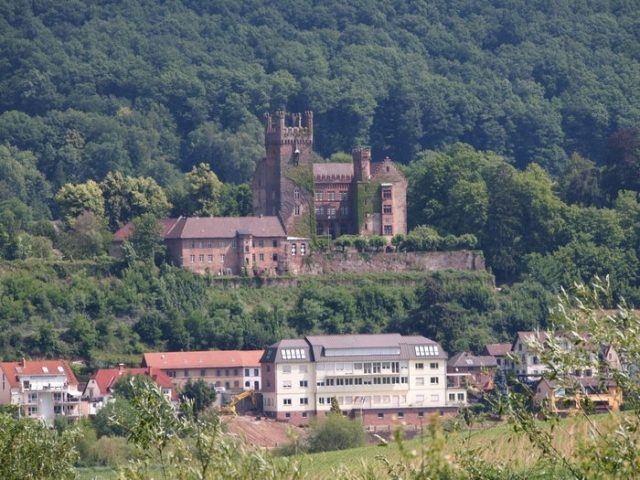
CastleNeckarsteinach

Mittelburg Castle

Mittelburg Castle

To be privately owned

The Mittelburg is a well-preserved and inhabited medieval hilltop castle near Neckarsteinach in the Bergstraße district. It is the second oldest of the four castles: Vorderburg, Mittelburg, Hinterburg, and Schwalbennest.

The Mittelburg was probably built around 1165 by Conrad I von Steinach, the youngest son of Bligger II von Steinach, and was half a Worms fief and half allodial property. Upon the death of Conrad's last descendant, Boppo von Steinach, the Worms half passed in 1325 to one of his sons-in-law, Luzzo von Helmstatt, while the allodial part went to the other son-in-law, Conrad zu Erbach, who promptly sold his share to Archbishop Matthias von Mainz. The Archbishop then concluded a castle peace with Luzzo and appointed Conrad von Helmstatt as bailiff in his half. The Worms half was repeatedly pledged in quick succession until, in 1382, Luzzo's son, Boppo von Helmstatt, came into possession of it, thus owning the entire Mittelburg. Boppo sold the Worms half to Hans von Hirschhorn in 1398. After Boppo died around 1400 without male heirs, the Mainz part of the castle went to Reinhard von Neipperg, who pledged it in 1442 to the then owner of the Hinterburg, Weiprecht III von Helmstatt. After Weiprecht III's death in 1478, a dispute arose between Weiprecht's nephew Martin, who owned the Mainz half, and Hans von Hirschhorn, who owned the Worms half, over the ownership of some properties belonging to the castle. In 1483, the Worms part was leased to Otto von Hirschhorn and his nephews. In 1497, the lord of the Vorderburg, Blicker XIV Landschad von Steinach, appears as the owner of a quarter. His heirs sold the share to Heinrich VII von Handschuhsheim, who already owned the Hinterburg. After the von Handschuhsheim family had to leave the Hinterburg in the 1540s after a lengthy ownership dispute, they also sold their share of the Mittelburg in January 1550 to the brothers Hans, Hans Pleikard, and Christof Landschad von Steinach. In the 16th century, the Landschad family regained possession of the entire Mittelburg. In 1575, Christof I Landschad von Steinach appears as the sole owner, and from him, the castle was inherited within the family line down to his grandson Friedrich († 1653), the last Landschad.

After the extinction of the Landschad family, the Worms and Speyer chapters repossessed the former feudal property (Hinterburg, Vorderburg, and half of Mittelburg), briefly placed it under self-administration, and then transferred it as a fief to Wolf-Heinrich von Metternich zu Burscheid in 1657. In the same year, he acquired the former Landschad allodial property from Dieter VIII Landschad's daughter Eva Elisabeth, as well as the remaining half of the Mittelburg from the Barons von Venningen, so that from the late mid-17th century, ownership of the four castles was once again united in one hand. After the extinction of the Metternich line in 1753, the former fiefs and even the former allodial property were confiscated by the Speyer and Worms chapters. In 1803, the entire property came to the state of Hesse as part of the mediatization. Hesse reached a settlement with the heir of the allodial property, Baron von Dorth, ceding to him not only the Mittelburg, which was used as an official residence, but also the ruins of the Hinterburg. Von Dorth also acquired the Vorderburg from a Dr. Wegerich, who had bought it from the state. In 1910, the Lords von Dorth renounced the ruins of the Hinterburg, which then reverted to the Hessian state. Mittelburg and Vorderburg passed upon the death of the last Baron von Dorth, Ludwig, in 1925, to the son of his adopted son Alexander, who had died before him, Boemund Freiherr von Warsberg-Dorth, whose descendants still own the castles today.

The castle was significantly rebuilt during the Renaissance, presumably by the Landschad von Steinach family. The medieval structure is said to have been heavily altered during this time. In 1840, it was rebuilt again, this time in the Neo-Gothic style. The castle is currently inhabited and cannot be visited.

Layout+

The complex, initially consisting of a mighty keep and a small core castle, was constantly expanded and later transformed into a Renaissance-style castle, modeled after Heidelberg Castle, with a columned gallery and arcaded hall. A large part of the old curtain wall and the drawbridge access on the east side also disappeared during this process.

Around 1820, a so-called "Gothicization" of the castle took place due to the romanticization common at the time. The additional turrets and the large staircase also date from this period.

Take Mobile History with you

You are reading this text for free. Premium adds what matters on the road: descriptions read aloud, sites found through your camera, whole regions taken offline.

  • Every description, including the ~17,700 Premium sites
  • Audio guide: have descriptions read to you on location
  • AR finder: see sites through your camera, with distance and bearing
  • Unlimited saved sites

14 days free, then from €2.99 a month. Cancel anytime.

Source: Wikipedia · Licence: CC BY-SA 4.0 · Image: http://www.wehrbauten.de/thread.php?threadid=984

This description draws on the facts documented in the linked Wikipedia article; Wikipedia content is licensed under CC BY-SA 4.0. Wording and editing: Mobile History.

Location: 49.4095, 8.8327