The Aurelian Walls can be visited
Ancient BuildingRoma
Mura aureliane (Aurelian Walls)
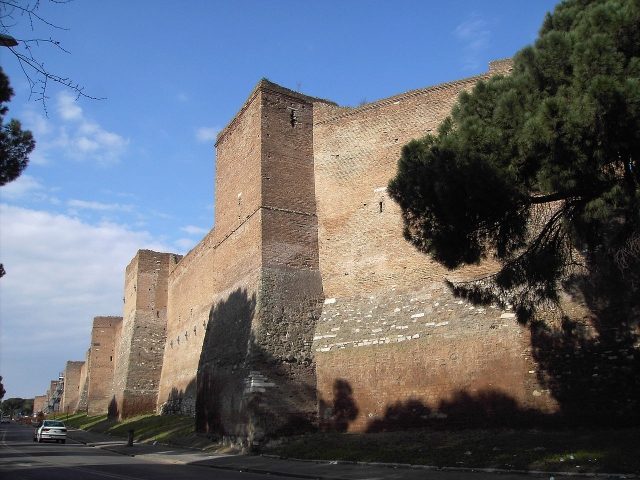
In Rome, the Aurelian Walls enclose large parts of the historic center and remain largely intact to this day.
History+
Construction of the Aurelian Walls began under Emperor Aurelian between 270 and 275 AD and was completed under his successor Probus around 282 AD. This fortification was a direct response to the threat from Germanic tribes, who repeatedly invaded Italy in the 3rd century and even endangered Rome. An impetus for the construction was Aurelian's defeat against the Juthungi in 271. The original wall stretched over 19 kilometers, was about 6 meters high, and 3.5 meters deep. It was mainly built of bricks and featured 18 larger gates and 383 watchtowers, spaced approximately 30 meters apart. Many existing structures, including the Tomb of Gaius Cestius, the Amphitheatrum Castrense, and parts of the Aqua Claudia, were directly integrated into the wall. In the 4th and 5th centuries, the wall was further reinforced and raised to almost 11 meters under emperors such as Maxentius, Honorius, and Arcadius.
Source: Wikipedia · Licence: CC BY-SA 4.0 · Image: http://en.wikipedia.org/wiki/File:Celio_-_le_mura_tra_porta_san_Sebastiano_e_porta_Ardeatina_1974.JPG
This description draws on the facts documented in the linked Wikipedia article; Wikipedia content is licensed under CC BY-SA 4.0. Wording and editing: Mobile History.
Location: 41.8733, 12.4985