To be privately owned
Neippergsches Castle

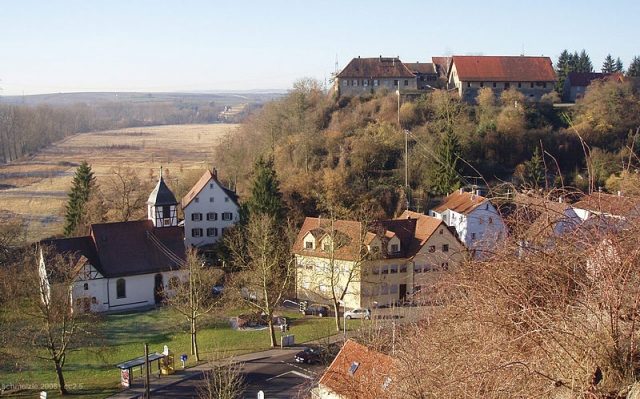
Neipperg Castle in the Klingenberg district of Heilbronn, situated on a mountain spur above the Neckar, dates back to the castle of the medieval local nobility. It was acquired by the Lords of Neipperg in the early 15th century and served as their main residence from the mid-16th century until the construction of Schwaigern Castle. The frequently rebuilt property, now used for residential and commercial purposes, retains remnants from many construction periods.
In the 13th century, Klingenberg Castle, along with the village of Klingenberg (which developed as a castle settlement) and the church patronage, was owned by Weissenburg Abbey. The abbey leased its Klingenberg property to the Margraviate of Baden, which in turn enfeoffed the Lords of Klingenberg, first mentioned in 1293 with a Reinbot (Remboto, Renbot) von Klingenberg. Reinbotstrasse in Klingenberg was named after him. In 1360, the Lords of Klingenberg participated in the war against Charles IV, siding with Counts Eberhard the Quarrelsome and Ulrich IV. The castle was captured by the army of Count Palatine Ruprecht, partly because the castle had become a "robber knight's castle" due to its predatory activities. On October 31, 1360, Emperor Charles IV permitted Heilbronn to use the stones of the Staufer castle, which is said to have been used to build the tower in Heilbronn later known as Götzenturm. In 1361, the Emperor also issued a ban on rebuilding the castle. In 1389, a "Burgstadel" (castle site) is still mentioned.
In 1407 and 1417, Eberhard von Neipperg acquired the margravial fief in two halves. The fief contract mentions a "Hofstatt" (farmstead). The Lords of Neipperg erected new buildings on the foundations of the castle. A castle is mentioned in 1439 and 1478, a fortress in 1522, and an associated wine press in 1539. Construction activity is also documented in 1577 under Philipp von Neipperg, who had his seat and thus the family's main residence in Klingenberg since 1554. From 1590, a forecourt is attested. In 1673, a distinction is made between an "Oberhaus" (upper house) and a dilapidated stone house. The still-preserved main building, the single-story "Schlössle" (small castle) facing the courtyard, was built in the mid-17th century in place of a predecessor building from the 16th century. At the same time, there were also plans for the new construction of a wine press, a dairy, and a cattle stable. The complex remained the main residence of the Lords of Neipperg until Schwaigern Castle was built in 1702.
In 1858 and 1861, the farm buildings were destroyed by fires and subsequently rebuilt by Heilbronn's city architect Louis de Millas. The complex was damaged in World War II. The servants' quarters, whose corner ashlar dates from 1526 and which had been baroque-style renovated in the 18th century, still have an emergency roof from the repairs after World War II. In 1950, a chapel with artistic glazing by Josef de Ponte was also established between the servants' house and the curtain wall.
The castle is now used for residential and commercial purposes.
Description+
The castle stands in the southwest on the remains of a castle wall with fragments of a Staufer belfry or residential tower. In the eastern corner of the castle is a plinth floor of the old castle with a cellar, which has walls up to one meter thick and a vault. The "Schlössle" and servants' house were rebuilt or renovated in the 18th century on foundations from the 16th century. The cattle stable and grain storage were built in 1860. The barn section adjoining the grain storage was built in 1875 over an older cellar.
Take Mobile History with you
You are reading this text for free. Premium adds what matters on the road: descriptions read aloud, sites found through your camera, whole regions taken offline.
- Every description, including the ~17,700 Premium sites
- Audio guide: have descriptions read to you on location
- AR finder: see sites through your camera, with distance and bearing
- Unlimited saved sites
14 days free, then from €2.99 a month. Cancel anytime.
Source: Wikipedia · Licence: CC BY-SA 4.0 · Image: https://commons.wikimedia.org/wiki/File:Klingenberg-schlossblick.jpg
This description draws on the facts documented in the linked Wikipedia article; Wikipedia content is licensed under CC BY-SA 4.0. Wording and editing: Mobile History.
Location: 49.1186, 9.1578