Hotel
CastleBaden-Baden
New Castle Baden-Baden
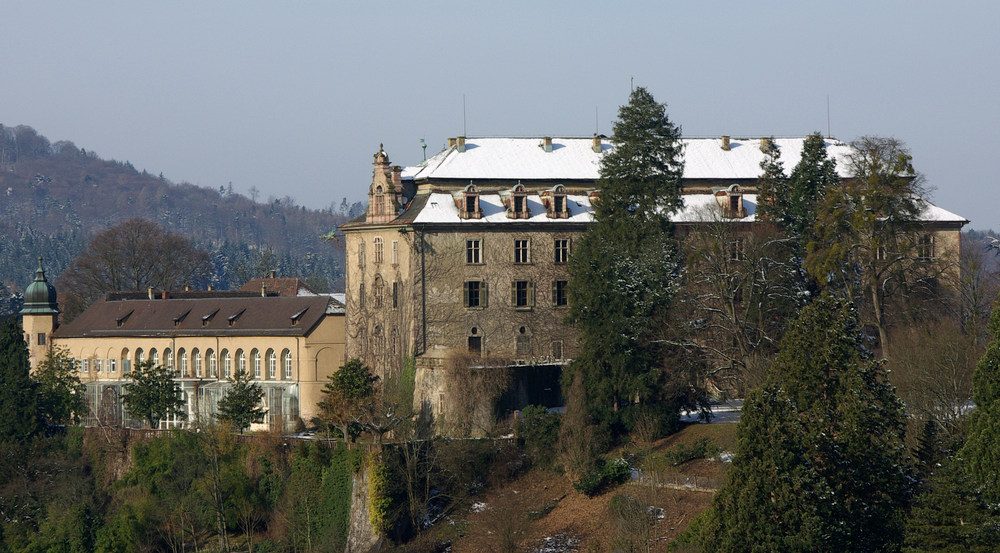
The New Castle (German: Neues Schloss) on the Florentinerberg in Baden-Baden was the seat of the Margraves of Baden from the late 15th century to the end of the 17th century and of the Margraves of Baden-Baden from 1535. As a castle complex from the Late Middle Ages, it has been rebuilt and extended several times. Today, the listed building is owned by Kuwaiti investors who wanted to convert the castle into a luxury hotel.
Architecture+
The most important parts of the building are: the three-storey main castle, the carriage house, the kitchen building and the archive tower (all Renaissance buildings from the 16th century) as well as the cavalier house in the castle courtyard, which can be accessed through the western gatehouse that was built in the 15th century. A palace garden with rare plants and trees forms a border to the New Castle in the east. From its 130-metre-long terrace (laid out in 1670), visitors can access terraced gardens with a variety of exotic plants. The park covers around 5.5 hectares.
History+
The construction of a castle complex on older walls above the market square of the town of Baden can be dated to between 1388 and 1399. The town was granted Town privileges in the second half of the 13th century. Around 1479, Margrave Christopher I converted the complex into a residence, making it the successor to Hohenbaden Castle. From 1529, the New Palace housed the archive of the Margraves of Baden. After the palace was destroyed by the troops of the French King Louis XIV in the Nine Years' War, Margrave Louis William moved the seat of government to Rastatt and built a new residence in the form of Schloss Rastatt. The New Castle in Baden-Baden was rebuilt in the early 18th century using the remaining outer walls. In the 19th century, it served as a summer residence for the Grand Dukes. Grand Duke Leopold had the palace restored by Friedrich Theodor Fischer in 1843–47. The state rooms were decorated in a new Renaissance style. Around 1900, the castellan showed paying visitors the banqueting halls and the grand ducal living quarters. The so-called Dagobert Tower, a pavilion with a spiral staircase from the period after 1575 that was destroyed in the Second World War, and the cellar vaults "with stone and iron doors, probably former dungeons" were also included. The castle garden was always open and free of charge. In 1919, the New Castle was granted to the House of Baden as private property following the separation of house and state assets after the November Revolution. It received the art treasures from the other palaces that had been left to the former ruling house, including the holdings of the older Zähringer Museum from the nationalized Karlsruhe Palace.
Source: Wikipedia · Licence: CC BY-SA 4.0 · Image: Rainer Lück http://1RL.de · Wikimedia Commons · CC BY-SA 3.0
This description is an excerpt from the linked Wikipedia article and was written by its authors. Like the original it is licensed under CC BY-SA 4.0 and may be reused under the same terms.
Location: 48.7644, 8.2417