The church can be visited
ChurchAnklam
St. Nicholas' Church
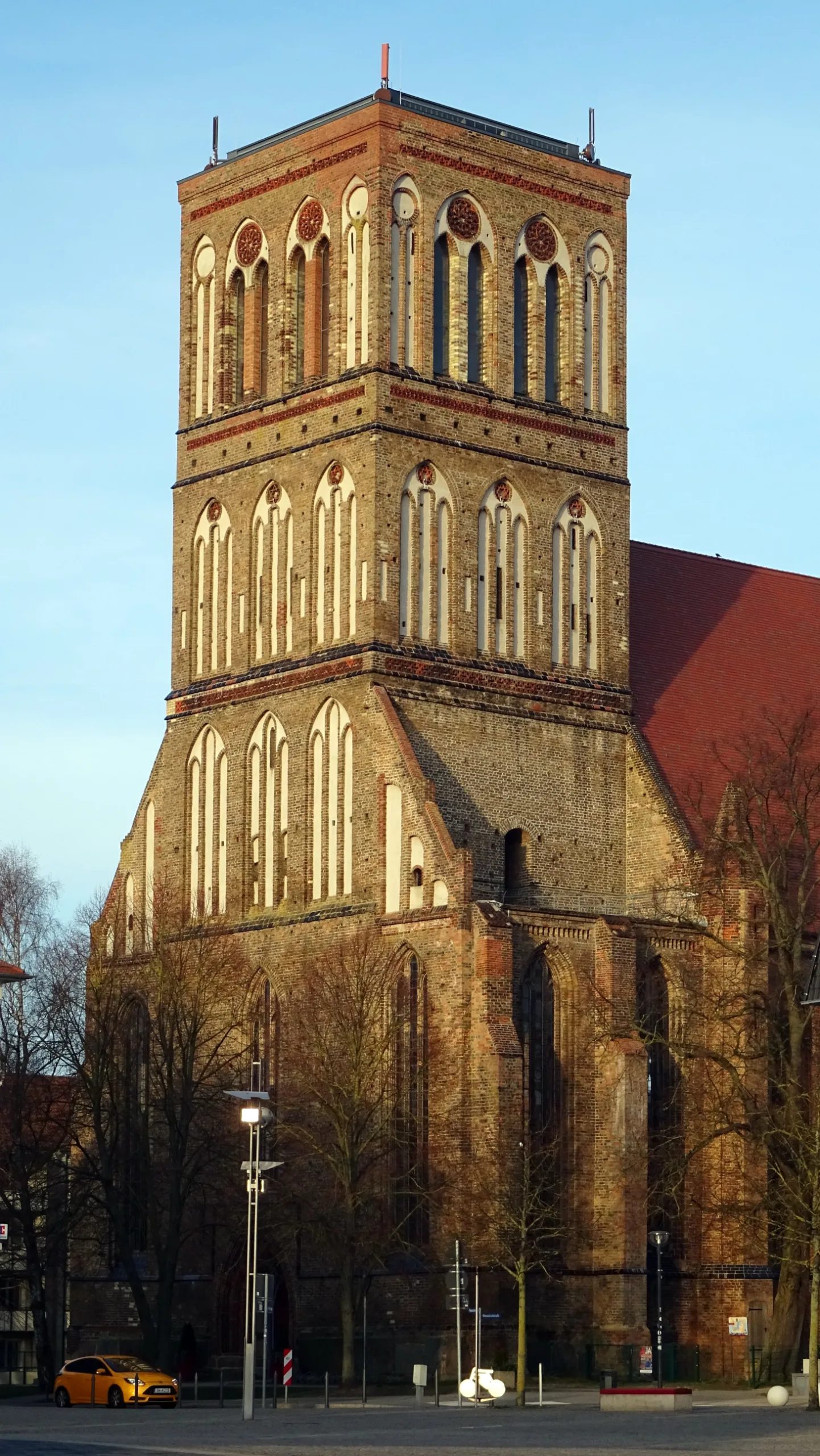
St. Nicholas' Church is, alongside St. Mary's Church, the second, younger of the two large medieval town churches in Anklam, Mecklenburg-Vorpommern. It is located on the northeast side of Anklam market square and was destroyed in 1945. It has been under reconstruction since 2010, but was deconsecrated on October 2, 2004, and is therefore no longer used as a church of the Evangelical Lutheran Church in Northern Germany.
History+
Construction, which began around 1280, was completed by the end of the 14th century. The church was first mentioned in a document in 1300. It is named after Nicholas of Myra, who is considered the patron saint of seafarers. With the installation of the choir stalls, St. Nicholas' Church was finally completed around 1500. In contrast to St. Mary's Church with its Romanesque origin, St. Nicholas' Church is a purely Gothic building, although a predecessor church had already been built since 1180. Until its destruction, the church was considered a landmark of Anklam and was a widely visible pilot's mark.
The significant brick Gothic building is a three-aisled hall church with a four-story tower and sacristy. The nave was covered with a large gable roof until 1945. The tower had always had a tall Gothic spire over 100 meters high, which was damaged and restored several times by lightning strikes and storms. Together with St. Mary's Church, which received a similar spire at the end of the 19th century, both churches formed the distinctive cityscape of Anklam with their "twin towers". The spire of St. Nicholas' had a special feature: its tip showed a clearly visible twist. On June 25, 1848, the aviation pioneer Otto Lilienthal was baptized in St. Nicholas' Church, whose birthplace was in the immediate vicinity of the church. The interior was richly decorated with valuable furnishings. Despite being relocated during World War II, some parts are still missing today. Others, such as the magnificent chandeliers, the Apostle Bell, and parts of the choir stalls, are now in Anklam's St. Mary's Church and the Stralsund Cultural History Museum. Medieval fresco paintings on the side walls and pillars are only preserved in fragments. During the heaviest bombing raid on Anklam on October 9, 1943, the window glazing of St. Nicholas' Church was destroyed by pressure waves and splinters from bombs impacting nearby, and the copper covering of the tower was significantly damaged. However, the church itself was not hit. The destruction of the church only occurred on April 29, 1945, by German artillery fire from the village of Ziethen, north of Anklam, on the town already occupied by the Red Army. The spire then crashed into the nave. A part of the spire was rediscovered in 2022 during construction work on a sidewalk in front of the church. However, the tower sphere, which traditionally also contained contemporary historical traditions, remains missing. The church partially burned out; only the tower stump and the enclosing walls with free pillars and arches remained standing. After the war, the ruin was provisionally secured. Only the south annex with the two chapels, the south entrance, and the sacristy were re-roofed and temporarily used by the church community, while the tower was made provisionally accessible and fitted with a small spire to use the tower as a platform for radio antennas. The nave remained exposed to the weather for over 50 years.
Dimensions (before destruction)+
Tower height with spire: 103.00 m Height to the gable covering of the tower: 58.00 m Tower footprint: 12.50 × 12.50 m Enclosing space: 23.00 m × 55.00 m Height to the apex of the vault: 16.50 m Height to the ridge of the roof: 35.00 m
Apostle Bell+
Of the bells of St. Nicholas' Church, the Apostle Bell has been preserved. It was cast in 1450 by Rickert de Monkehagen. With a weight of 4500 kg, a diameter of almost 180 cm, and the strike note h0, it is the third-largest bell in the Pomeranian Evangelical Church District and the largest medieval bell in Mecklenburg-Vorpommern. Since its recovery from the ruins of St. Nicholas' Church in 1946 and its installation in 1947, it has been part of the carillon of St. Mary's Church. Since 2014, it has been newly hung there in the bell chamber below a new carillon with five bells and is only rung on special festive days.
Commenced Reconstruction+
In the early 1990s, the building's situation became increasingly critical; there was a risk of collapse. Citizens of Anklam formed the Förderkreis Nikolaikirche Anklam/Vorpommern e. V. (since 2009 Förderkreis Nikolaikirche Anklam e. V.) to advocate for the preservation and reconstruction of the church. From 1995 to 1996, the nave was provided with an emergency roof and secured. Since then, extensive securing and restoration work has been carried out on the preserved parts of the building and on the tower, financed by urban development funds, monument preservation, municipal subsidies, and donations. In 2004, the Hanseatic City of Anklam took over responsibility for the deconsecrated building as part of a hereditary building right contract, and in 2007, planning began for comprehensive securing and reconstruction of the former church.
With the help of the federal government's economic stimulus package, the state of Mecklenburg-Vorpommern, and the Hanseatic City of Anklam, the roof of the nave was rebuilt in its original form and height between 2010 and 2011. From spring 2013 to spring 2014, the roof of the south annex (chapels, vestibule, sacristy) was renewed. For the future use of St. Nicholas' Church for exhibitions and events, there is a plan under the working title Ikareum. This is a quartet of uses as an event venue, a historical monument, a Regional Information and Tourist Center (RITZ), and a personal museum for Otto Lilienthal, the latter already existing at another location. This design includes, among other things, an accessible spire in historical form and a nave usable for exhibitions and events on several transparent levels, including the roof space. The Ikareum is part of the Anklam Triad investment package agreed between the state and the city, which also includes the construction of a new swimming pool and a school campus. On September 19, 2020, it was announced that funding for the expansion had been promised by the Minister of State for Culture, Monika Grütters. On December 17, 2022, the first construction phase of the nave's reconstruction was handed over with the opening of the pilot exhibition Lilienthal LAB. The topping-out ceremony for the RITZ functional annex followed on August 2, 2023.
New Windows in St. Nicholas' Church+
The windows in the nave of St. Nicholas' Church were destroyed on October 9, 1943, as a result of bomb impacts near the building and were not replaced until the start of reconstruction work in 1995. The first new stained-glass window was created as a reproduction of the St. Nicholas window from 1909 and was inaugurated on October 2, 2004. The window, financed by donations, was manufactured by Glasgestaltung GmbH Altlandsberg. It depicts Saint Nicholas holding his hand in blessing over St. Nicholas' Church. In 2004, the Förderkreis Nikolaikirche Anklam e. V. launched a fundraising campaign parallel to the installation of the St. Nicholas window to promote further glazing of the nave with small donations. The first window panes from the fundraising campaign were installed in St. Nicholas' Church starting in summer 2009 and received a short inscription applied by sandblasting, according to the donor's wishes. The fundraising campaign was completed in summer 2014. The manufacture and installation of the windows were carried out by Glaserei Koch from Neubrandenburg. In memory of the destruction and the victims of World War II, a second colored stained-glass window – also financed by donations and manufactured by Glasgestaltung GmbH Altlandsberg – was installed next to the St. Nicholas window in summer 2009 as the Memorial Window. In addition to several banners commemorating the destruction of Anklam and the victims, the window shows St. Nicholas' Church in three stages: at the time of destruction, as a roofless ruin shortly after the end of the war, and as a building under reconstruction with the emergency roof.
The most recent stained-glass windows in St. Nicholas' Church, the Lilienthal choir windows, are dedicated to the future use of the building as an exhibition and event venue with the project name Ikareum. Designed by the Englishman Graham Jones as part of the design competition held in 2010 and manufactured by Glasstudios Derix Taunusstein, the three windows were produced in 2014, installed in St. Nicholas' Church in November 2014, and inaugurated on December 19, 2014.
In memory of Anklam's Hanseatic past and as an appreciation for the Hanseatic League DIE HANSE, window panes with coats of arms of modern Hanseatic cities were installed in St. Nicholas' Church between 2010 and 2017 through a fundraising campaign by the Hanseatic City of Anklam. The following overview lists the donated and installed coats of arms of the Hanseatic cities in St. Nicholas' Church:
In spring 2015, the coat of arms windows of Anklam's four partner cities/municipalities (Heide, Burlöv/Sweden, Gmina Ustka/Poland, Limbaži/Latvia) were installed in the window above the west entrance of St. Nicholas' Church Anklam, surrounding the Anklam coat of arms window. The coat of arms windows, donated as a gift for the city's 750th anniversary in 2014, were designed and manufactured based on the Hanseatic coat of arms windows and differ from them only by the red background of the city/municipality names above the coat of arms.
The installation of new windows in the nave was completed in autumn 2017 with the installation of new windows in the south annex. While the three windows on the upper floor of the south annex were glazed with colorless clear glass, the two windows in the sacristy were each designed with four coats of arms. Historically documented guilds in Anklam were chosen as motifs. The design is based on guild seals exhibited in the Museum im Steintor. The eight white coats of arms with a red or blue background show the guilds of coopers, locksmiths, ship carpenters, chamberlains, bakers, tailors, fishermen, and shoemakers. The windows with the Hanseatic coats of arms, Anklam's partner cities/municipalities, and the guild coats of arms were also manufactured and installed by Glaserei Koch in Neubrandenburg.
Current Use+
Since 1999, the church has been open to visitors again during the summer months and has been used for exhibitions and events. In 2008, the tower was made accessible to the public with a covered viewing platform at a height of approximately 50 m. In 2021, the complex interior renovation began, the first phase of which was completed in December 2022 with a reopening.
Take Mobile History with you
You are reading this text for free. Premium adds what matters on the road: descriptions read aloud, sites found through your camera, whole regions taken offline.
- Every description, including the ~17,700 Premium sites
- Audio guide: have descriptions read to you on location
- AR finder: see sites through your camera, with distance and bearing
- Unlimited saved sites
14 days free, then from €2.99 a month. Cancel anytime.
Source: Wikipedia · Licence: CC BY-SA 4.0 · Image: Foto: Jörg Heldt (Community)
This description is a machine translation of an excerpt from the linked Wikipedia article. The source text was written by its authors, the translation is by Mobile History; like the original it is licensed under CC BY-SA 4.0.
Location: 53.8564, 13.6890