The Castle can be visited
CastleZahrádky (Neugarten)
Nový Castle
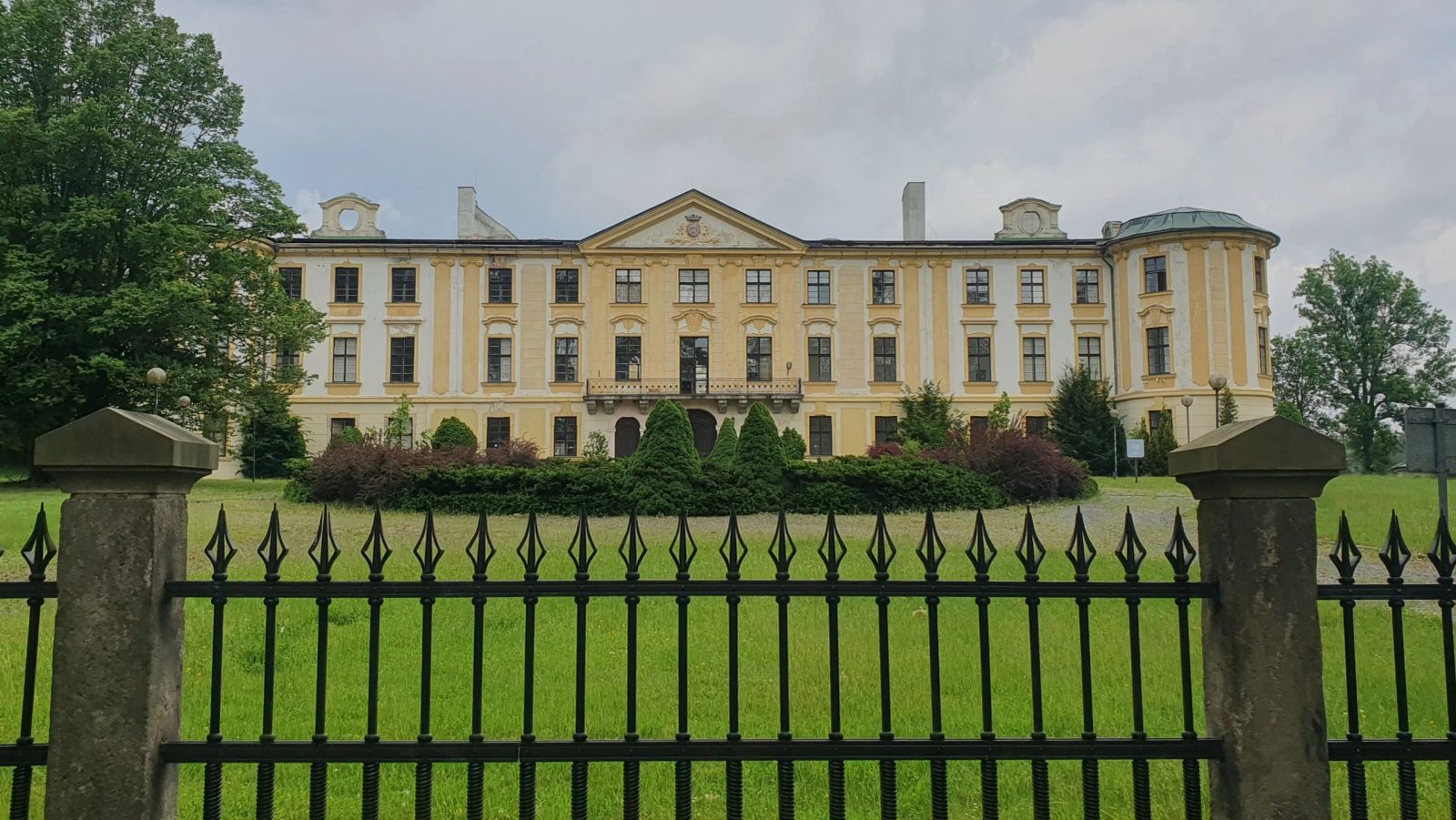
Nový zámek, also Nový Vítkovec (German Neuschloß Castle, Neuschloss) is the name given to the Baroque castle in Zahrádky u České Lípy (Neugarten) in North Bohemia (Czech Republic). The castle is surrounded by one of the most important English parklands in the Czech Republic. In 2003, the castle building was almost completely destroyed by a major fire.
History+
In 1376, the Nový Vítkovec castle complex was first mentioned as the New House on the rock spur above the Robitzer Bach. The owners were the Lords of Mniechov (Miechow), who sold the castle to the Lords of Wartenberg after 1480. They rebuilt the complex between 1547 and 1550 and erected a stately Renaissance castle, which at that time was considered the largest and most magnificent in Bohemia. In 1575, the manorial seat, which had been converted into a fief of the Bohemian Crown in 1547, became a free allodial property again and was named Neuschloß. After the Battle of White Mountain in 1620, Johann Georg von Wartenberg from the Tetschen line, who had asserted his claims to the manor after a long dispute against other family members in 1617, was dispossessed. In 1623, the general Albrecht von Wallenstein became the owner, who carried out some Baroque alterations and had the straight lime avenue laid out across the pheasantry into the Gründeltal. After his assassination in 1634, Neuschloß with the dominion of Böhmisch Leipa was the only one of his confiscated possessions that was left to his widow Duchess Isabella Katharina von Friedland, née Countess von Harrach (1601–1654) as a widow's residence. Her daughter Princess Maria Elisabeth von Friedland (1626–1662) married Imperial Count Rudolph von Kaunitz in 1645, whose family gained great fame during the time of Empress Maria Theresia through the Austrian State Chancellor and opponent of King Frederick the Great, Prince Wenzel Anton von Kaunitz. In subsequent years, new acquisitions led to the later Landtafelgut Neuschloß with Böhmisch Leipa and Hauska, and the Fideikommissherrschaft Neuschloß-Leipa was established. At the end of the 18th century, Neuschloß was rebuilt in the Baroque style and retained this appearance until after the expropriation in 1945. Under Michael Karl Josef Count von Kaunitz, his son Vinzenz was a great patron of the natural sciences, and the astronomer Alois Martin David stayed at the castle several times as a guest of the house. In the 19th century, parts of the surroundings were also redesigned in a romantic sense. A typical example of this is the artificial rock castle Jiljov (Veilchenburg). The nearby Höllengrund was also opened up with paths and a boat trip through the rock gorge was set up. After the death of Imperial Count Albrecht von Kaunitz (1829–1897), the castle came into the possession of his eldest daughter Marie (* March 28, 1855; † January 18, 1918) married to Egon Karl Prince zu Hohenlohe-Waldenburg-Schillingsfürst. After Marie Princess zu Hohenlohe-Waldenburg-Schillingsfürst was widowed and fell into financial difficulties, she had to sell Neuschloss to the husband of her sister Eleonore Countess Kaunitz, Géza Count Andrássy von Csíkszentkirály und Krasznahorkay. He gave it to his daughter Marizza Countess Andrássy, who was married to Prince Johannes von und zu Liechtenstein. Marizza von Liechtenstein in turn gave Neuschloß in equal parts to her sons Emanuel and Johannes Liechtenstein in 1936. In 1945, after the end of the Second World War, the House of Liechtenstein was dispossessed without compensation and Czechoslovakia became the owner of the entire castle complex. The castle's farmyard was converted into a state farm during the communist era, and the castle itself was subsequently used by the Czech Charles University in Prague as a training and further education center. As such, the castle was only partially accessible to the public. In 1992, a hotel was established in the castle.
On January 30, 2003, a fire broke out in the roof truss of Neuschloß, which quickly engulfed the entire roof area. Due to falling debris and penetrating extinguishing water, the entire castle building was almost completely destroyed. In some places, the force of the collapsing roof area caused the floor slabs to break through to the ground floor. The resulting damage was estimated at over 100 million Czech crowns (approx. 3.5 million euros). The restoration of the castle has so far been limited to safety measures; an emergency roof was erected in 2003. A fundraising campaign for the reconstruction was launched by the municipality of Zahrádky in the Czech Republic.
Castle Park+
The castle park is one of the most important of its kind in the Czech Republic. It houses 20 species of conifers and 17 different species of deciduous trees. The western half of the park became the property of the state farm after 1945, and a high iron fence has since divided the complex into two halves. This part of the park is now overgrown and no longer recognizable as such. The reconstruction of the orangery on the north side of the park began in 2002, but was abandoned after the fire in the castle.
Take Mobile History with you
You are reading this text for free. Premium adds what matters on the road: descriptions read aloud, sites found through your camera, whole regions taken offline.
- Every description, including the ~17,700 Premium sites
- Audio guide: have descriptions read to you on location
- AR finder: see sites through your camera, with distance and bearing
- Unlimited saved sites
14 days free, then from €2.99 a month. Cancel anytime.
Source: Wikipedia · Licence: CC BY-SA 4.0 · Image: Foto: Jörg Heldt (Community)
This description is a machine translation of an excerpt from the linked Wikipedia article. The source text was written by its authors, the translation is by Mobile History; like the original it is licensed under CC BY-SA 4.0.
Location: 50.6356, 14.5248