The Castle can be visited
CastleNürnberg
Nürnberger Castle
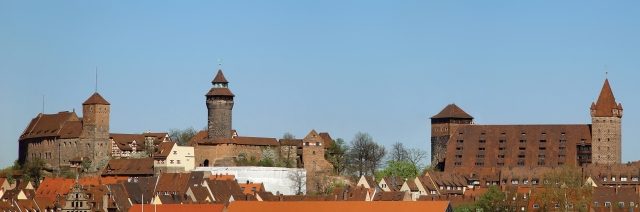
Nuremberg Castle combines the Imperial Castle and the Burgrave's Castle. It served as an imperial residence, an imperial castle, and a Hohenzollern burgrave's seat.
History+
Archaeological findings prove settlement on the castle hill before the year 1000. However, the first written mention of Nuremberg in 1050 does not refer to the castle; it only appears in historical sources in 1105. Around 1140, King Konrad III began construction of the Imperial Castle as a royal palatinate. The burgraviate, which he transferred to the noble free lords of Raabs, passed to Friedrich von Zollern in 1190/91. In the 13th century, Nuremberg gained imperial city independence, and the Imperial Castle came under the city's care. After the destruction of the Burgrave's Castle in 1420, the last burgrave sold his title to the city council in 1427, making the castle entirely municipal property.
Source: Wikipedia · Licence: CC BY-SA 4.0 · Image: http://commons.wikimedia.org/wiki/File:N%C3%BCrnberg_Burg_ArM.jpg
This description draws on the facts documented in the linked Wikipedia article; Wikipedia content is licensed under CC BY-SA 4.0. Wording and editing: Mobile History.
Location: 49.4579, 11.0756