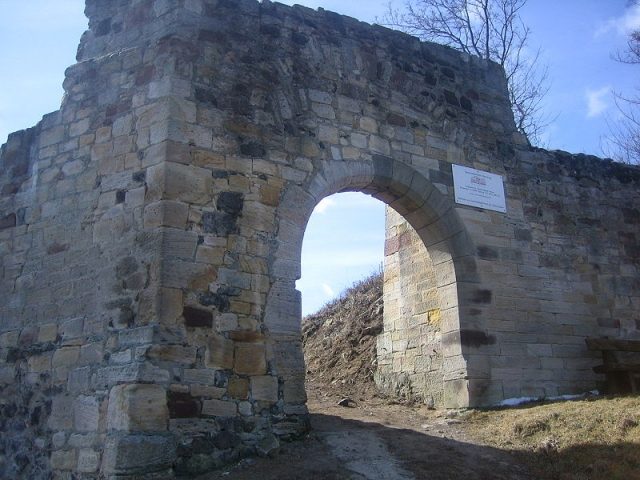
The remains of the Castle can be visited
Oberburg Castle
The Obernburg of Gudensberg is the ruin of a hilltop castle above Gudensberg in the Schwalm-Eder district in Hesse (Germany). The former castle was built in the Romanesque style. The Gudensberg town coat of arms shows the castle gate.
The castle ruin is located above Gudensberg on the forested summit of the Schloßberg (305.8 m above sea level), a basalt cone that is passed in a north-south direction by the Goldbach, a tributary of the Ems, to the east. The outer bailey of the Obernburg was the vanished Wenigenburg.
From the Schloßberg, there is a good view, to the north past the Odenberg to the Langenberge, to the northeast to the Kaufunger Wald, to the east to Felsberg and the Heiligenberg, and to the southwest to Fritzlar and across the Edertal to the Kellerwald.
The Schloßberg was at least since 1045 the seat of the Counts in the Hessengau. Since 1027, this office was held by the family of the originally Swabian Counts Werner. The Obernburg was first mentioned in a document as Burg Udensberc in 1121 as the seat of the Gisonen, the family of the Gau Counts, who had inherited the Gau County after the death of Werner IV in 1121. The Gau Count was the head of the Gau court and responsible for collecting taxes and duties. He led the army and held Thing on the nearby Mader Heide. This was followed by the founding and settlement of the town of Gudensberg. The heiress of Giso IV, Hedwig, probably married Count and later Landgrave Ludwig I of Thuringia before 1122, whereby the county fell to the Thuringian Ludowinger until the Thuringian-Hessian War of Succession and was subsequently mostly administered by younger brothers of the Landgraves as "Counts of Gudensberg". One of them, Konrad of Thuringia, became known for razing the neighboring Mainz cathedral city of Fritzlar in 1232 after a long siege and having most of the inhabitants killed, but then entered the Teutonic Order as penance and became its Grand Master a few years later.
In 1170, Landgrave Ludwig of Thuringia ceded his allod in Gudensberg to the Fulda Abbey. However, since the Obernburg, like the rest of the county, had been a Mainz fief since 1121, it passed to the new Hessian landgravial house after the death of Heinrich Raspe (1247), the last Ludowingian Landgrave of Thuringia, which began with Heinrich, the "Child of Brabant" and grandson of St. Elisabeth. After Heinrich was proclaimed Landgrave of Hesse on the Mader Heide in 1247, he moved his official residence first to Marburg and then in 1277 to Kassel.
In 1312, the castle was stormed by the Mainz ally Heinrich von Waldeck during a feud between the Archbishopric of Mainz and the Landgraviate of Hesse. On September 2, 1387, in a renewed feud with Mainz, the Wenigenburg, also located on the mountain, was destroyed, while the Obernburg was successfully defended by Ekkebrecht von Grifte against the Mainz Archbishop Adolf I of Nassau and remained undamaged. From 1413 to 1427, the Obernburg was again a main stronghold against Mainz aggressions under the Hessian Landgrave Ludwig I.
The castle bailey was built in 1500. In 1613, the keep collapsed. In 1627, the engraving of the city of Gudensberg by the copper engraver Matthäus Merian the Elder was made. This demonstrably oldest pictorial representation of the Oberburg is depicted in Wigand Gerstenberg's Landeschronik von Thüringen und Hessen. In the Topographia Germaniae, Matthäus Merian published this view of the Obernburg from 1642 to 1688.
During the Thirty Years' War, Johann t'Serclaes von Tilly convened a Landtag of the Hessian cities at the Obernburg. In 1640, Gudensberg was destroyed by Croatian troops.
After 1700, the castle gradually fell into disrepair. During the Seven Years' War, the still partially preserved castle was severely damaged in 1761 by two days of shelling by British troops under John Manners. In 1806, Napoleonic troops plundered the remains of the Obernburg and completely destroyed them. Jérôme Bonaparte, King of Westphalia and Napoleon's brother, had the castle remains auctioned off in 1809.
The castle gate was renewed and secured in 1850, but only in 1900 was the surrounding wall renovated. In 1901, the city of Gudensberg acquired the Obernburg. In 1950, the keep was repaired. From 1986, the Obernburg was restored and secured by the "Obernburgfreunde Gudensberg". The renovation work was completed in 2006. However, today only part of the walls, the substructure of the keep, and the castle gate remain.
Since May 14, 2006, the Obernburg has been used as an exhibition venue for art exhibitions. The installation "Spiel mit dem Licht" (Play with Light) by the artist Adolf Luther was located on the plateau until October 15, 2007. In addition, works by the American artist Mac Whitney were exhibited on the castle hill as part of the exhibition "Die 70er Utopie" (The 70s Utopia).
Take Mobile History with you
You are reading this text for free. Premium adds what matters on the road: descriptions read aloud, sites found through your camera, whole regions taken offline.
- Every description, including the ~17,700 Premium sites
- Audio guide: have descriptions read to you on location
- AR finder: see sites through your camera, with distance and bearing
- Unlimited saved sites
14 days free, then from €2.99 a month. Cancel anytime.
Source: Wikipedia · Licence: CC BY-SA 4.0 · Image: http://de.wikipedia.org/wiki/Obernburg_%28Gudensberg%29#mediaviewer/Datei:Burgtor_Obernburg.JPG
This description draws on the facts documented in the linked Wikipedia article; Wikipedia content is licensed under CC BY-SA 4.0. Wording and editing: Mobile History.
Location: 51.1756, 9.3675