CastleRheinbreitbach

Upper Castle Rheinbreitbach
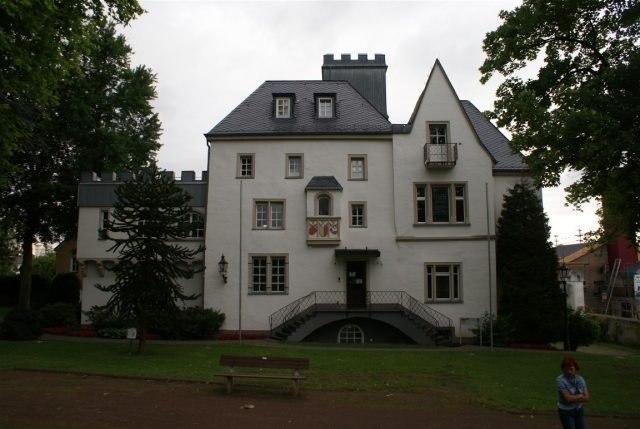
Upper Castle Rheinbreitbach

To be privately owned

The Obere Burg (Upper Castle) is a stately property in Rheinbreitbach, a local municipality in the Rhineland-Palatinate district of Neuwied, dating back to the 15th century. It is the seat of the municipal administration and is protected as a cultural monument. The Obere Burg was so named to distinguish it from the Untere Burg (Lower Castle) located further north.

The castle was initially a fief of the Cologne collegiate church of St. Maria ad Gradus, owned by a Junker von Lewendal. In 1655, according to a communication from Cologne, it passed into the ownership of Dr. Adolf Bequerer and, through his wife's marriage, fell to Peter von Geyr a few years later. From 1730, it belonged to the von Buschmann family, and from 1829 to Johann Wilhelm Schmitz of Cologne. Around this time, the northern wing was significantly extended. In 1907, the writer Rudolf Herzog acquired the Obere Burg, had it expanded in the Historicist style, and died there in 1943.

Towards the end of the Second World War, the building suffered damage, which was only partially repaired decades later. In the mid-1980s, the property was put up for sale by its then-owners. In 1990, the local municipality of Rheinbreitbach acquired the castle to establish its seat there and use it as a cultural center. By 1993, the building underwent extensive interior and exterior renovation. In 1992, the "Förderkreis Obere Burg" (Friends of the Obere Burg) was founded, which supports the organization of cultural events, including art exhibitions, concerts, and readings.

Layout+

The origin and core of the building is a three-story central structure, on the east side of which a tracery oriel window is attached. To the south, there is a building section originally built as a wine press and temporarily used as a dining hall. The north wing of the Obere Burg, with its library and "chapel," features two stepped gables and two barrel vaults on the ground floor. These building sections are topped by a four-story, originally three-story tower. The interior of the building includes (as of 1940) numerous paintings from the 19th and 20th centuries, as well as some sculptures. The castle is embedded in a park on its east and south sides, where the so-called Park Festival takes place annually in August.

Take Mobile History with you

You are reading this text for free. Premium adds what matters on the road: descriptions read aloud, sites found through your camera, whole regions taken offline.

  • Every description, including the ~17,700 Premium sites
  • Audio guide: have descriptions read to you on location
  • AR finder: see sites through your camera, with distance and bearing
  • Unlimited saved sites

14 days free, then from €2.99 a month. Cancel anytime.

Source: Wikipedia · Licence: CC BY-SA 4.0 · Image: Roland Neubert, Halle (Saale)

This description draws on the facts documented in the linked Wikipedia article; Wikipedia content is licensed under CC BY-SA 4.0. Wording and editing: Mobile History.

Location: 50.6167, 7.2296