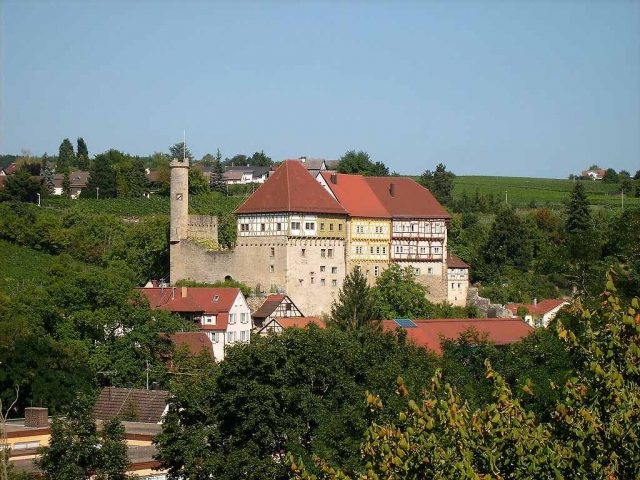
CastleTalheim

Upper Castle Talheim

Upper Castle Talheim

To be privately owned

The Upper Castle (also: Upper Fortress) is a castle complex that shapes the townscape in Talheim in the district of Heilbronn in northern Baden-Württemberg.

The origins of the complex, which was built on a northern slope of the Schozach valley above Talheim, are obscure. The construction period is generally assumed to be the 12th/13th century, making the complex younger than the original manor house of the village near the Kilianskirche. In the High Middle Ages, in addition to the Upper Castle, two other castle complexes were built on the northern bank of the Schozach: the Lower Castle and Ehrenberg Castle.

The reason for the construction of several castles in the same place within a short time is most likely due to the fragmentation of local property into several co-heir shares. The largest share was initially held by the Lords of Talheim, who are considered the builders of the Upper Castle and had their ancestral seat there. The medieval complex differed significantly from today's complex and, with its shield wall, curtain wall, zwinger, and keep, corresponded to the typical image of fortified hilltop castles. Its current form with the three aligned residential buildings was achieved through further fragmentation of ownership and through renovations by numerous different owners until the late 16th century.

In 1456, the eastern part of the complex passed from Bernhard von Talheim to the Counts of Katzenelnbogen and from them in 1479 to the House of Hesse. After a temporary enfeoffment of the Lords of Sickingen, Gerhard von Talheim occupied the castle and was awarded it in 1484 against compensation. In 1471, he had enfeoffed the stair tower called Schneck in the northwest, along with a guardhouse that no longer exists today, to the Württemberg Count Ulrich V. The stone house in the southwest of the complex passed in 1481 from Barbara von Bebenburg to Hans von Venningen and from him in 1499 to Gerhard von Talheim, who thus again owned the entire castle, albeit partly only as a fief. His sons Gerhard and Joachim, after disputes, divided the castle courtyard by a wall into a western and an eastern half. Joachim von Talheim and his wife Katharina (née Laemmlin) built the easternmost of the three residential buildings around 1534.

The western half of the castle with the Schneck came to the Heilbronn patrician family Lyher through the marriage of Brigitta von Talheim and Rochus Lyher in 1550. The eastern half (Hessian Castle) remained with the Lords of Talheim. After repeated disputes with the alcoholic and indebted Hans Ludwig Lyher, Württemberg took possession of the entire western (Lyher) part in 1606, which was considered an appurtenance to the Schneck, which had been granted as a Württemberg fief. In 1607, Lyher sold his co-heir shares in the village to the Teutonic Order, which thus came into possession of four-sixths of the village. Lyher's son Philipp Burkhard Lyher received the western part of the castle back in 1611 as a Württemberg fief, while the eastern part of the castle was acquired by the Teutonic Order in 1614 and later belonged to various free noble families, most recently to the Barons of Gemmingen.

The Württemberg fief (western part of the castle and Schneck) passed in 1640 to the South Bohemian nobleman Friedrich Kasimir Chanowsky (* 1584; † 1648 in Stuttgart) of Dlouhá Ves/Langendorf from the Pilsen district, who was born as the second son of Heinrich Chanowsky von Langendorf (* 1550 in South Bohemia; † 1611/12 in Brettach) and Johanna Raphi (* unknown; † 1627) and was a Württemberg Zweirösser (1622), Kammerjunker (1625–1627), Viertelsdirektor (1640) and councilor and belonged to the committee of the Knightly Canton Kocher. In 1683, his heiress daughter Eva Maria Chanofsky received the castle as a male fief for 300 guilders. In 1694, she married August von Schmidberg, the youngest son of Ludwig von Schmidberg. Therefore, the western part of the castle is also called Schmidberg's Little Castle. At that time, the Lord of Kreislau leased the castle from the Schmidbergs. The castle included a barn, five acres of vineyard, two acres of orchard, and two acres of forest wood. In 1777, the last branch of the Schmidberg family died out, and the castle, which was in a desolate state, came as a lease to Pastor Vincenz in Talheim.

From 1778, Württemberg took in protected Jews from Horkheim Castle in the Württemberg part of the castle. For this reason, the complex was also called Talheim's Jewish Castle. The Jewish community of Talheim built a washhouse and bakery (later a synagogue) in the castle courtyard in 1793 and acquired the Württemberg part of the castle in 1821 for a purchase price of 1910 guilders. The rest of the complex also passed into private hands between 1813 and 1833.

Construction Description+

The complex has an almost rectangular floor plan of 35 meters width and 25 meters depth. The three residential buildings are aligned in the south of the complex. The western residential building is Schmidberg's Little Castle. Striking here is the approximately square Alemannic half-timbered superstructure on the remains of the 14-meter high and approx. 1.70-meter thick shield wall. The roof, which describes the shape of a pyramid, rises from the square base. The Hessian Castle comprises the two eastern residential buildings, with the eastern building being older and the central building having been added later. In the north of the complex, remains of the shield wall with a former battlement are preserved. In the northeast are the foundations of the former keep. In the northwest is the stair tower called Schneck after the spiral staircase inside. In the northwest of the inner courtyard below the Schneck, the synagogue building was located until 1952, which is commemorated today by several memorial plaques.

Take Mobile History with you

You are reading this text for free. Premium adds what matters on the road: descriptions read aloud, sites found through your camera, whole regions taken offline.

  • Every description, including the ~17,700 Premium sites
  • Audio guide: have descriptions read to you on location
  • AR finder: see sites through your camera, with distance and bearing
  • Unlimited saved sites

14 days free, then from €2.99 a month. Cancel anytime.

Source: Wikipedia · Licence: CC BY-SA 4.0 · Image: https://commons.wikimedia.org/wiki/File:Burg_Talheim_Vollansicht.jpg

This description draws on the facts documented in the linked Wikipedia article; Wikipedia content is licensed under CC BY-SA 4.0. Wording and editing: Mobile History.

Location: 49.0851, 9.1960