ResidenceMainz

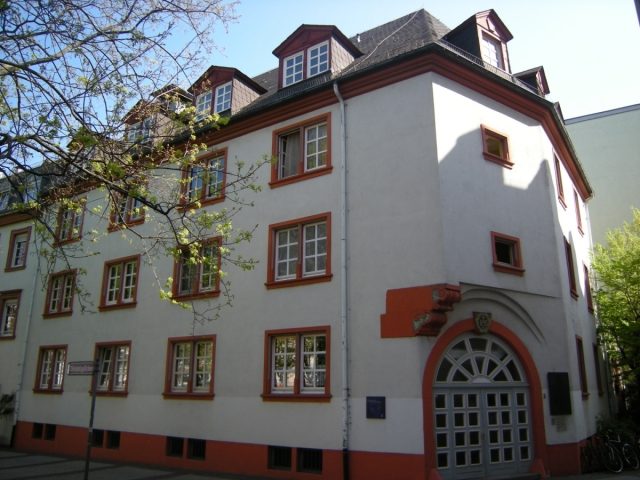
Palais Algesheimer Hof

Palais Algesheimer Hof

To be privately owned

The Algesheimer Hof, also known as the Hof zum Algesheimer, is located at Hintere Christophsgasse 3 in Mainz's Old Town.

According to a chronicle from 1550, the Algesheimer Hof was Johannes Gutenberg's last residence. Here, after his appointment as courtier to the Archbishop of Mainz, Adolf II of Nassau, he spent his final years with free board and lodging.

Gutenberg died three years after this appointment. An entry in a book printed after Gutenberg's death reveals that Gutenberg died on St. Blasius' Day, therefore on February 3, 1468.

Like the Hof zum Gutenberg, Gutenberg's non-existent birthplace, the property was incorporated into the newly founded university in 1477 and came into the possession of the Jesuits in 1526. Their signet IHS, a short form of Iesum Habemus Socium ("We have Jesus as a companion"), can still be found today in the keystone of the archway. Extensive renovations took place in the 18th century, before a historicizing new building, incorporating the preserved baroque portal, was erected after the destructions of the Second World War.

The area on which the Algesheimer Hof was built was already developed in Roman times. During excavation work for the directly adjacent modern building, extensive building remains made of Roman bricks were found. The extent and high-quality workmanship of the bricks suggest a larger official building of the Roman administration of Mogontiacum.

The Algesheimer Hof is located in the Old Town of Mainz, at the corner of Christophsgässchen and Hintere Christophsgasse, on the edge of Karmeliterplatz. It lies at the end of a short axis that runs from Gutenberg's birthplace past St. Christoph's Church, Gutenberg's baptismal church.

Features+

A commemorative plaque is affixed to the main entrance of the house. It bears the inscription:

Algesheimer Hof According to an old manuscript, the inventor of printing, Johannes Gutenberg, died in this house on February 3, 1468.

 Today, a coat of arms above the entrance still commemorates the later owners, the Jesuits.

Origin of the Name+

The building bears the name of the town Algesheim (today Gau-Algesheim), whose area was already settled in Roman times and whose first documented mention occurred in the Lorsch Codex in 766 AD, when the Frankish-Merovingian Alagastesheim must have existed for over two centuries. It is also conceivable that it was named after a person who came from Algesheim or was connected to this place.

Take Mobile History with you

You are reading this text for free. Premium adds what matters on the road: descriptions read aloud, sites found through your camera, whole regions taken offline.

  • Every description, including the ~17,700 Premium sites
  • Audio guide: have descriptions read to you on location
  • AR finder: see sites through your camera, with distance and bearing
  • Unlimited saved sites

14 days free, then from €2.99 a month. Cancel anytime.

Source: Wikipedia · Licence: CC BY-SA 4.0 · Image: http://schloesserrundschau.de/pfalz/schloesser/mainz14.html

This description draws on the facts documented in the linked Wikipedia article; Wikipedia content is licensed under CC BY-SA 4.0. Wording and editing: Mobile History.

Location: 50.0018, 8.2725