ResidenceBerlin-Mitte

Palais am Festungsgraben
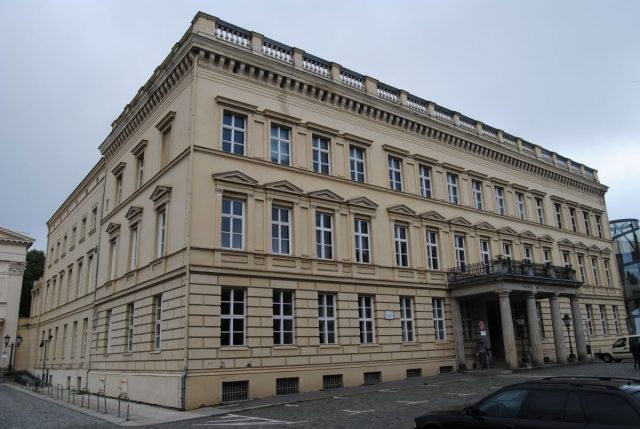
Palais am Festungsgraben

Gallery

The Palais am Festungsgraben, formerly Palais Donner, is located in Berlin-Mitte directly behind the Kastanienwäldchen (Chestnut Grove) behind the Neue Wache, next to the Maxim Gorki Theatre in the building of the Sing-Akademie. The Palais is named after the nearby Festungsgraben (Fortress Moat), a now filled-in canal arm of the Spree, which belonged to the new Berlin fortifications built in the 17th century and later served for goods transshipment. The Palais houses original furnishings and, since 1990, the Theater im Palais and, since 2004, the Saarländische Galerie. A Tajik tearoom, which was exhibited in the Soviet pavilion of the Leipzig Trade Fair in 1974 and later handed over to the then Central House of the DSF, was closed on May 1, 2012 – but was able to reopen in the Kunsthof Berlin.

The building stands on the terrain of the former Berlin city fortifications. By royal order, King Frederick II of Prussia gifted the plot of land to his valet Johann Gottfried Donner on November 7, 1751. Donner had the Palais built according to plans by Christian Friedrich Feldmann from 1751 to 1753. Donner himself lived in one half of the Palais with his family, while the Prussian General Mint Master Johann Philipp Graumann took up residence in the other half.

After Donner's death, the Royal Prussian Financial Administration bought the Palais and set up the official residence for the Prussian Finance Minister on the upper floor. Among others, Freiherr vom und zum Stein lived here for four years. In 1797, the right side wing was raised by one storey. From 1808, the Palais became the official seat of the Prussian Ministry of Finance. In 1863 and 1864, the building was rebuilt according to plans by Georg Heinrich Bürde and Hermann von der Hude. The Palais underwent further structural alterations in 1934 by the then Prussian Finance Minister Johannes Popitz, who had the Schinkel Festival Hall of a demolished Berlin townhouse installed on the ground floor.

During World War II, the Palais was damaged by air raids and the fighting for Berlin at the end of the war. The Soviet Military Administration in Germany had the building repaired and rebuilt after the war and subsequently used it for its own purposes. In 1947, the Palais was made accessible to the public as the House of Culture of the Soviet Union. From 1950 to 1990, the Palais, as the House of German-Soviet Friendship (or House of Culture of the Soviet Union), was the central seat of the GDR organization of the same name, the Society for German-Soviet Friendship.

After German reunification, the listed Palais became the property of the State of Berlin and is used culturally, museologically, and gastronomically under its new name, Palais am Festungsgraben. The representative premises can be rented for festivities from FLORIS Catering GmbH, which has leased the historic premises from the State of Berlin since 2005. Since 1990, the Theater im Palais has been located in a hall that was already used as a theatre venue during GDR times. In September 2004, the Representation of Saarland to the Federal Government rented 200 m² of exhibition space in the Palais and established the Saarländische Galerie im Palais am Festungsgraben there.

Take Mobile History with you

You are reading this text for free. Premium adds what matters on the road: descriptions read aloud, sites found through your camera, whole regions taken offline.

  • Every description, including the ~17,700 Premium sites
  • Audio guide: have descriptions read to you on location
  • AR finder: see sites through your camera, with distance and bearing
  • Unlimited saved sites

14 days free, then from €2.99 a month. Cancel anytime.

Source: Wikipedia · Licence: CC BY-SA 4.0 · Image: http://schloesserrundschau.de/berlin/berlin06.html

This description draws on the facts documented in the linked Wikipedia article; Wikipedia content is licensed under CC BY-SA 4.0. Wording and editing: Mobile History.

Location: 52.5186, 13.3956