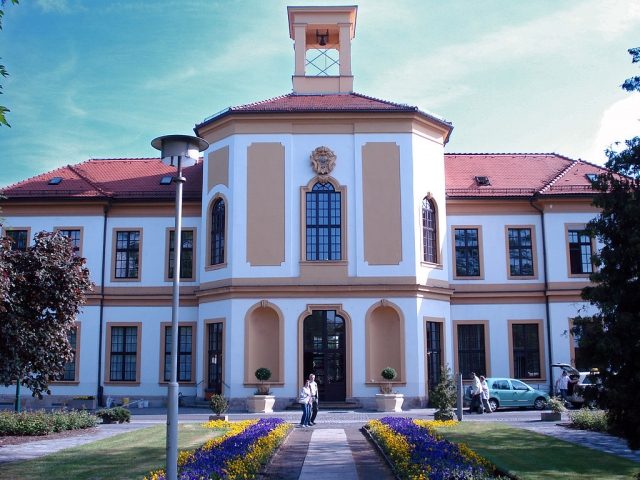
Hospital
Palais Brühl-Marcolini

The Palais Brühl-Marcolini is a garden palace built from 1727 onwards in the suburb of Ostra, laid out near Dresden from 1670, in today's Friedrichstadt district. Today, the Dresden-Friedrichstadt Hospital is housed in the palace and in later extensions and new buildings on its grounds. The Palais Brühl-Marcolini is not to be confused with the Palais Marcolini in the Waldschlösschen area and the former Palais Brühl on the Brühl Terrace.
Construction Phases+
Already in the late 17th century, there was a stately garden at this location, which was purchased in 1718 by the Imperial Count of Manteuffel. In 1726, Augustus the Strong acquired the property and gifted it in 1727 to a Duke of Württemberg, whose wife Countess Ursula Katharina Lubomirska was a mistress of the king. In 1727/28, she presumably had Johann Christoph Naumann build a garden palace there with a central octagonal garden hall and a ballroom above it, as well as short transverse wings on the later Friedrichstraße.
In 1736, the Countess had to sell the property to Count Heinrich von Brühl, who immediately had the palace extended by Johann Christoph Knöffel with side wings to form a courtyard of honor. The main axis on the garden side was completed by the elaborate construction of the Neptune Fountain, which was built from 1741 and completed in 1744 by Lorenzo Mattielli.
From 1774, Johann Daniel Schade and Johann Gottfried Kuntsch rebuilt the palace again, this time for the new owner Count Camillo Marcolini. Around 1780, the so-called "Chinese" and "Pompeian" rooms were created by Johann Ludwig Giesel and Christian Traugott Weinlig. The external figural decoration was crafted by Johann Baptist Dorsch and Thaddäus Ignatius Wiskotschill. Dorsch created two sandstone lions at the main portal, two herms, and the count's coat of arms; Wiskotschill created lanterns, other herms, and garden figures, which were later placed in the Bürgerwiese. These sculptures were partially damaged by the air raids on Dresden in 1945.
In 1835, the new owner, city councilor Carl Ernst Werner, set up rental apartments in the palace. Tenants included the sculptor Ernst Julius Hähnel and the composer Richard Wagner.
Current Situation+
Today, the baroque palace building with the Chinese and Pompeian Rooms is preserved. The paintings in the Pompeian Room are by Johann Ludwig Giesel. Since 1849, the Dresden-Friedrichstadt Hospital has been housed in the palace. For this purpose, extensions and alterations were made, which led to the loss of the French Garden and the main axis.
Historical Events in the Palace+
On June 10, 1813, Napoleon Bonaparte took up residence in the palace. Here, on June 26, 1813, a meeting took place with Prince Metternich. Metternich's attempt to persuade Napoleon to make concessions in Poland, Prussia, Northern Germany, and Illyria failed. Austria therefore entered the war on August 11, 1813, and in the Treaty of Teplitz of September 9, 1813, the restoration of the European balance of power was set as the war aim.
Take Mobile History with you
You are reading this text for free. Premium adds what matters on the road: descriptions read aloud, sites found through your camera, whole regions taken offline.
- Every description, including the ~17,700 Premium sites
- Audio guide: have descriptions read to you on location
- AR finder: see sites through your camera, with distance and bearing
- Unlimited saved sites
14 days free, then from €2.99 a month. Cancel anytime.
Source: Wikipedia · Licence: CC BY-SA 4.0 · Image: http://de.wikipedia.org/wiki/Datei:Hospital_Dresden_Friedrichstadt17.jpg
This description draws on the facts documented in the linked Wikipedia article; Wikipedia content is licensed under CC BY-SA 4.0. Wording and editing: Mobile History.
Location: 51.0596, 13.7184