Cultural Events
Palais in the Great Garden

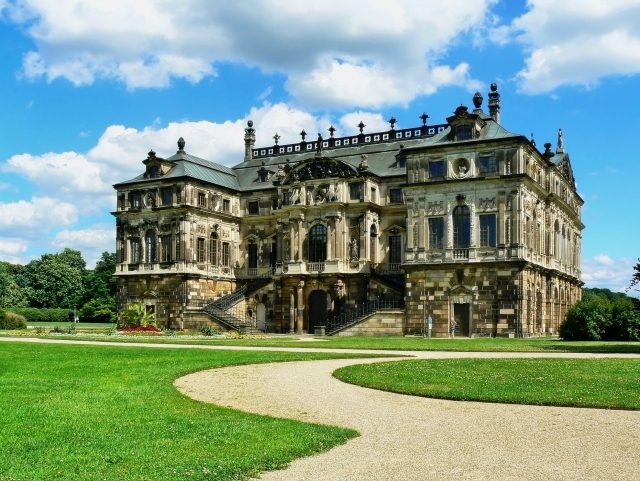
The Palais in the Großer Garten, also known as the Summer or Garden Palais, is a Baroque pleasure palace in Dresden. It is located in the Großer Garten, an extensive green area on the outskirts of the city center.
The Palais is considered the first significant secular building in Saxony to be erected after the Thirty Years' War. It is also one of the earliest Baroque buildings in the German-speaking world and is one of Dresden's most important art and cultural-historical buildings.
Built around 1680, the Palais was initially a pleasure palace of the Albertines, the Saxon princely house. From about 1730, it served to store parts of the Royal Art Collections, and from the 19th century, exhibitions were also presented. The air raids on Dresden in 1945 led to severe damage to the building. Its exterior has now been restored; the reconstruction of the building's interior is not yet complete. As a result, it can currently only be used to a limited extent for exhibitions.
Location+
The Palais is located in the Großer Garten, approximately two kilometers southeast of the Inner Old Town. It stands in the center of the approximately two square kilometer park, which it dominates. It is located at the intersection of two right-angled sightlines, the main avenue and the cross avenue. Within a radius of about 500 meters, there are only a few, much smaller buildings. To the southeast is the Palace Pond with its fountain, and the northwest side is lined by a flower garden.
Building+
Exterior
As an early work of Dresden Baroque, the Palais belongs to the typical German expression of this architectural style, which appears somewhat stricter than classical Baroque. Characteristic stylistic elements include the strong, high-contrast facade articulation with its opulent but strictly ordered ornamentation. The architecture incorporates features of 17th-century French chateau construction, identifying the Palais as a pleasure house type – the Château de Marly-le-Roi near Paris is considered one of its models. On the other hand, forms of Genoese palaces also found their way into the stylistic mix.
The three-story building has an H-shaped floor plan, as two projecting side wings connect to the central tract on the northeast and southwest sides. The facade articulation is emphasized both vertically and horizontally. The facades of the main fronts facing the city center and the pond each have 13 axes. Of these, in both cases, three are allocated to the two projecting side wings and the remaining seven to the central tract. Its three central axes, in turn, are emphasized on both sides by a central risalit, each topped by a segmental pediment. The side facades are divided into nine axes and are also accentuated by a central risalit with columns stepped floor by floor, which, however, features a triangular pediment with a tympanum. The side wings form two courtyards on the city and country sides, which are open on one side. Double-flight and twice-turned open staircases lead into these, leading to the first upper floor.
The facades are richly decorated with sculptural ornamentation, including festoons, friezes, vases, pilasters, capitals, and reliefs. Busts of twelve Caesars and four empresses adorn the exterior of the building. Several facade niches contain, among other things, four larger-than-life sandstone sculptures depicting the Judgment of Paris, which, like the design of the portals, probably date back to George Heermann. Marcus Conrad Dietze, Abraham Conrad Buchau, and the brothers Jeremias and Conrad Max Süßner were also involved in the facade's decoration.
Interior
The ground floor of the central tract is occupied by a vestibule, consisting of a hall with a column-supported cross vault. Above it is the large ballroom, which extends over two floors. In the two side wings, there are three smaller halls per floor.
The interior furnishings of the building were completely lost in 1945 due to the bombing of Dresden. Originally, the ballroom, in particular, was richly decorated with partly gilded stucco. The stucco marble work also carried out in the ballroom was the oldest in Saxony. Some of the stucco was already manufactured in a factory-like manner. The ornamentation of the side halls was created by French artists in a style previously unknown in Dresden. The ballroom's furnishings also included four life-size stucco allegories. The wall and ceiling paintings were executed by Samuel Bottschildt with his nephew, pupil, and later successor, Heinrich Christian Fehling. The fresco depicted the apotheosis of the Palais's builder, Johann Georg III. The painting is considered a first highlight of Dresden monumental painting and served as a model for Fehling's and Silvestre's pavilion ceiling paintings in the Dresden Zwinger.
No restoration of the interior furnishings destroyed in 1945 has yet taken place.
Construction and Use as a Pleasure Palace
From 1676, the Großer Garten was laid out for the then Electoral Prince Johann Georg. Two years later, construction of the Palais began according to plans by the chief architect Johann Georg Starcke, to whose main works it is counted today. At that time, it stood far outside the gates of Dresden's fortifications and was not intended for residential purposes but solely for the entertainment of the princely house and its guests. When the Palais was completed in shell construction in 1683 after five years of building, its builder had already been Elector of Saxony for three years after the death of his father. The interior work was only completed around 1690, shortly before the death of Johann Georg III. Simultaneously with the interior construction of the Palais, a first redesign of the Großer Garten took place according to plans by Johann Friedrich Karcher. In this context, the eight square Cavalier Houses, which were grouped around the Palais, were also built between 1684 and 1694. Five of these one-and-a-half-story, mansard-roofed pavilions, which contained play and refreshment rooms for the court society, have been preserved to this day.
After the death of Johann Georg IV, the Palais passed to his younger brother August the Strong in 1694. In the following three decades, it was a venue for the lavish court festivals typical of absolute rulers. The highlight was the Venus Festival organized by August the Strong on September 23, 1719, on the occasion of the wedding of his son, the then Electoral Prince Friedrich August, to the Austrian Archduchess Maria Josepha. Zacharias Longuelune erected a now-lost Venus Temple near the Palais especially for this occasion. In the course of the 1720s, the importance of the Palais for court festivals declined sharply. Court fashion had changed, which is why other castles and complexes such as the Zwinger and the Baroque Garden Großsedlitz were henceforth preferred. Initially planned alterations to the Palais were no longer carried out.
Use for Collections and Exhibitions
In the late 1720s, a repurposing finally occurred. At the end of 1729, August the Strong had the extensive collection of antiquities displayed on the ground floor of the Palais. He had acquired it a year earlier in Rome. Of the 194 ancient statues, 160 came from the Chigi family collection and 34 from the possession of Alessandro Albani. It was the first large collection of antiquities in Germany. The collection of antiquities formed the basis of the Sculpture Collection of the Staatliche Kunstsammlungen Dresden and remained in the Palais until 1747.
Subsequently, the interest of the Electors in the Großer Garten declined. One reason for this was the destruction of the Palais and its surroundings during the Seven Years' War. After Dresden had fallen into the hands of Austria and the Imperial Army in connection with the Battle of Maxen in 1759, the Prussian Army under Frederick the Great attempted to conquer the Saxon residential city in 1760. The fighting led to devastation in the Dresden suburbs and the Großer Garten. Chief architect Julius Heinrich Schwarze began the reconstruction.
The Battle of Dresden, in which Saxons and French faced Prussians and Russians in 1813, resulted in renewed war damage. Even before it had been cleared, the Russian governor Repnin-Wolkonski had the Großer Garten opened to the public. This was a decisive impulse for the future of the Palais. From 1828, a horticultural society used it as a depot and, in the same year, organized the "First Public Exhibition of Rare Fruits and Plants." In the spring of 1829, the first larger exhibition of flowering plants followed. Further fruit and plant exhibitions followed and made the Palais famous as a venue for flower, plant, and fruit exhibitions. In 1841, the Royal Saxon Antiquities Association moved into the ground floor and used it to exhibit sacred sculptures. After the death of court sculptor Ernst Rietschel, his extensive estate was conceived as a museum and housed in the ballroom on the upper floor of the Palais in 1861. The Rietschel Museum was transferred to the Dresden Sculpture Collection in 1889 and moved to the Albertinum. The museum of the Antiquities Association, with its numerous objects of originally ecclesiastical origin, thus expanded to the upper floor in 1890 and remained the main user of the Palais building for the following decades.
In 1887, the 1st International Horticultural Exhibition Dresden took place in the Großer Garten. In 1896, the 2nd International Horticultural Exhibition Dresden followed on the site of today's Transparent Factory and in the Großer Garten. In 1907, the 3rd International Horticultural Exhibition Dresden took place, where, in addition to the presentation of plant material, large thematic overall pictures were created for the first time. The current flower and floristry exhibition Dresdner Frühling im Palais is based on the latter.
Destruction and Reconstruction
The air raids on Dresden destroyed the Palais shortly before the end of World War II in February 1945. The building completely burned out. As a result, the interior furnishings, such as stucco and furniture, as well as the unevacuated holdings of the museum of the Antiquities Association, were almost completely lost. All roofs and floor ceilings were destroyed, and large parts of the facades, especially in the area of the southern building wing, were severely damaged. Incendiary bombs also severely affected the building's statics.
As early as 1946, safeguarding measures began on the masonry to preserve the Palais, and in 1954, the gradual reconstruction. In 1964, the roof was covered with a temporary steel structure, so that in 1965, the remaining stucco could be secured. By about 1969, the Palais was largely restored externally but was hardly used in the 1970s and 1980s. From 1968 to 1974, a narrow axis in the ballroom was provisionally restored. Between 1978 and 1984, an atelier for the reconstruction of the Semperoper was located in the Palais, where, among other things, the stage curtain of the opera house was painted. The roof was completed in 1993, a year before the ceiling stucco on the ground floor was finished. On August 1 of the same year, the company Schlösser und Gärten Dresden (today part of the Staatliche Schlösser, Burgen und Gärten Sachsen) was founded, whereby the administration of the garden and Palais passed from the city of Dresden to the Free State of Saxony. Under its direction, extensive renovations to the exterior of the building took place in the 1990s. Since both old and new masonry parts were used, the Palais facade, like the Dresden Frauenkirche, appears as a mosaic of light and dark stones.
While the reconstruction of the exterior of the Palais is now complete, the interior rooms have only been partially renovated since 1990. From 1995, the first public events took place again on the ground floor. In October 2000, the Förderverein Palais Großer Garten e. V. was founded, which, together with the Bürgerstiftung Dresden, advocates for a historically accurate reconstruction of the interior rooms, especially the ballroom, and their use for cultural events. The Förderverein, under its member Günter Voigt, also organized demonstrations for the reconstruction of the ballroom, where a conference on the Großer Garten took place for the first time in 2002. In 2002 and 2003, the Palais was surveyed. Until 2005, indoor climate investigations and further safeguarding measures on plaster and stucco were also carried out. In 2005, the Bürgerstiftung and Förderverein organized the first Bürgerball in the Palais. In addition, exhibitions of modern art are shown, and chamber music is performed under the name Offenes Palais.
The flower and floristry exhibition Dresdner Frühling im Palais has attracted tens of thousands of visitors to the Palais since 2006. The organizer is the Landesverband Gartenbau Sachsen, based in Dresden. Gardeners, florists, artists, and light and sound designers have since created a total work of art of colors, shapes, and scents every two years. With 42,000 plants in 2014, the show is considered Germany's most important spring flower exhibition. With the exhibition, the Landesverband Gartenbau Sachsen aims to continue the tradition of large flower and plant shows in Dresden and to present the work of gardeners and florists.
Take Mobile History with you
You are reading this text for free. Premium adds what matters on the road: descriptions read aloud, sites found through your camera, whole regions taken offline.
- Every description, including the ~17,700 Premium sites
- Audio guide: have descriptions read to you on location
- AR finder: see sites through your camera, with distance and bearing
- Unlimited saved sites
14 days free, then from €2.99 a month. Cancel anytime.
Source: Wikipedia · Licence: CC BY-SA 4.0 · Image: Thomas Eichler
This description draws on the facts documented in the linked Wikipedia article; Wikipedia content is licensed under CC BY-SA 4.0. Wording and editing: Mobile History.
Location: 51.0378, 13.7628