To be privately owned
Saurau Palace

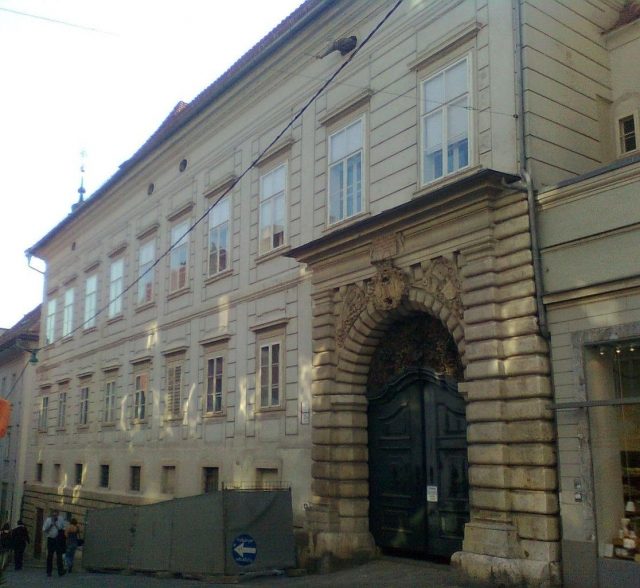
Palais Saurau, also known as Palais Saurau-Goeß, is a large city palace at the upper end of Sporgasse near Karmeliterplatz in the First District of Graz, Innere Stadt.
The construction period of Palais Saurau is assumed to be from 1564 to 1566. The years are indicated on a pillar at the entrance. The patron was the Graz castle captain and Baron Pangratz von Windischgrätz, to whom the building plot was gifted by Emperor Ferdinand I in 1564. He had the palace built on the city wall near the inner Paulustor, which no longer exists today. In 1629, Baron Friedrich von Windischgrätz sold the building to Count Carl von Saurau, the then Styrian governor. Windischgrätz was a Protestant and had to leave Styria. The building received its current name from the new owner. Count Carl von Saurau maintained numerous estates in Styria. His descendants had the building baroque-ized in the 18th century and expanded into a town house and administrative seat for the family.
The master builder Johann Joachim Carlone was also entrusted with work on the Palais around 1694. Next to the property of the stately home was a dilapidated powder tower at that time, which the guardian of Count Raimund Maria Saurau acquired in 1756, had demolished, and thus enlarged the garden. Only after the extinction of the Saurau family line did the building pass into the possession of the Goeß family, related to the Saurau family, as an inheritance in 1846. The last of the Saurau family, Count Zeno Maria von Saurau, was the Grand Marshal of Styria. The Palais, extensively restored in 1988/89, is now largely rented out. It is still owned by the Goeß-Saurau family.
Architecture and Design+
The three-story Palais consists of four wings enclosing an almost rectangular inner courtyard. The south side of the building was once open with arcades but was later built over by the construction of a staircase. Some remnants of the Ionic columns are still present today. Particularly noteworthy is the ornate portal, a rusticated round-arch stone portal with a coat of arms of the Count of Saurau inserted in 1630. In the spandrels of the arch are the coats of arms of Count Carl von Saurau and his wife Susanna Catharina Freiin von Teuffenbach. At the apex of the arch is a Rocaille cartouche with an alliance coat of arms of Count Raimund Maria von Saurau and his first wife, Maria Anna née Countess von Dietrichstein. It was created by the sculptor Johannes Piringer. The portal is topped by a richly decorated, wrought-iron transom grille (around 1730 or 1740), and is considered one of the most significant Baroque wrought-iron works in Styria.
The large inner courtyard with a paving of so-called "Murnockerln" (Mura pebbles) is accessible through a cross-vaulted entrance. The original arcades have only been preserved in the wing facing the Schlossberg. The Pawlatschen, so-called balcony corridors, rest on classical stone consoles and surround the rest of the inner courtyard. A covered arcade, built by Carl von Saurau, leads to the neighboring Stiegenkirche. A cross-vaulted arcade from 1566 is accessible via a staircase at the passage. A second staircase leads to the Schlossberg garden on the first floor. In the garden, there is an octagonal pavilion at the height of the second floor. On the east side of the park, remnants of the old city wall are still present, which had connected the inner Paulustor with the Graz Clock Tower.
The bel étage of Palais Saurau is located on the second upper floor. It consists of three halls and a cabinet with Rococo furnishings from around 1770. The stucco ceilings feature gilded decorations. The floral motifs of the border zone were probably created by Heinrich Formentini. The walls of the halls are covered with damask; the cabinet is fitted with wood paneling. The interior includes several Louis XVI tiled stoves with white glaze, made around 1775/78 by Michael Adamez. The first floor in the south wing contains three rooms and a cabinet with Josephinist-Classical furnishings. The wallpaper was purchased in Brussels in 1830 and is decorated with depictions of exotic trees and shrubs, around which birds and butterflies flutter.
The Half-Figure of the Turk+
Palais Saurau is particularly known for the half-figure of the Turk, which protrudes from a hatch below the eaves. In his outstretched right hand, he holds a sword. This is a rotatable Quintana figure, often used as an opponent substitute in equestrian games. A local legend tells of the Turk's connection to the siege of Graz by the Turks in 1532 during the 1st Austrian-Turkish War (1526-1555), but the half-figure is rather to be regarded as a house sign of the Saurau family. At the time of the Turkish War, Palais Saurau did not yet exist. Especially Count Karl von Saurau, as a military commander, repeatedly defeated the Turkish conquerors. A copy is attached to the house wall; the original has been exhibited in the Graz City Museum since 1951.
Take Mobile History with you
You are reading this text for free. Premium adds what matters on the road: descriptions read aloud, sites found through your camera, whole regions taken offline.
- Every description, including the ~17,700 Premium sites
- Audio guide: have descriptions read to you on location
- AR finder: see sites through your camera, with distance and bearing
- Unlimited saved sites
14 days free, then from €2.99 a month. Cancel anytime.
Source: Wikipedia · Licence: CC BY-SA 4.0 · Image: http://commons.wikimedia.org/wiki/File:Palias_Saurau_Sporgasse_Graz.jpg
This description draws on the facts documented in the linked Wikipedia article; Wikipedia content is licensed under CC BY-SA 4.0. Wording and editing: Mobile History.
Location: 47.0731, 15.4394