Cultural Events
Palais Schönburg
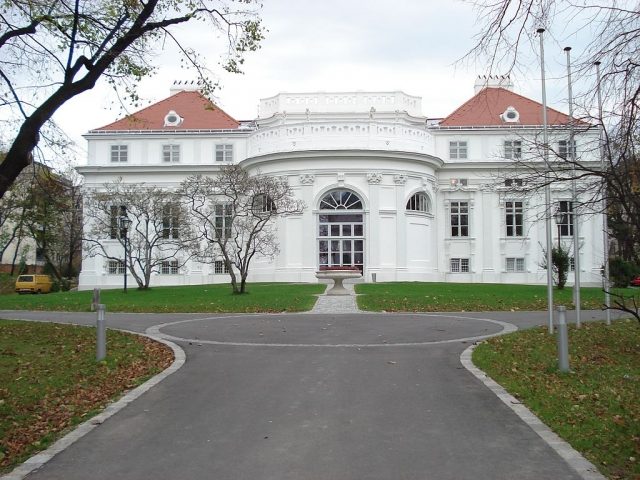
The Palais Schönburg (also: Palais Schönburg-Hartenstein and Palais Starhemberg-Schönburg) is a palace in the 4th district of Vienna, Wieden, at Rainergasse 11.
The financial expert Gundaker Thomas Starhemberg commissioned the construction of a baroque palace between 1705 and 1706 on a plot of land in the then suburb of Wieden, which had been in the possession of the Starhemberg family since 1450, based on designs by Johann Lucas von Hildebrandt.
In 1811, the palace passed into the possession of Joseph Nepomuk Keglevich Graf von Buzin, who had it rebuilt and extended. Around 1841, the Schönburg-Hartenstein family acquired the palace and had the rooms – with the exception of the library – redesigned.
In the 1970s, two out of three heirs sold their shares to Conti-Bank. After its bankruptcy, the machinery traders Marian and Danek Gertner took over the palace and forced the remaining Schönburg heiress to withdraw in 1979 through a partition lawsuit. For decades thereafter, they tried to commercially utilize the property as a hotel by extending and converting the dilapidated building. This ultimately failed due to monument protection and massive resistance from citizen initiatives and residents against the planned expansion of the side wings. As a result, the decay of the building continued.
After a generational change in the owner family, at the beginning of the 21st century, the palace was largely restored to its original state during a general renovation and adapted into an "event location". The renovation work, which included the restoration of the facade and roof as well as the revitalization of the surrounding park, lasted from 2007 to 2008 and was financially supported by the Federal Monuments Office and the Vienna Old Town Preservation Fund. The palace, individual rooms, and the garden can be rented for events since July 2008.
Architecture+
The garden palace presents itself as an elongated rectangle, which is extended in its central axis by a transverse oval towards the forecourt. The wide vestibule, occupying more than a third of the palace front, with a high attic, was originally open to the outside through three large round-arched gates separated by double pilasters. This has since been closed. Staircase arms were built into the vestibule on both sides, leading up to the ceremonial hall. The steps of all staircases, including two narrow spiral staircases, are made of hard Kaiserstein from Kaisersteinbruch.
Take Mobile History with you
You are reading this text for free. Premium adds what matters on the road: descriptions read aloud, sites found through your camera, whole regions taken offline.
- Every description, including the ~17,700 Premium sites
- Audio guide: have descriptions read to you on location
- AR finder: see sites through your camera, with distance and bearing
- Unlimited saved sites
14 days free, then from €2.99 a month. Cancel anytime.
Source: Wikipedia · Licence: CC BY-SA 4.0 · Image: http://commons.wikimedia.org/wiki/File:Sch%C3%B6nburg-Palais1.JPG
This description draws on the facts documented in the linked Wikipedia article; Wikipedia content is licensed under CC BY-SA 4.0. Wording and editing: Mobile History.
Location: 48.1886, 16.3699