Local government
Palais Seligmann

The Historic Town Hall+
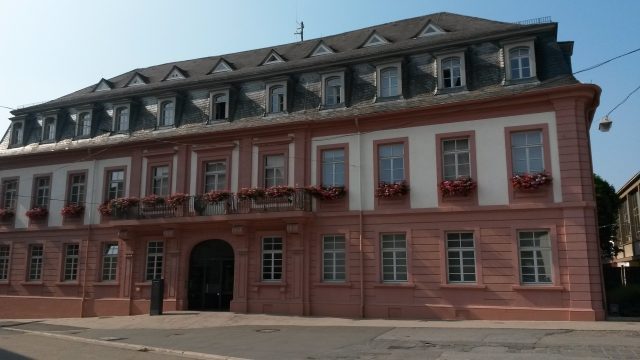
The Town Hall with the Hall of Mirrors, formerly the palace of Aaron Elias Seligmann, later Baron von Eichthal, is the representative building in the city center.
From Private Residence to Town Hall+
The building was constructed between 1726 and 1731 by the Electoral Court Architect Gabriel de Gabrieli for the Electoral Court Chamber Council and banker Franz von Stengel. In 1818, the building was acquired by the court factor Aaron Elias Seligmann, who had been elevated to the hereditary Bavarian nobility in 1814 and to the rank of Baron von Eichthal in 1826. He had the building extensively renovated and redesigned in the Neoclassical style. The magnificent Hall of Mirrors on the first floor, which is still used today for council meetings and receptions, dates from this period.
After the death of Baron von Eichthal, the building remained in the possession of his family until it was acquired by the city in 1891. Since then, it has served as the Town Hall and the seat of the city administration.
Architectural Features+
The Town Hall is a three-story building with a richly structured facade. The central projection is emphasized by a balcony supported by columns and a triangular pediment. The windows are framed by elaborate stucco decorations. The interior of the building is equally impressive. In addition to the Hall of Mirrors, the former private rooms of the Baron, which are now used as offices and meeting rooms, are particularly noteworthy.
The Hall of Mirrors
The Hall of Mirrors is the highlight of the Town Hall. It is a large, rectangular room with high ceilings and numerous mirrors that give the room a special spaciousness and brightness. The walls are decorated with stucco work and paintings. The Hall of Mirrors is not only used for official occasions, but also for concerts and other cultural events.
Significance for the City+
The Town Hall is not only an architectural masterpiece, but also a symbol of the city's history and identity. It embodies the transition from a princely residence to a modern municipal administration. As a central meeting point and venue for important decisions, it plays a crucial role in the life of the city.
Take Mobile History with you
You are reading this text for free. Premium adds what matters on the road: descriptions read aloud, sites found through your camera, whole regions taken offline.
- Every description, including the ~17,700 Premium sites
- Audio guide: have descriptions read to you on location
- AR finder: see sites through your camera, with distance and bearing
- Unlimited saved sites
14 days free, then from €2.99 a month. Cancel anytime.
Source: Wikipedia · Licence: CC BY-SA 4.0 · Image: Jörg Heldt
This description draws on the facts documented in the linked Wikipedia article; Wikipedia content is licensed under CC BY-SA 4.0. Wording and editing: Mobile History.
Location: 49.3489, 8.6909