ResidenceFreiburg im Breisgau

Sickingen Palace
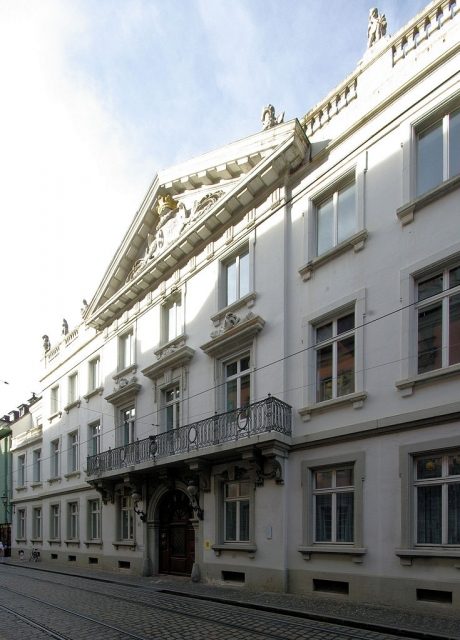
Sickingen Palace

County Court Freiburg

The Palais Sickingen (Sickingen Palace) in Salzstraße in Freiburg is today the seat of the Freiburg Regional Court. Colloquially, it is also referred to as the Sickingen Palace.

It was built between 1769 and 1773 by Pierre Michel d’Ixnard as a city palace for Baron Ferdinand Sebastian von Sickingen-Hohenberg. The Sickingen family was the successor to the Schnewlin family and owned numerous properties in Breisgau; these include their summer residence, Sickingen Castle in Freiburg Ebnet. The building, executed in French Neoclassical style, was erected on the site of the houses "zum Maienthau" and "zum Wolkenbruch," which were owned by the Schnewlin von Landeck family until the end of the 16th century and then passed to the Barons von Sickingen-Hohenburg. Additionally, the Red House and the House "zur Scheuer" stood there. The high-quality interior decoration can still be viewed today in photos inside the palace. It consisted, in addition to many gildings on plaster and wood, of 240 paintings.

After the builder died in 1772, the house served as a residence for his son Kasimir, followed by his son Count Wilhelm. With the end of Further Austria came the end of his time in Freiburg: to be a subject of only one emperor and not also have to serve the Grand Duke of Baden, he moved to Austria. In 1806, the palace therefore went to the Grand Duchy of Baden for 50,000 guilders. First, it was rented to the Freiburg Reading Society, founded in 1807, which still exists today under the name Museumsgesellschaft. But very quickly it became the grand ducal residence in Freiburg. Residents at that time included Ludwig, Leopold (with his wife Sophie) in 1819, and especially Friedrich II, who used it more frequently: in 1850 for several weeks, in 1853 during a trip as Prince Regent, in 1856 after his marriage to Luise, in 1876 for the unveiling of the Victory Monument, and in 1880 on the occasion of visiting the agricultural exhibition in Waldkirch.

The last grand ducal resident was Hilda; she was also there during the bombing night of November 27, 1944, until she too fled to the bunker facilities on Schlossberg, and the buildings were destroyed down to their foundations by several bomb hits. Only the facade on Salzstraße survived the attack relatively unscathed.

The building was rebuilt between 1962 and 1965, with the exterior facade being restored to its old form. This facade is still topped today by the coat of arms of the Dukes of Sickingen. The client was the State Building Authority Freiburg on behalf of the state of Baden-Württemberg. It integrated the palace as a historical monument into the new building of the Regional Court, which still uses it today. Between 2010 and 2011, the facade was restored and renovated.

Take Mobile History with you

You are reading this text for free. Premium adds what matters on the road: descriptions read aloud, sites found through your camera, whole regions taken offline.

  • Every description, including the ~17,700 Premium sites
  • Audio guide: have descriptions read to you on location
  • AR finder: see sites through your camera, with distance and bearing
  • Unlimited saved sites

14 days free, then from €2.99 a month. Cancel anytime.

Source: Wikipedia · Licence: CC BY-SA 4.0 · Image: http://de.wikipedia.org/wiki/Datei:Landgericht_%28Freiburg%29.jpg

This description draws on the facts documented in the linked Wikipedia article; Wikipedia content is licensed under CC BY-SA 4.0. Wording and editing: Mobile History.

Location: 47.9944, 7.8518