ResidenceGraz-Innere Stadt

Stubenberg Palace
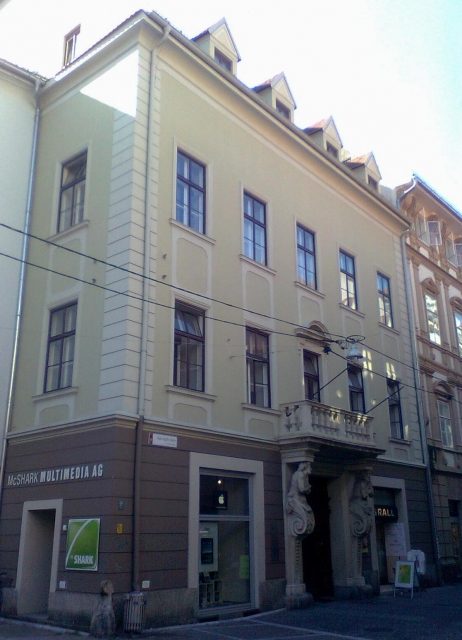
Stubenberg Palace

To be privately owned

The Palais Stubenberg-Wildenstein is a former Graz city palace. It is located at the corner of Tummelplatz and Hans-Sachs-Gasse in the first district, Innere Stadt. The building is directly connected to the Palais Lengheimb.

In the former Neugasse (today's Hans-Sachs-Gasse), in 1689, the governor Georg von Stubenberg was gifted a tax-free plot of land by the provincial estates, whereupon he had the palace built by master builder Bartholomäus Ebner. Only two years later, the building was sold to Count Michael Weikhart Vetter von der Lilie. In 1709, his widow married Count Josef von Wildenstein, whereby the palace was included in the Wildenstein family entailment. In 1819, the Palais Stubenberg-Wildenstein was sold to the Styrian provincial estates, who established the "Ständische Zeichenschule" (Estates Drawing School) in its premises. In addition to this school, the palace also housed a collection of paintings and copper engravings, from which the Landesbildergalerie (Provincial Picture Gallery) emerged.

In 1893, the palace was sold to the Accident Insurance Institution, which meant the drawing academy and the gallery had to find another location. Besides being used for offices, the building also housed a wine tavern and a printing shop. After a bombing raid on November 1, 1944, the east wing on "Tummelplatz" had to be demolished in 1948 and replaced by a new building. In the same year, the palace came into the possession of the City of Graz, which established the City Archives in the building from 1970 to 2000. The premises were eventually re-rented.

Architecture and Design+

A large part of the facade of the three-story building was only very simply reconstructed during the rebuilding after the bombing raid in November 1944. However, the original facade on the "Hans-Sachs-Gasse" side has been preserved. The formerly round-arched stone portal has two Atlantes herms on the left and right, which support the central balcony. It was created in 1710 under the influence of the Viennese Atlantes portals. This figural portal framing is unique in Graz.

The staircase of the courtyard-side stairwell, dating from the construction period around 1690, is supported by two pillars. The wall niches with plaster casts of the Roman goddesses Aphrodite and Hera, as well as the demigod Heracles, are significantly younger and works from the second quarter of the 19th century, when the "Ständische Zeichenakademie" (Estates Drawing Academy) was located in the palace.

Take Mobile History with you

You are reading this text for free. Premium adds what matters on the road: descriptions read aloud, sites found through your camera, whole regions taken offline.

  • Every description, including the ~17,700 Premium sites
  • Audio guide: have descriptions read to you on location
  • AR finder: see sites through your camera, with distance and bearing
  • Unlimited saved sites

14 days free, then from €2.99 a month. Cancel anytime.

Source: Wikipedia · Licence: CC BY-SA 4.0 · Image: http://commons.wikimedia.org/wiki/File:Palais_Stubenberg_Graz_Tummelplatz.jpg

This description draws on the facts documented in the linked Wikipedia article; Wikipedia content is licensed under CC BY-SA 4.0. Wording and editing: Mobile History.

Location: 47.0695, 15.4427