ResidenceDüsseldorf-Karlstadt

Wittgenstein Palais
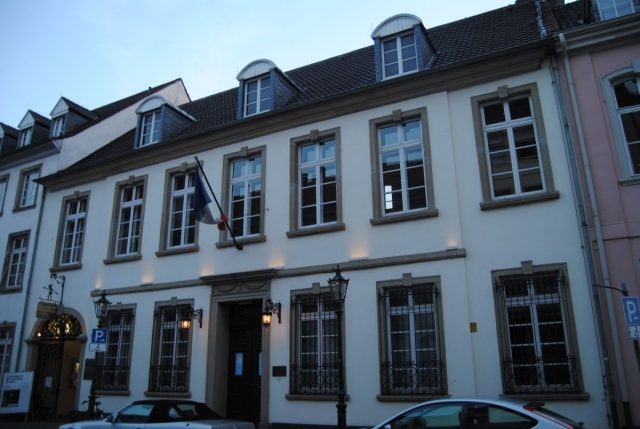
Wittgenstein Palais

Cultural center

The cultural center Palais Wittgenstein at Bilker Straße 7–9 in Düsseldorf's Carlstadt houses a chamber music hall, the Düsseldorf Marionette Theater, the Institut Français Düsseldorf, and an Art Nouveau cafeteria (former butcher shop London, previously Lorettostraße).

The building now known as Palais Wittgenstein (house no. 7) was built after 1790 by the wine merchant Heinrich Huyssen, who came from an Essen family, as part of the settlement of Carlstadt. In 1801, he lived in Essen again, but still owned the house. The next owner was Senate President Johann Theodor Jakob Reichsfreiherr von Kylmann (1751–1837), later his daughter Constanze (1801–1872) and her husband Freiherr Phillip von Lezaack (1796–1878). In 1874, Prince Alexander zu Sayn-Wittgenstein bought the house, but left it again in 1876. In 1878, the wine merchant Eduard Hauth moved his wine business from Schwanenmarkt to Bilker Straße 7 and was able to use the wine cellars built by Huyssen. In 1887, he had the courtyard, among other things, excavated and cellared. The gate of Palais Wittgenstein is the masterpiece of Paul Bogus, purchased for 600 Goldmark for the Hauth house, Bilker Straße 7, on the occasion of the Düsseldorf Trade Exhibition in 1902. House no. 9 was built by Gottfried Bensberg, owner of the Krautmühle in Neustadt. In 1790, the engraver Johann Gerhard Huck lived here.

The building complex Bilker Straße 7–9 was transferred to the state capital Düsseldorf. From 1974–76, the buildings, which were severely damaged in World War II, were historically reconstructed externally by the Municipal Building Department, architect Alo Terhoeven, and furnished internally to meet modern needs. In 1976, the Palais Wittgenstein was opened as a cultural center. As part of the renovation measures in 1976, the former butcher shop Peter London, previously Lorettostraße 30, acquired by the city of Düsseldorf in 1975, was incorporated into the Palais and has since been used as a cafeteria. It is an example of Historicism around 1900 and was acquired by Theodor London for 28,000 Goldmark on the occasion of the World Exhibition in Ghent, Belgium, exhibited there in 1906, and awarded a first prize.

Current Use+

The Institut Français Düsseldorf, founded in 1950, moved into Palais Wittgenstein in 1977. It organizes language courses and cultural programs and maintains a media library, offices, and classrooms.

Regular concerts and readings take place in the chamber music hall of Palais Wittgenstein, which offers 234 seats.

Through the inner courtyard of the Palais, one reaches the Düsseldorf Marionette Theater, which presents sophisticated productions for adults and older children aged eight and above in approximately 230 performances per year. The repertoire includes 21 productions, including operas and modern musical theater, dramas and fairy tales, with a focus on adaptations of Michael Ende's works. The theater includes workshops and a theater prop room in the basement with over 500 figures. The Marionette Theater has been located in the Palais since 1965, then known as "Theater Rheinischer Marionetten" of the Zangerle family.

Take Mobile History with you

You are reading this text for free. Premium adds what matters on the road: descriptions read aloud, sites found through your camera, whole regions taken offline.

  • Every description, including the ~17,700 Premium sites
  • Audio guide: have descriptions read to you on location
  • AR finder: see sites through your camera, with distance and bearing
  • Unlimited saved sites

14 days free, then from €2.99 a month. Cancel anytime.

Source: Wikipedia · Licence: CC BY-SA 4.0 · Image: http://schloesserrundschau.de/nrw/schloesser/duesseldorf007.html

This description draws on the facts documented in the linked Wikipedia article; Wikipedia content is licensed under CC BY-SA 4.0. Wording and editing: Mobile History.

Location: 51.2223, 6.7728