Museum
Palais Zum Römischen Kaiser
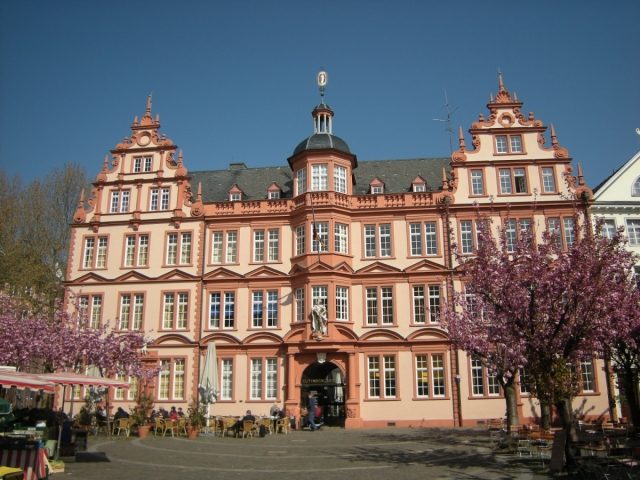
The House of the Roman Emperor, formerly Zum Marienberg, is a Renaissance building in Mainz. It was the first major new building in Mainz, which had been destroyed by the Thirty Years' War, and served as a model for further magnificent buildings of the Electorate of Mainz nobility. Today, part of the building houses the Gutenberg Museum and the official residence of the Mainz City Clerk.
17th Century+
The historic building was constructed for the wealthy merchant, electoral councilor, and rent master Edmund Rokoch in the second half of the 17th century. The Late Renaissance building with its elaborate facade was the richest bourgeois house in the city and marks the beginning of the reconstruction of the war-damaged and depopulated city. In 1653, the western part of the building was first erected in the tradition of narrow bourgeois gabled houses.
From 1657, this house was supplemented by an identically designed gabled house on the eastern part of the current property and finally completed by the central building connecting the two parts, the so-called Private Palais Zum Marienberg.
Above the passageway is the portal figure of a Roman emperor standing next to cannonballs. It is presumably intended to depict Charles V after the Turkish Wars.
18th Century+
The building was adorned with sculptural facade decorations and, from 1742, under its new name, Zum römischen Kaiser (To the Roman Emperor), which is still used today, served as a hotel where, among others, Mozart, Voltaire, and Goethe stayed as guests.
The figure in armor above the entrance presumably depicts Emperor Charles VI.
The former gateway is spanned by a Baroque ceiling vault from 1685, which exhibits a wealth of motifs and is considered the best ceiling stucco of its time in Mainz. In October 2009, the stucco decoration suffered water damage, causing parts of the stucco to fall off; the damage has since been repaired. In the passageway stands the Gutenberg monument, executed in sandstone in 1827 by Joseph Scholl.
As a magnificent bourgeois house, the building significantly influenced Mainz architecture. It served as a model for the Episcopal Palace and the Schönborner Hof.
20th Century+
Since 1930, the building has housed the Gutenberg Museum, which completely burned out during World War II. In 1960/61, the building was reconstructed and, since 1962, together with a new building constructed by architect Rainer Schell, serves as a museum for the art of printing. It houses the specialized library, the restoration department, and administration of the museum, as well as the Gutenberg Society.
In 2005, "Gebäudewirtschaft Mainz" began an urgently needed facade renovation with financial support from the Denkmal-Netzwerk Mainz, the German Foundation for Monument Protection, and the General Directorate for Cultural Heritage Rhineland-Palatinate. It cost around 460,000 Euros and was completed in 2009.
Take Mobile History with you
You are reading this text for free. Premium adds what matters on the road: descriptions read aloud, sites found through your camera, whole regions taken offline.
- Every description, including the ~17,700 Premium sites
- Audio guide: have descriptions read to you on location
- AR finder: see sites through your camera, with distance and bearing
- Unlimited saved sites
14 days free, then from €2.99 a month. Cancel anytime.
Source: Wikipedia · Licence: CC BY-SA 4.0 · Image: http://schloesserrundschau.de/pfalz/schloesser/mainz13.html
This description draws on the facts documented in the linked Wikipedia article; Wikipedia content is licensed under CC BY-SA 4.0. Wording and editing: Mobile History.
Location: 49.9995, 8.2757