CastleNürnberg-Fischbach

Peller Castle

Peller Castle

Cultural facilitie

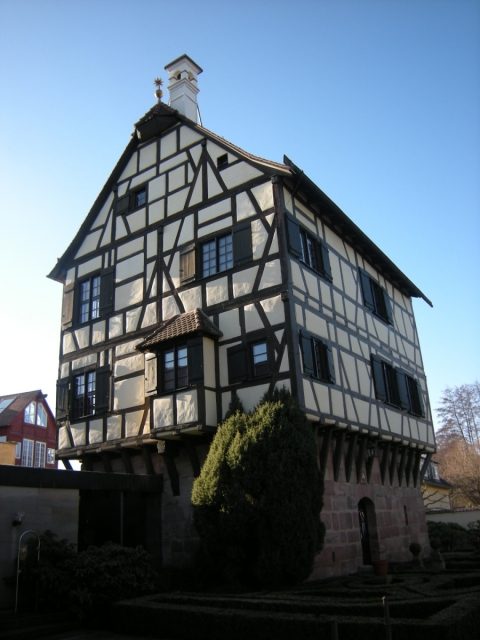
The so-called Pellerschloss in Fischbach is one of the few examples of a typical 16th-century manor house whose original structure has been preserved. Two projecting half-timbered upper floors with a gabled roof and a hipped dormer rest on a stone base equipped only with loopholes; diagonally placed support beams emphasize the expansive superstructure. The oriel was integrated into the wooden construction. Above the segmental arch entrance on the north side is the Peller coat of arms. The applied plaster, which a photograph by Guido von Volckamer from 1894 still shows, was removed at the beginning of the 20th century. The castle was once surrounded by a moat, which has since been filled in.

The origins of the privately owned seat have not yet been researched. Allegedly, the Holzschuher family owned the estate around 1400, but there is no proof for this. The existence of the manor house can only be proven for the year 1517, when Matthias Melber – owner of the estate since 1506/07 – opened the small castle to the city of Nuremberg. The property passed to Jakob Welser in 1527, who bequeathed the seat to his son of the same name in 1541. He died unmarried in 1553. He was followed by the Schmittmayr family in 1557, the Murach family in 1573, the Imhoff family in 1609, the Paumgartner family in 1677, and finally, from 1687 until their extinction in 1870, the Peller family, who gave the seat its name.

During the Second Margrave War in 1552/53, the half-timbered upper floors were destroyed. Presumably shortly after 1557, the new owner Schmittmayr rebuilt them on the old sandstone plinth. The work was completed after 1573 by Philipp von Murach and his wife Felicitas von Redwitz, whose alliance coat of arms has been preserved on the south side. The Imhoff family repaired the damage from the Thirty Years' War; minor repair work in 1722/23 primarily concerned the exterior – the moat and bridges – and, according to the requirements of the forest office, was to be carried out in stone as far as possible. The defensive structures still present at that time were removed after 1751 and replaced by a garden with the existing sandstone wall.

After the extinction of the Peller family (1870), the former moated castle was sold two years later by the heirs for 18,000 guilders and, after frequent changes of ownership and use (temporarily also as a restaurant), came into the possession of the municipality of Fischbach in 1962, and the city of Nuremberg in 1972. Weddings are now held in the ground floor hall, and the rooms can be rented by companies and private individuals for events.

Take Mobile History with you

You are reading this text for free. Premium adds what matters on the road: descriptions read aloud, sites found through your camera, whole regions taken offline.

  • Every description, including the ~17,700 Premium sites
  • Audio guide: have descriptions read to you on location
  • AR finder: see sites through your camera, with distance and bearing
  • Unlimited saved sites

14 days free, then from €2.99 a month. Cancel anytime.

Source: Wikipedia · Licence: CC BY-SA 4.0 · Image: http://schloesserrundschau.de/bayern/schloesser01/nuernberg29.html

This description draws on the facts documented in the linked Wikipedia article; Wikipedia content is licensed under CC BY-SA 4.0. Wording and editing: Mobile History.

Location: 49.4210, 11.1923