ChurchBosau

Petrini Church

Petrini Church

The church can be visited

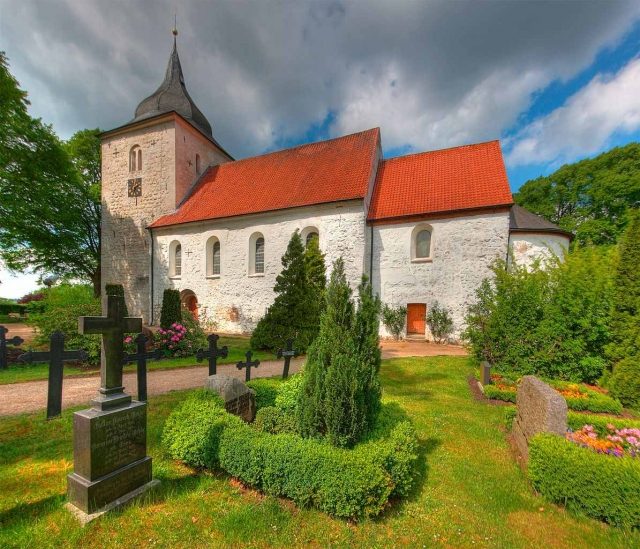
St. Peter's Church in Bosau, at the southern end of Lake Plön, is a Romanesque fieldstone church from the 12th century, founded by Bishop Vicelin.

Bosau was temporarily the seat of the Diocese of Oldenburg from 1150 to 1156 under Bishops Vicelin and Gerold. As such, St. Peter's Church is a former bishop's church and is therefore also referred to as the "smallest cathedral in the world". The chronicler and priest Helmold of Bosau wrote his Chronica Slavorum here from 1167 to 1172.

Bosau's St. Peter's Church has been the central venue for the Bosau Summer Concerts for over 40 years.

Diocese of Oldenburg in Holstein

The Diocese of Oldenburg in Holstein was founded by Archbishop Adaldag of Hamburg on behalf of Emperor Otto I in 972 for the purpose of missionary work among the Slavs and the colonization of the Wendish territories. The territory of the diocese initially stretched from the Danish border on Kiel Bay to the border of the Diocese of Havelberg in the south, but was restricted to actual Wagria (East Holstein) in the 11th century.

The founding of the diocese was followed by a long period of Slavic uprisings and warlike conflicts after some peaceful years. In 983, the church in Oldenburg went up in flames. The most violent Wagrian uprising occurred after calmer phases in 1066 under the leadership of the Liutizi tribe, who destroyed everything Christian in the land. Bishop Ezzo escaped the massacre, but the Diocese of Wagria disappeared from history for over 80 years.

Bosau before the Church Founding

The Bosau peninsula in Lake Plön was originally an island and probably already the site of a Wendish cult in pre-Christian times. The name Bosau is the evolution of the Slavic settlement name Bozowe, a possible interpretation is "among the beeches", other suggestions range from "God's field" to "settlement of Boz". One of the first bishops of Oldenburg (Holstein) had already established a protected farmstead here in the 10th century, but it could not be maintained and was finally destroyed by the Slavs in 1066.

Bosau as the Seat of the Diocese of Oldenburg

In the 12th century, Henry the Lion again vigorously pushed forward the colonization in the Slavic settlement areas of eastern Nordalbingia and Mecklenburg in a second major effort. In the course of this second colonization, the old Wendish missionary diocese of Oldenburg was formally restored. (→ Wendish Crusade)

In 1149, the Wendish missionary Vicelin was appointed Bishop of Oldenburg, after the episcopal see had been vacant for over 80 years. Because the area around Oldenburg itself was still a Wendish retreat and the episcopal see there was not yet secure, Bishop Vicelin moved to Bosau.

Church Founding by Vicelin+

Bishop Vicelin had St. Peter's Church built in the years 1151–1152, one of many fieldstone churches from the time of his mission in Holstein and Wagria, still known today as Vicelin churches. The later Bosau pastor and chronicler Helmold († 1177) writes about this in his Slavic Chronicle, Book I, Chapter 71:

"So was the peace in the land of the Wagrians, and the young planting increased more and more by God's grace. Also, trade in Lübeck became more flourishing day by day, and the ships of the merchants there multiplied. Bishop Vicelin, however, began to inhabit the island, which was called Bozowe, and camped under a beech tree until they had built huts in which they could stay. There he began to build a church in the name of the Lord and in memory of Saint Peter, the prince of the apostles."

Construction began in 1151, with craftsmen and materials coming from Segeberg and Neumünster. When Bishop Vicelin returned to Bosau in 1152 from the Imperial Diet of Merseburg of the young Emperor Frederick Barbarossa, the church building was so far advanced that Vicelin could perform the consecration (Helmold, Slavic Chronicle, Book I, Chapter 75). A few days after the church consecration in Bosau, he suffered a stroke that paralyzed his right side and severely impaired his speech. After two years of suffering, he died on December 12, 1154, in Neumünster. Under his successor, Bishop Gerold, who resided in Eutin from 1156, the originally Oldenburg episcopal see was moved to Lübeck in 1160 (according to recent research, perhaps not until 1163). Gerold died in 1163 at the home of his friend Helmold in Bosau, whom he had encouraged to write the chronicle.

Building History+

It is not possible to determine exactly what St. Peter's Church in Bosau originally looked like, as the building plan was changed during construction and the church was later rebuilt several times. Remains of foundations found during excavations in the nave suggest a three-aisled basilica. The west tower, choir, and apse were not initially present; they were only added around 1200 when the three-aisled basilica was converted into a hall church.

The oldest surviving depiction of the church from 1559 shows the tower in a round shape with a pointed spire. The foundations of an original round tower could also be proven by excavations and are clearly marked in the ground around the current tower with fieldstones. During the bombardment of the church in the Thirty Years' War in 1627, the round tower was destroyed except for minor remnants. The reconstruction of the tower took place on an almost square floor plan, and the tower received a curved Baroque helmet.

At the Bosau church, the original fieldstone technique can be observed particularly well, as large parts have been preserved in their original state. The fieldstones were poured into wooden formwork with gypsum mortar from the Segeberg Kalkberg, so that the appearance of the white surface was visible far across Lake Plön. After large parts of the gypsum surface were lost and the masonry had to be repaired with bricks, the church was uniformly given a white lime wash in 1970, so that its current appearance – apart from the round tower – is very close to that of earlier times.

Furnishings+

Fresco Remains and Baptismal Font

Inside the church, small remnants of the original Gothic wall painting have been preserved in the apse, with tendril paintings and a not fully preserved fresco (Peter and a donor), which were discovered and uncovered in 1952. The oldest object in the church is the medieval baptismal font made of Swedish granite from the 12th or 13th century, standing to the left of the main altar; it rests on a younger limestone base from the island of Gotland.

Main Altar

The winged altar is considered one of the oldest and most significant in East Holstein. However, the current depiction of the carved altarpiece is no longer the original. Until 1915, the altarpiece hung unnoticed on the south wall of the church and deteriorated. The consequences of the well-intentioned restoration were catastrophic; the historic altarpiece was completely redesigned. Almost all figures were swapped and repositioned, some altered or even newly created; the apostle Judas Thaddeus lost his attribute, the club, thus becoming John the Baptist. The alleged, repeatedly described sequence in the central part – Mary, Christ with Abraham and Moses, John the Baptist – replaced the original sequence Peter – Christ (without Abraham/Moses) – Judas Thaddeus. Of the 14 main figures, 12 were swapped, one "re-baptized", only Christ remained in his place. The redesign of the winged altar, including the secondary figures, in 1915, was thorough and comprehensive. However, it can be documented by records and photos stored in the archive of the State Office for Monument Preservation Schleswig Holstein. During the next restoration around 1968, the prophets were again swapped. The current front view of the altar is therefore a random product of the 20th-century restorations.

On the back, overpaintings were removed from the left wing in 1915. Older paintings with the following themes came to light: Crucifixion, Entombment, Mass of St. Gregory, and Christ's Descent into Hell. Even if these paintings probably date from the 15th century and thus do not belong to the original inventory of the winged altar, the Bosau altar is nevertheless one of the oldest altarpieces featuring a Mass of St. Gregory. The so-called side altar of the "Apostles Peter and Paul" is a remnant from the "eternal vicarage" founded by the parishioners in 1493 and endowed with 350 Lübeck marks.

Triumphal Cross

An artist from the workshop of Bernt Notke created the large triumphal cross around 1470, which hangs in front of the choir arch and immediately draws all attention upon entering the church. It shows Jesus being executed on the cross like a criminal. The three lilies growing from his head are signs of his purity and innocence. Four angels hovering around the crucified one catch the flowing blood from his wounds in communion chalices. The four ends of the crossbeams are extended and show the symbols of the evangelists: the angel as a sign for Matthew, the lion for Mark, the bull for Luke, and the eagle as a sign for John. The crossbeams are designed as the tree of life with growing foliage, thus pointing to Jesus' victory over death.

During the restoration of the triumphal cross in 1916, five relics were discovered in Christ's head. With each relic was a parchment strip with its exact designation. According to this, the bone fragments are said to come from Saints Lawrence, Maternianus, and Maurice, further bone splinters allegedly from the Eleven Thousand Virgins who suffered martyrdom near Cologne. A small limestone is said to be "de monte Tabor", i.e., from Mount Tabor in Palestine.

Late Gothic Carvings

Also from the Late Gothic period are the carved figures on both sides of the apse arch of Mary on the crescent moon (walnut wood) and of Bishop Vicelin (oak wood), to whom a church model was placed in his hand in the 19th century. The choir stalls from the 15th century show finely carved heads on the cheeks.

Baroque Pulpit

Still during the Thirty Years' War, the richly decorated pulpit was carved in 1636, which is quite astonishing given the great destruction of 1627. Between corner columns, Christ and the Evangelists, as well as Paul and Andrew, stand in niches. The small hourglass on the pulpit balustrade is intended to indicate the length of the sermon, it was donated by a parishioner at Christmas 1734.

Gallery with Picture Panels

The supports of the north gallery, erected in 1656, are rather roughly hewn. Its twenty painted panels between columns tell scenes from the life of Christ, especially of his suffering and death. The pictures, painted in a popular style, are by Hans Welcker, who also painted the original ceiling painting of the Baptism of Jesus, which is now on the west side of the gallery.

Epitaphs

On the south wall hang three epitaphs, two in the Late Renaissance style and one in the Baroque style. The most magnificent is that of Henning Meyer (around 1670) with fully sculpted figures, twisted columns, and rich floral ornamentation in the auricular style. (The episcopal bailiff Meyer had to donate a total of seven similar panels as penance for marital infidelity.)

Organ

The current organ of the church was built in 1972 by the Becker company. The facade consists of darkened oak. The instrument has 16 stops on two manuals and pedal.

Take Mobile History with you

You are reading this text for free. Premium adds what matters on the road: descriptions read aloud, sites found through your camera, whole regions taken offline.

  • Every description, including the ~17,700 Premium sites
  • Audio guide: have descriptions read to you on location
  • AR finder: see sites through your camera, with distance and bearing
  • Unlimited saved sites

14 days free, then from €2.99 a month. Cancel anytime.

Source: Wikipedia · Licence: CC BY-SA 4.0 · Image: http://de.wikipedia.org/wiki/Datei:Petrikirche_Bosau_2009.jpg

This description draws on the facts documented in the linked Wikipedia article; Wikipedia content is licensed under CC BY-SA 4.0. Wording and editing: Mobile History.

Location: 54.1068, 10.4252