The church can be visited
ChurchStuer
Stuer Church
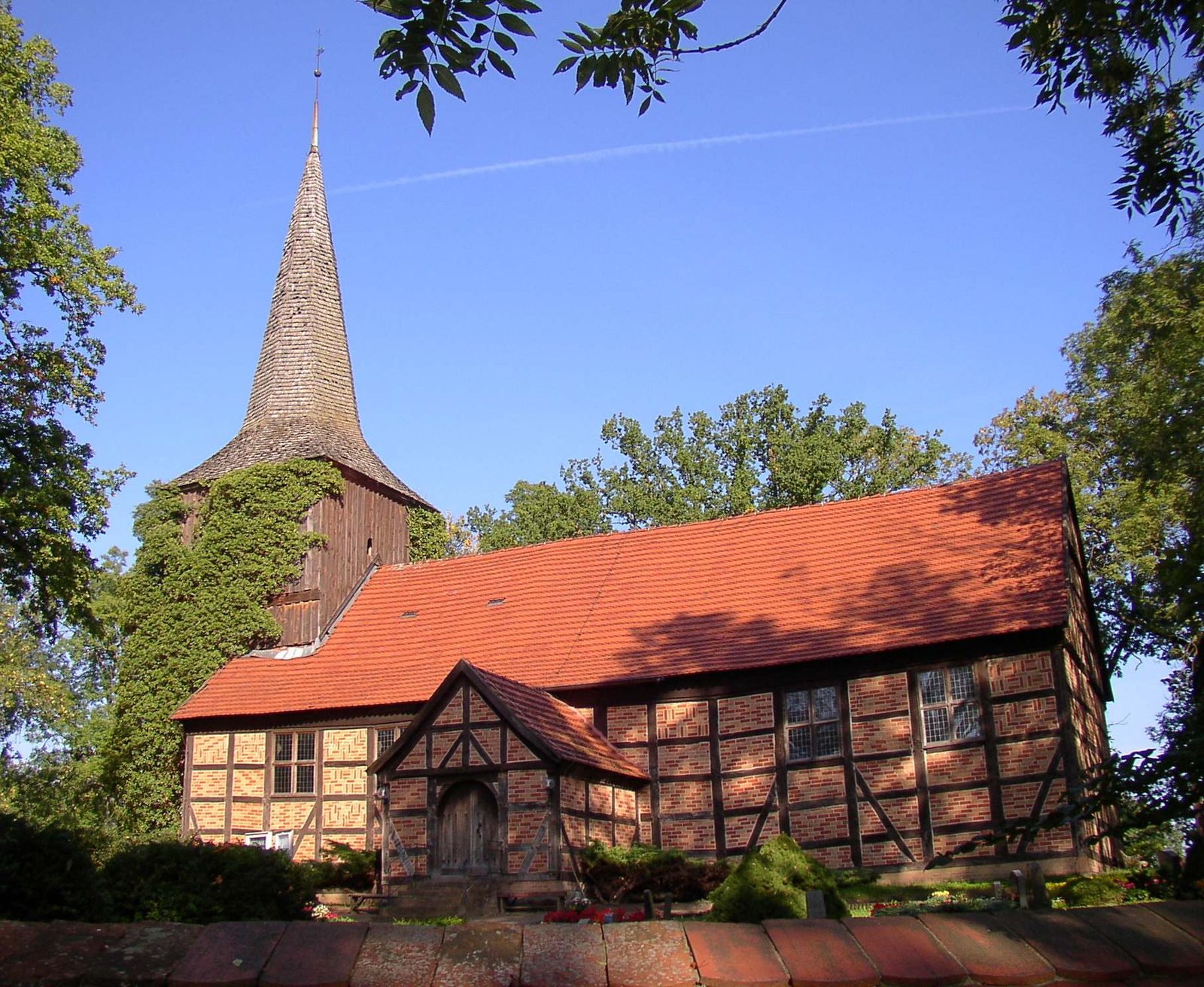
The village church (also St. Peter's Church) in Stuer, a municipality in the Mecklenburg Lake District in Mecklenburg-Vorpommern, belongs to the Evangelical-Lutheran Parish of Stuer in the Neustrelitz provostry, Mecklenburg church district of the Evangelical-Lutheran Church in Northern Germany.
History+
At the southern end of Lake Plau, between Plau and Röbel/Müritz on the B 198, the Stuer village church is situated on a hill, surrounded by an old cemetery. Even before the founding of Plau, Pope Alexander III mentioned the lake "lacus Sturichse" in a document from March 1178. In 1289, Bishop Hermann of Schwerin granted the cathedral chapter tithes "in Sture" in the Waren region. On September 29, 1340, Nikolaus III and Bernhard II, as Princes of Werle, enfeoffed their vassal Andreas von Flotow in Dobbertin Monastery with all property and rights of the entire village of Stuer "Villa Sture" and the mill, and from 1344 with further estates in the Malchow region. This marked the beginning of the flourishing of the von Flotow noble family in the vicinity of Stuer. The Flotows reached the peak of their power when Duke Albrecht of Mecklenburg pledged the Malchow and Röbel regions to them in 1354. Documentary evidence regarding the introduction of the Reformation in the countryside is extremely rare, but in Stuer in 1532, Pastor Cyriacus von Bernburg had asked Duke Heinrich of Mecklenburg to confirm him in his evangelical pastorate and to transfer to him the administration of the sacraments and other ecclesiastical duties. The success of this request is not known, but there is no doubt that the Duke granted the fulfillment of this wish, as the Reformation was already firmly established in 1532. The Flotows of Stuer had become Protestant very early; from 1505, the brothers Dietrich, Hartwig, Jaspar, and Melchior were mentioned in Stuer. As early as around 1524, they had taken in a Lutheran clergyman, Cyriacus von Bernburg, as a tutor for their children and allowed him to preach the Gospel, because the clergymen in Stuer were "very clumsy and unlearned." He had worked for five to six years when the Flotows granted him the parish, where he preached the pure Gospel for two years. As late as 1587, the Flotows held feudal possessions of 34 estates and villages with mills and lakes. The castle in Stuer was considered the main seat. After the destruction of many villages and estates during the Thirty Years' War, the castle also burned down in 1660 and was abandoned as a residence. The ownership remained with the von Flotows until 1830, when Georg von Flotow sold the ancestral seat to District Administrator Gustav Dietrich von Oertzen. Although his son Karl (Carl) Friedrich August von Flotow succeeded in reacquiring part of the possessions with the old ancestral estate in 1853 and taking the oath of fealty for it in 1855, some estates, such as Neu-Stuer, already had new owners. However, the church patronage, which had been in the hands of the Flotows since pre-Reformation times, remained with the von Flotows.
Building History+
Already in the early Middle Ages, there was a church in Stuer at this location, as evidenced by the testimony of Plebanus Herr Eberhard "Eurett, perner tho dem Sture" in a Flotow sales document from July 3, 1363. During the Thirty Years' War, the church in Stuer was also destroyed. No information about its reconstruction has been preserved. In 1658, the rectory, newly built years before, is said to have burned down. The current rectory was built in 1809. In 1717, the church building was erected as a half-timbered hall with an integrated west tower in its present form. In 1750, the south porch was added. Around 1900, renovation work was carried out inside the church. Until 1945, it was the patron church of the von Flotow family, most recently Jürgen Tiedecke von Flotow (1902–1976), later co-founder of the German Nobility Archive. Unfortunately, the church chronicle with many historical data and references to the origin of the furnishings was lost in 1945. From 1989 to 1995, extensive restoration and renovation work was carried out under the professional direction of architects Peter Andrees and Jörn Rau, and restorers Heiko Brandner, Volker Ehlich, and Bödecker & Schlichting.
Architectural Description+
Exterior+
The church is a rectangular half-timbered building, 10 meters wide and 24.5 meters long, erected on fieldstone foundations. It is flanked by a half-timbered porch with a gable roof to the south and the semi-recessed half-timbered tower to the west with a north entrance. The tower is clad with boards above the nave's gable roof and is crowned by an octagonal pyramidal spire covered with oak shingles.
Interior+
The interior is characterized by the visible half-timbered walls and the flat wooden beam ceiling with largely preserved historical joists. The red-ground marbling of individual ceiling beams was uncovered during the last restoration. In the center of the room, a carefully crafted oak central support with widely projecting head braces, the "Hausbaum," a key structural feature of the Prignitz single-pillar churches, stands out. The old brick floor dates back to the time of construction. The church interior gains its architectural and art-historical significance from the extremely high-quality furnishings from various stylistic periods, which, as a grown ensemble, reflect the spatial impression prevailing since the 18th century.
Altar
The altarpiece, crafted between 1460 and 1500, is a remarkable late Gothic carving and is attributed to the Master of the Güstrow Cathedral Altar. In the central shrine, the carved, richly figured crucifixion scene of Jesus Christ, surrounded by four saints. Top left, an Anna Selbdritt group with Elisabeth, Jesus, and John, below it St. Peter with the key. Top right, St. Anthony with the pig, below it St. Catherine with wheel and sword. As a special feature for the Müritz region, 20 people are depicted before the crucifixion. Above the figures and the cross, very fine ornamental work. On the opened side wings, four Passion scenes are depicted: on the left, the Flagellation and the Prayer in Gethsemane, on the right, Christ Carrying the Cross and the Condemnation by Pilate. The back of the wings depicts the four Evangelists: Matthew with the winged man, Luke with the bull, Mark with the lion, and John with the eagle, all engaged in writing. In the central part of the predella, the Entombment as a carving. The opened wings then show a hymn verse on the right and left, and on the back of the wings, the Institution of the Last Supper can be seen. To the left of it, the Flotow coat of arms, and to the right, the Blücher coat of arms. Above them, the names of the founders: Augustin Didrich von Flotow and Katharina Elisabeth von Blücher, Anno 1688. The altar was probably restored at this time on behalf of the couple, with the existing paintings altered and the polychromy of the figurative Gothic carvings removed.
Patron's Boxes
On both sides of the altar are patron's boxes from the late 17th, early 18th century. Formerly probably made for another church space, they were the seat of the von Flotow family during divine service. To the north, left of the altar, the "von Flotow-Stuer" box, formerly a two-story box structure, painted with 16 coats of arms of the von Flotow family, which are also largely found on the escutcheons on the walls. The lead-glazed sliding windows with panes of so-called "green forest glass," produced in Mecklenburg in the 18th century, are largely preserved. To the south, right of the altar, a single-story box structure, the "von Flotow-Altenhof" patron's box with unpainted oak wood crowning. At an angle to it, a simple, two-row box pew is attached, built approximately at the same time as the boxes. On the single-row patron's pew made of oak wood to the right of the altar, the inscription is carved on the cheek: HARTWIG VON FLOTOW ANNO 1658, on the front with three Flotow coats of arms and the names Hartwig, Augustin, and Friedrich von Flotow, as well as the year 1688.
Candle Chandeliers
Two carefully restored candle chandeliers provide festive lighting. They originate from the Jewish community of Sternberg. When they gave up their synagogue in 1906, the chandeliers were acquired by Jürgen von Flotow for the church in Stuer.
Pulpit and Baptismal Font
The pulpit without a soundboard and the wooden baptismal font in the late Renaissance style bear, in addition to the year 1688, the initials and coats of arms of the von Flotow and von Blücher couple.
Escutcheons
A special feature in the church interior are the 65 escutcheons used as coffin fittings on the walls. They were made between 1680 and 1930 from tin and bronze and represent a piece of the von Flotow family history.
Organ
On the west side of the nave, on a small platform, is the new organ (II/P/8+3 Tr) built in 1995 by organ and harmonium builder Karl Lötzerich from Kassel and completed after his death in 1996. The balustrade around the organ gallery is an addition from the late 18th century. To the right and left of the organ are marbled beams.
Bells
Two bells hung in the tower. The largest bell, one meter in diameter, has the inscription: above SOLI DEO GLORIA, on the front side of the field: PATRONUS HERR MAJOR GEORG FRIEDRICH DIETRICH PHILIPP VON FLOTOW PASTOR M * JOHANN GOTTFRIED LEUE CHURCHWARDENS JOHANN ULRICH LORENZ JÜRGEN SCHRÖDER. On the opposite side of the field: CAST IN THE YEAR 1823 BY VALENTIN SCHULTZ IN ROSTOCK. The smaller bell, 0.75 meters in diameter, had the same inscription with the year 1822. The preceding bells from 1719 were cast by Michael Begun and those from 1747 by C. D. Heitze.
Cemetery+
Around the half-timbered church, on a slope, is the old cemetery with historical grave crosses, enclosed by a fieldstone cemetery wall.
Grave Crosses+
East of the church are several grave crosses, including for Andreas von Flotow (* July 25, 1900; † April 30, 1933), retired lieutenant, Elisabeth von Flotow (* April 16, 1873; † January 31, 1946), née Countess von Bernstorff, Georg Jürgen von Flotow (* October 25, 1868; † May 25, 1956) and his unmarried youngest brother Ernst von Flotow (* January 1, 1873; † August 7, 1956), painter. Jürgen von Flotow, father of the SA leader Andreas von Flotow, who was shot in 1933, had died in Southern Germany. In a clandestine operation, the body was brought to the German Democratic Republic and – according to von Flotow's wish – buried in Stuer. Helmut Sakowski used this operation in his novel "Verflucht und geliebt" (1981); the film adaptation is dramatically designed. On the western slope of the cemetery is the grave of Gustav Bardey.
Fallen Soldier's Cross+
At the northwest corner of the church, a tall wooden cross on a square fieldstone base commemorates the fallen of the First World War. The inscription on the crossbeam quotes from the Gospel of John (15:13): NO ONE HAS GREATER LOVE THAN THIS, THAT HE LAY DOWN HIS LIFE FOR HIS FRIENDS
Pastors+
Names and years indicate verifiable mention as pastor.
mentioned 1530 Cyriacus von Bernburg, from 1524 tutor to the Flotow children. 1569–1573 Christoph Duderow, thereafter in Altkalen. 1573–1578 Jakob Sachse, thereafter in Garwitz. 1578–1588 Johannes Kökeritz, "after he had chastised the congregation in a sermon, he was stabbed by a Priborner with a gag-spear after a violent exchange of words in the pulpit." 1588–1616 Nikolaus Windelbrand. 1616–1622 Georg Wehle. 1622–1642 Balthasar Näse, had a complaint against his "Kaspelkinder" in 1642. 1650–1667 Petrus Actus Franck from Jever in Friesland. 1668–1680 Johann Seyer. 1681–1704 Georg Lukow from Wismar. 1705–1742 Christoph Heinrich Delbrügk, died of "inflammatory suffocation." 1742–1800 Paschen Friedrich Delbrügk from Stuer, son of the predecessor. 1800–1832 Johann Gottfried Leue from Salzwedel, compiled a chronicle of his time. 1832–1854 Gorg Diederich Ludwig Gottfried Leue from Stuer, son of the predecessor, was dismissed from office in 1854. 1855–1867 Johannes Wilhelm Ludwig Schumacher. 1986–1878 Franz Gustav August Werner from Serrahn, thereafter in Basedow. 1878–1909 Johannes Heinrich Bahlcke from Fallersleben. 1910–1927 Gottfried Gustav Wilhelm August Herrmann Fritsche from Spornitz, drowned in 1927 and buried in Stuer. 1928–1940 Ernst-Günter Hans Martin Franz Salchow from Teterow. 1940–1950 Ulrich Schabow. 1950–1977 Harri Kruse. 1980–2003 Wolfgang Kasch. 2003–2009 Wolfgang Kasch (with official assignment). since September 8, 2019 Burkhard Müller-Ludwig.
Current Parish+
The Evangelical-Lutheran Parish of Stuer includes the villages of Altenhof, Bad Stuer, Darze, Neu Stuer, Stuer with St. Peter's Church, and Stuer-Vorwerk. The Stuer parish forms a pastoral district with the Grüssow-Satow parish, which has its rectory there. The Stuer – Wendisch-Priborn parish was dissolved on October 1, 2009.
Take Mobile History with you
You are reading this text for free. Premium adds what matters on the road: descriptions read aloud, sites found through your camera, whole regions taken offline.
- Every description, including the ~17,700 Premium sites
- Audio guide: have descriptions read to you on location
- AR finder: see sites through your camera, with distance and bearing
- Unlimited saved sites
14 days free, then from €2.99 a month. Cancel anytime.
Source: Wikipedia · Licence: CC BY-SA 4.0 · Image: Doris Antony , Berlin · Wikimedia Commons · CC BY-SA 3.0
This description is a machine translation of an excerpt from the linked Wikipedia article. The source text was written by its authors, the translation is by Mobile History; like the original it is licensed under CC BY-SA 4.0.
Location: 53.3791, 12.3390