ChurchAndernach

Mariae Himmelfahrt Church
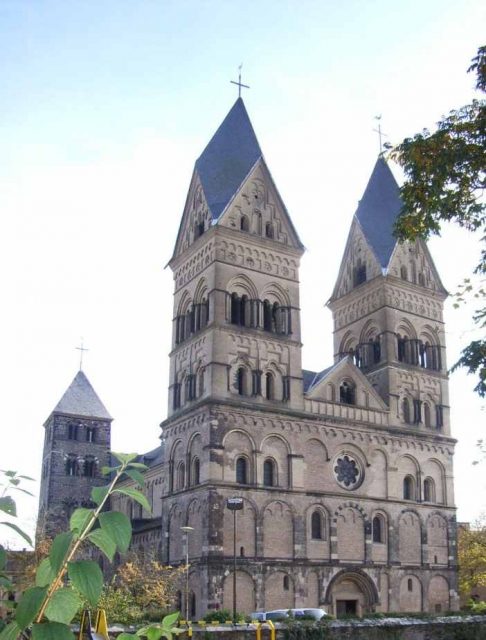
Mariae Himmelfahrt Church

The church can be visited

The Roman Catholic parish church of Maria Himmelfahrt (Assumption of Mary) in Andernach, a mighty gallery basilica with four towers, a westwork, and a choir, is located on the western edge of the city in direct proximity to the city wall and thus also on the west side of the Roman fort of Antunnacum, from which the later settlement emerged.

Carolingian burial sites beneath the present church prove that it is an earlier foundation. Little is known about the appearance of this church and also of its successor building from the early 12th century, of which the freestanding bell tower is preserved. The predecessor building, gifted in 1194 by Emperor Henry VI to Archbishop Johann I of Trier, who was the first bishop of Trier to also bear the title of Elector, fell victim to the flames in 1198 as a result of a dispute between Otto IV and Philip of Swabia, who conquered and plundered Andernach. The church building of the old city church was largely destroyed, except for the freestanding bell tower.

In place of the burnt-down church, whose freestanding bell tower was integrated into the new church building as the northeast tower and oldest part of the building, Johann I had the present Marienkirche rebuilt as a three-aisled gallery basilica by about 1220. It is possible that the new construction was already underway at the time of the destruction of the predecessor building in 1198, so that the fire only briefly interrupted the construction work. By 1250, the west towers were completed. The old westwork probably had only single-story towers and an open hall on the ground floor.

The Marienkirche was always both a city church and a bishop's cathedral and can therefore rightly call itself "Mariendom" (St. Mary's Cathedral), a designation used in Andernach vernacular alongside the equally common "Liebfrauenkirche" (Church of Our Lady), which was often doubted. For the Archbishop of Trier was also the parish priest in his own church in Andernach.

At the beginning of the 18th century, the church was in ruins. The Electoral Trier court architect Johann Georg Seitz, father of the architect Johannes Seiz, prepared an expert opinion in 1739 for damage repair, which considered the demolition of the towers and the removal of the collapsed side aisles. The commitment of Andernach citizens saved the church from a "reduction" to a torso with partial demolition of the west towers and removal of the side aisles, so that it can be admired in its full size today.

In the years 1740–1742, the restoration of the damaged church sections was consistently pursued, especially the reconstruction of the collapsed side aisles. The church served as a model, in whole or in part, for several church buildings (Maria Laach Abbey Church), even into the late 19th century (St. Anna in Neuenkirchen (Westphalia)).

Extensive restoration work was carried out in the late 19th century on the choir apse and the sections only provisionally repaired in 1740–1742, as well as the reconstruction (Romanesque restoration) of the richly designed west facade in 1893/1894 with the insertion of the large rosette, which is one of the most beautiful examples of Cologne-Rhenish architecture from the beginning of the 13th century. Thus, the visible condition today corresponds approximately to that from the mid-13th century.

The interior design includes the Imperial Altar (donated by Frederick III in 1475), a 13th-century basalt column baptismal font, an old Y-shaped crucifix, eight abstractly designed church windows with motifs from the Litany of Loreto, a valuable oak pulpit with sounding board from Maria Laach Abbey, and the communion rail from Maria Laach also came to Andernach as a result of secularization.

In connection with the new construction of the parish hall directly next to the church, the remains of a Roman bath complex from the 4th century were discovered in 2006. These were integrated into the building and made accessible to the public in 2009. Part of the bath complex can be viewed through a glass dome in front of the parish hall.

Bells+

In the northeast tower with its clock, hangs the peal of seven bells. Among these are three valuable medieval bells. Acoustically outstanding among them is the heaviest bell of the peal, cast in 1356 and weighing around 1,950 kilograms.

Take Mobile History with you

You are reading this text for free. Premium adds what matters on the road: descriptions read aloud, sites found through your camera, whole regions taken offline.

  • Every description, including the ~17,700 Premium sites
  • Audio guide: have descriptions read to you on location
  • AR finder: see sites through your camera, with distance and bearing
  • Unlimited saved sites

14 days free, then from €2.99 a month. Cancel anytime.

Source: Wikipedia · Licence: CC BY-SA 4.0 · Image: http://de.wikipedia.org/wiki/Datei:Maria-Himmelfahrt1-Andernach.jpg

This description draws on the facts documented in the linked Wikipedia article; Wikipedia content is licensed under CC BY-SA 4.0. Wording and editing: Mobile History.

Location: 50.4395, 7.3964