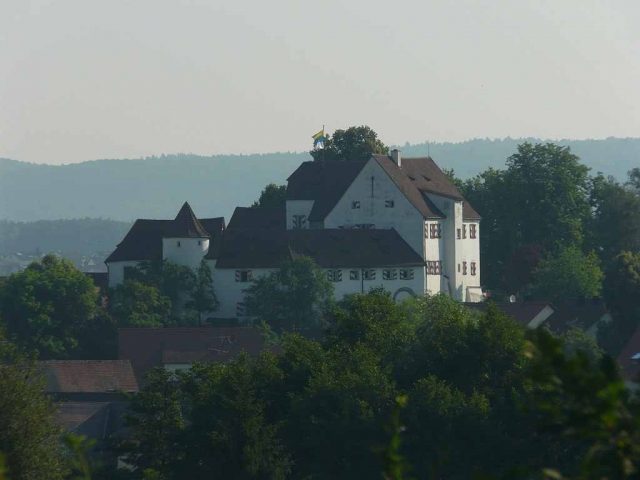
To be privately owned
Pfinzing Castle

In 1119, Bishop Otto I of Bamberg endowed the founding estate of Michelfeld Monastery with the estate of "Henphenvelt," including the parish and all appurtenances. There is no mention of a castle at that time. However, a younger source reports that Henfenfeld was one of the six "Munitiones" (fortifications) that the bishop had acquired during his lifetime. The appearance of the Bamberg cleric Kaezelinus von Henfenfeld as "prolocutor" (advocate) of the prince-bishopric as early as 1059 was cited by Gustav Voit as proof of a noble family that maintained a castle in Henfenfeld. A nobleman calling himself Wirnt von Henfenfeld in 1147 is now attributed by Eckard Lullies to the Lords of Ebermannsdorf, who were at times leading followers of the Counts of Sulzbach. At this time, Henfenfeld was in the hands of the Counts, as they exercised secular power as bailiffs of the prince-bishopric in the Nordgau and of Michelfeld Monastery. With the extinction of the Counts of Sulzbach, the castle and lordship of Henfenfeld fell to the Staufer as a church fief in 1188.
Still visible large-format ashlar walls of the high medieval building stock suggest that the castle was rebuilt and/or expanded around 1200. The imperial ministerial family, appointed as lower bailiffs at the castle, successfully reclaimed the castle after the collapse of the Staufer Empire, but fell into economic and power-political distress in the late 13th century. In the early 1290s, during the Hirschberg War, a bitter feud broke out between Gebhard von Henfenfeld and the Lords of Wildenstein, which may have cost further resources. The fact that Heinrich V von Wildenstein appears in 1312/1323 as the husband of a Henfenfeld and as co-owner of the castle suggests the sacrifices with which the feud was pacified.
In the 14th century, the Lords of Henfenfeld had to sell many estates, especially to Engelthal Monastery and to Nuremberg citizens, until finally Ulrich von Henfenfeld even had to give up the ancestral castle in 1372 and sold it to Hermann von Breitenstein. Hermann's son Erasmus passed the castle on to Günther Lisberger in 1395, who granted co-ownership to the Nuremberg mining entrepreneur Herdegen Valzner, one of the richest and most influential men of his time. However, in May 1400, the castle already found a new owner in Wolfhart von Hüttenbach. In 1405, the period of rapid changes of ownership was over when Hartung IV von Egloffstein acquired it.
The Lords of Egloffstein purposefully began to expand their sovereign rights from their new castle. However, they lost the privilege of high jurisdiction in 1420 again in 1429, when their policy turned against King Sigismund himself. In the further 15th century, the Henfenfeld castle lords often attracted attention through harsh feuding measures, which were interpreted by the cities as highway robbery. With the victorious outcome of the Landshut War of Succession for Nuremberg in 1504/05 and the incorporation of the Hersbruck office into the imperial city's territory, Henfenfeld was also subject to the new territorial sovereignty and high jurisdiction. The Egloffsteiners tried in vain for some time with legal means to shake off the Nuremberg "yoke," but decided at the latest in 1524 to sell the castle and lordship. They entered into negotiations with the Nuremberg patrician family Pfinzing, which dragged on until 1529. After the Bamberg prince-bishopric, as liege lord, had finally agreed, the sale to Martin I Pfinzing could be sealed in 1530. Thus, the former imperial castle passed to one of the oldest and most distinguished Nuremberg families, who until their extinction in 1764 also called themselves Pfinzing von Henfenfeld after the castle.
In the Second Margrave War, the castle was occupied by the enemy as early as May 1552 and handed over to the margravial partisan Hans von Egloffstein, who claimed that he had been overcharged by the Pfinzings in the 1530 sale. During the disputes, the ailing Martin I Pfinzing died, and only his son Martin II achieved the return of Henfenfeld. The subsequent invasion of margravial troops on May 4, 1553, was less fortunate: the castle was set on fire and completely burned out.
In the years after 1557, presumably under the direction of the Nuremberg stonemason and master builder Paulus Beheim, the castle was restored for the Pfinzing family. The lordship and castle, which largely lost its defensive appearance during its reconstruction, had by then become part of a Vorschickung (family foundation) and were therefore administered by the respective eldest of the family. From 1587 to 1599, this task fell to Paulus II Pfinzing, the famous cartographer and creator of the Pfinzing Atlas. After Johann Sigmund Pfinzing, the last of the family who had significantly shaped the destiny of Nuremberg for over half a millennium, was laid to rest, the administration of the family foundation passed in 1764 to the brothers of the widow, born Haller von Hallerstein. Johann Sigmund III Haller, colonel of the Franconian district troops and Nuremberg Imperial Schultheiss from 1794 to 1804, managed the family assets until his death in 1805.
After the legal abolition of family foundations in 1808, the heirs were no longer able to maintain the extensive Pfinzing-Haller estate. In 1817, the castle was sold to the wealthy merchant and commercial court assessor Karl Benedikt Schwarz, who had already acquired the estates of Artelshofen and Hirschbach. So that the buyer could exercise the patrimonial jurisdictions, he was ennobled by King Maximilian I Joseph. Under Karl Benedikt von Schwarz and after his death in 1832 under his son Georg Christoph Benedikt, much was renovated, especially from 1826 to 1838; among other things, stucco ceilings were installed in various rooms. The Baroque garden was transformed into a landscape garden. After 1920, the von Schwarz family opened a catering business in parts of the upper floor. In 1939, a camp for the female Reich Labor Service was established in the rooms, and the NS Teachers' League also temporarily maintained a training center here.
In 1952, the heiress Erika von Schwarz sold the castle to the Deutsche Bundesbahn (German Federal Railway), which set up a training center here. Since then, there have been several interventions in the historic building fabric. Nevertheless, the castle has largely retained its late 16th-century appearance to this day. In the northeast, it is protected by a lined moat. A massive bridge, renewed in 1959, leads to the inner gate and the castle courtyard, around which the buildings attached to the curtain wall are grouped. Immediately south of the gate entrance, renewed in the 16th century, the former keep has been preserved. In its lowest floor, it still houses the dungeon of the patrimonial court with a preserved winch above the "Angstloch" for lowering loads or people. The once freestanding keep was probably deprived of its upper floors as a result of the fire catastrophe in 1553 and integrated into the residential buildings during reconstruction. While the ashlar blocks have been partially preserved on the facades that were built over at that time, they were worked off on the courtyard-side facades. During reconstruction, the gate area north of the keep was also built over. Here, the new large parlor, now called the red hall, was set up.
South of the keep, the three-story main building connects, which in the early modern period was called "Neuer Bau" (New Building). This designation could indicate a new construction or renovation in the late Middle Ages. To access it, the stair tower was added in 1624, which lost its originally very representative tower spire due to a renovation in 1795. A second Kemenate (stone house) was built in the 1560s on the western curtain wall with living quarters on the upper floor, while the ground floors once housed horse stables, coach houses, and utility rooms.
The outer bailey is at least partially preserved, but in the years after 1952, it was largely adapted to the purposes of the Bundesbahn. Thus, north of the driveway from the front gate, the elongated building with the Voit and Amtsknecht (bailiff's assistant) apartments, the stables, and the former tithe barn connects. At the rear gate, a considerably modernized staff residence and the economy building newly built in 1832/33 have been preserved. It was already expanded with staff apartments on the upper floor during its construction and today houses a catering business on the ground floor.
From a garden monument preservation perspective, the extensive castle garden is of great supra-regional importance and has largely been preserved as a landscape garden designed in the early 19th century, despite interventions after 1952 due to parking lot construction and agricultural use in the east. Noteworthy is the allegedly only hornbeam avenue in Germany and a monument pedestal, which served as the base for a bust of Karl Benedikt von Schwarz made by Jacob Daniel Burgschmiet in 1833. The bust was removed in 1968 and has been missing ever since. After the dissolution of the Bundesbahn school in 1983, the property was privatized again and has since been predominantly used for housing business premises.
Take Mobile History with you
You are reading this text for free. Premium adds what matters on the road: descriptions read aloud, sites found through your camera, whole regions taken offline.
- Every description, including the ~17,700 Premium sites
- Audio guide: have descriptions read to you on location
- AR finder: see sites through your camera, with distance and bearing
- Unlimited saved sites
14 days free, then from €2.99 a month. Cancel anytime.
Source: Wikipedia · Licence: CC BY-SA 4.0 · Image: http://de.wikipedia.org/wiki/Datei:SchlossHenfenfeld1.jpg
This description draws on the facts documented in the linked Wikipedia article; Wikipedia content is licensed under CC BY-SA 4.0. Wording and editing: Mobile History.
Location: 49.4965, 11.3919