CastleAltdorf bei Nürnberg

Altdorf Castle
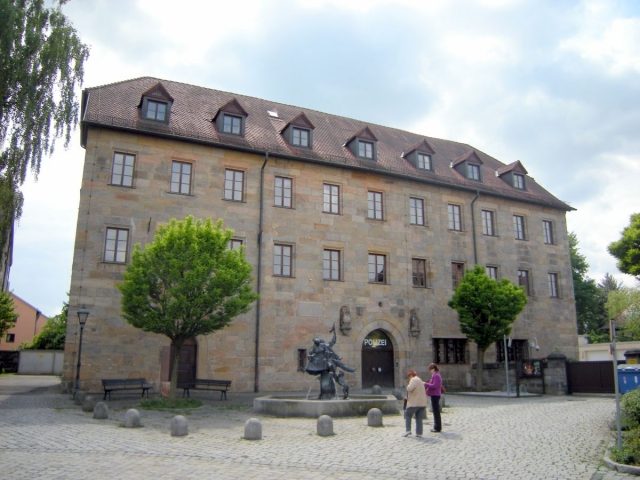
Altdorf Castle

Police station

Already in the 12th century, royal officials appeared in Altdorf: in 1129 a Marquard, in 1154 one from the family of Thann, in 1284 a knight Ludwig zu Altdorf as a witness in a legal transaction of the imperial ministerials of Thann. In the 1290s, this official was also seated in Altdorf, which was the center of an imperial estate complex that was pledged by King Albrecht I to Emicho Count of Nassau in 1299. In 1324, Konrad II von Rohrenstadt served as judge in Altdorf. He was followed in 1352 by Georg von Strahlenfels, in 1358 by Volkolt von Thann, in 1374 by Georg Knauer, and in 1396 by Wilhelm von Raitenbuch. From 1399 onwards, the official title of Pfleger (administrator) became common: in 1399, Bertold Ratz von Eismannsberg, in 1447 Ulrich von Freudenberg, and in 1500 Jörg von Mistelbach zu Lintach and Egensbach sealed as Altdorf Pfleger.

The seat of the territorial judge first appears as an official court in the purchase agreement by which Johann Count of Nassau sold the former imperial estate of Altdorf with its appurtenances to the Nuremberg Burgrave Albrecht in 1360. From the hands of the burgrave's son-in-law Swantibor Duke of Stettin, Altdorf finally passed to Elector Ruprecht II of the Palatinate in 1393. The Palatinate lost Altdorf to Nuremberg in 1505 as a result of the Landshut War of Succession, during which Altdorf was besieged and shelled by Nuremberg troops in 1504 after the Palatine Pfleger Jörg von Mistelbeck had initially refused to surrender.

The old Palatine official court was not used until 1552 and was not, as Gustav Voit believed, located at the site of the Nuremberg Pflegschloss (administrator's castle). When the Nuremberg city building authority began planning for a new official castle in 1522/23, the location had not yet been definitively clarified. Finally, the council wished to purchase some bourgeois properties, including a plot behind the "old ampthof" (old official court). The planning of the new castle was entrusted to the Nuremberg master builder Hanns, presumably Hanns Beheim the Younger. In May 1522, he presented a material list that envisioned a three-story, approximately 30-meter-long solid building with a vaulted ground floor. The upper floors were to have plank ceilings.

In the spring of 1523, the new building was decided upon, with the rural administration office announcing that an elaborate moat system would have to be dispensed with to avoid costly deep foundations for the new building. Nevertheless, the complex was to be secured with a wall, a small tower, and a drawbridge. The construction work apparently dragged on for some time, as Nuremberg's chief master builder Paulus Beheim still gave advice on paving in front of the castle in 1530. In 1531, an overview of the timber delivered to the construction site was created. Structural improvements were also carried out in the years up to 1542.

However, the Second Margrave War caused the efforts of the past decades to go up in smoke. Altdorf was captured for the first time on May 28, 1552. Even Altdorf citizens are said to have participated in the subsequent looting of the castle, which was to be judicially investigated after the recapture of the city by Nuremberg troops on June 22, 1552. The second margravial attack on Altdorf on June 2, 1553, was less fortunate: during the almost complete incineration of the city, the Pflegschloss also burned down.

Planning for the restoration of the castle had already begun in 1558, so construction work likely followed immediately. The date 1558 is also attested by inscription. A more recent building report concerns the castle's drawbridge, which was significantly dilapidated in 1600 and had to be renewed. The dispatcher of the city building authority and later Nuremberg armorer Matthes Pfeffer then planned the construction of the official's and gatekeeper's residence in 1604, which was to be built directly next to the castle gate.

The Pflegschloss, a three-story ashlar building covered with a half-hipped roof, has remained an official building to this day. After the mediatization of the imperial city's territory in 1806 and its incorporation into the Kingdom of Bavaria, it initially became the seat of the district court. With the legal separation of justice and administration and the establishment of the Nuremberg district office in 1862, the local court moved in for several years. After the destruction of the district office and later district administration office in Nuremberg's Zeltnerstraße in 1945, the castle was used again for the administration of the Nuremberg district from 1946 to 1965. Since 1971, it has served as a police station. After the castle was adapted by the state building administration for various changed uses, it can be assumed that hardly any original substance from the imperial city period has been preserved inside.

Take Mobile History with you

You are reading this text for free. Premium adds what matters on the road: descriptions read aloud, sites found through your camera, whole regions taken offline.

  • Every description, including the ~17,700 Premium sites
  • Audio guide: have descriptions read to you on location
  • AR finder: see sites through your camera, with distance and bearing
  • Unlimited saved sites

14 days free, then from €2.99 a month. Cancel anytime.

Source: Wikipedia · Licence: CC BY-SA 4.0 · Image: http://schloesserrundschau.de/bayern/schloesser01/nuernbergland004.html

This description draws on the facts documented in the linked Wikipedia article; Wikipedia content is licensed under CC BY-SA 4.0. Wording and editing: Mobile History.

Location: 49.3847, 11.3545