To be privately owned
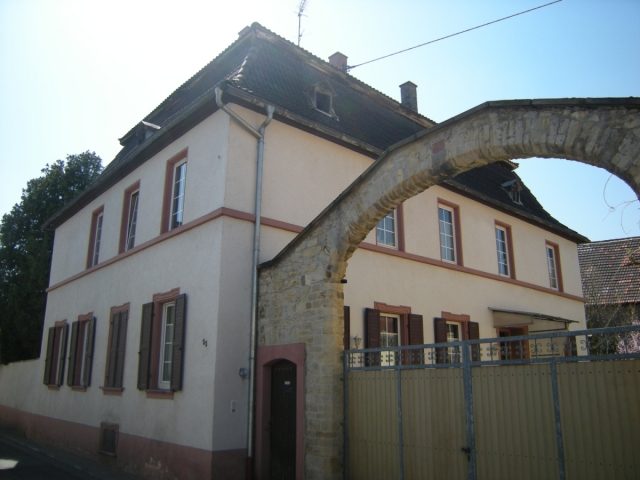
Polyscher Manor
The history of the Polysche Hof dates back to 1733. A foreclosure record from that year mentions an oil miller named Heinrich Stock, who had to auction off his property due to financial difficulties. However, since no one bid for the estate, it took until September 1739 for Friedrich Wilhelm Carl von Poly to acquire the Polysche Hof in the Nordhöfer quarter through an exchange with his house in the former Guntersblumer Alsheimergasse (today Bleichstraße 16). This granted the Polysche Hof a free noble status. After Friedrich Wilhelm Carl von Poly died of smallpox a few decades later, his son Friedrich Ludwig von Poly, his daughter Carolina Henrietta Eleonora, and his wife Charlotta Sophia von Poly had the property demolished and rebuilt. The reasons for this were its poor condition and the widow Friedrich Wilhelm Carl von Poly's wish not to live in a house where her husband had died.
After Charlotta Sophia von Poly died in November 1782, ownership of the property passed to her son Friedrich Ludwig von Poly, who was by then a captain. When Friedrich Ludwig von Poly had the free noble dwelling and fields appraised by the Guntersblum court in June 1785, the Polysche Hof was valued at 26,660 guilders. Shortly thereafter, he leased some fields for 12 years. In April and May 1793, when the officers of the Guard and the orderly hussars resided in the Polysche Hof at the Royal Prussian Headquarters, they caused such damage in the stable behind the residential building that the torn horse troughs had to be extensively repaired. After the French Revolution began at the end of the 18th century, the manor was sold to the noble family of Leiningen by June 1794 at the latest. When further damage was discovered shortly thereafter, the community apologized to the owner of the Polysche Hof, Count Wilhelm Carl von Leiningen-Guntersblum, for its failure to protect the noble buildings during the passage of the imperial hussars.
Due to this fact, they eventually also covered the costs for the remaining repair work on the Polysche Hof. When parts of Germany were annexed by the Peace of Campo Formio in 1797, Wilhelm Carl von Leiningen-Guntersblum (1737–1809) was informed that all properties of absentees, regardless of their condition, should be placed under sequestration. Since Wilhelm Carl von Leiningen-Guntersblum was absent, he sent his wife Eleonora von Leiningen (1770–1832) to the sequester in January 1798, who just in time prevented the sealing of the properties. In 1800, she finally owned the Pohlisch estate. In 1817, it consisted of a two-story residential building, an oil mill, a stable, a barn, a cattle shed, and a pigsty.
After Eleonora von Leiningen died on December 23, 1832, her property passed to her daughter Maria Anna Karoline Amalie von Leiningen (1792–1831). However, she lived with her husband, Baron Maximilian von Berlichingen († 1847), in Mannheim and therefore sold the property a short time later to the oil miller Peter Grasmann. In 1842, he had the residential building on the Polysche Hof rebuilt, adding an additional floor. As oil milling on the Polysche Hof gradually declined in the following period, the property was largely converted into residential space.
Location+
At its inception, the Polysche Hof was located in the so-called Nordhöfer quarter, a district of Guntersblum somewhat outside the town center. Nevertheless, numerous important buildings of Guntersblum are still in close proximity today, such as the Guntersblum Protestant church and the market square. The Julianenbrunnen and the Guntersblumer Kellerweg are also only a few hundred meters to the west today.
Layout+
The current layout of the Polysche Hof consists of a residential building, an annex, some stables, and other small rooms and a courtyard. In direct proximity to the Polysche Hof, there are also exclusively residential buildings today. Furthermore, the Polysche Hof is located on a side street, which was later even named Ölmühlstraße (Oil Mill Street) after the last commercial use of the Polysche Hof. Today, the Polysche Hof can be reached via Julianenstraße, which connects Ölmühlstraße with the main street.
Current Use+
After the use of the property for operating an oil mill ended, the plot was increasingly converted into residential space. In the 1920s, part of the property was converted into a cinema, which, however, closed again in the post-war period. In 2003, a descendant of Grasmann still owned the property with the current address Ölmühlstraße No. 9/11. In 2003, the cinema at Ölmühlstraße 9 was sold, renovated, and converted into an apartment.
Take Mobile History with you
You are reading this text for free. Premium adds what matters on the road: descriptions read aloud, sites found through your camera, whole regions taken offline.
- Every description, including the ~17,700 Premium sites
- Audio guide: have descriptions read to you on location
- AR finder: see sites through your camera, with distance and bearing
- Unlimited saved sites
14 days free, then from €2.99 a month. Cancel anytime.
Source: Wikipedia · Licence: CC BY-SA 4.0 · Image: http://schloesserrundschau.de/pfalz/schloesser/bingen17.html
This description draws on the facts documented in the linked Wikipedia article; Wikipedia content is licensed under CC BY-SA 4.0. Wording and editing: Mobile History.
Location: 49.7980, 8.3423