The remains of the ancient town can be visited
Ancient BuildingRoma
Porta Latina
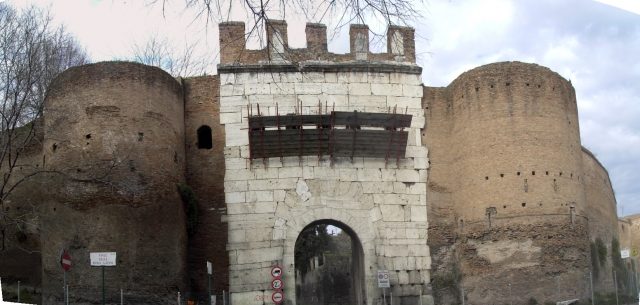
An ancient city gate in Rome, the Porta Latina, forms part of the Aurelian Walls. It once served as the starting point of the Via Latina and has a well-preserved travertine facade.
History+
The gate was constructed between 271 and 275 AD as part of the Aurelian Walls. Originally, it featured a simple arched passage with only one tower on the western side, clad in brickwork. Later, a second tower was added on the eastern side, the facade was covered with travertine, and a gun chamber with five windows was installed above the gate. However, these windows were sealed as early as the 6th century. The gate's width was reduced to 3.75 meters and its height to 5.65 meters, likely for fortification purposes. A portcullis and a relieving arch were also added. The exact dating of these alterations is debated but is often attributed to the time of Honorius, although a Constantinian monogram on the exterior suggests an earlier restructuring.
Source: Wikipedia · Licence: CC BY-SA 4.0 · Image: http://de.wikipedia.org/wiki/Datei:Celio_-_Porta_Latina_2030st.JPG
This description draws on the facts documented in the linked Wikipedia article; Wikipedia content is licensed under CC BY-SA 4.0. Wording and editing: Mobile History.
Location: 41.8765, 12.5024