CastleExeter

Powderham Castle

Powderham Castle

The Castle can be visited

Powderham Castle is situated 6 miles (9.7 km) south-east of Exeter in Devon on the western bank of the River Exe estuary, across which it faces the small river-side village of Lympstone. It is situated situated 14 mile (0.4 km) north-east of the village of Kenton, where the entrance gates to the main approach road are situated. Building commenced, after 1390, by Sir Philip Courtenay (d.1406), the 5th or 6th son of Hugh Courtenay, 2nd Earl of Devon (d.1377). Powderham Castle remains in the ownership of his descendants the Courtenay family and has been, since 1556, the seat of the Earls of Devon, which title was de jure from that date held by the family but was not recognised legally until 1831. The castle was altered extensively in the 18th and 19th centuries, most notably by James Wyatt in the 1790s.

Origin of the name+

The manor of Powderham is named from the ancient Dutch word polder, and means "the hamlet of the reclaimed marsh-land".

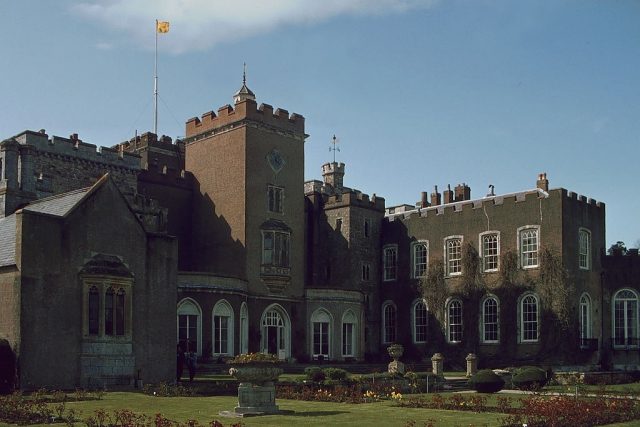
The original building on the site was a fortified manor house, the appellation "castle" was added probably no earlier than the 17th century. The building has never been a true castle, that is to say with a keep and moat, although it did possess a curtain wall and yard on the east side (now the rose garden) as shown in the 1745 engraving by Buck. Leland mentioned a barbican or bulwark in this area, but these were demolished as part of the 18th-century landscaping works designed to provide an uninterrupted view from the lower rooms towards the Exe Estuary. Many castle-like elements on the west front (main entrance) were added in the 19th century. The gatehouse was built between 1845-7 to a design by Charles Fowler. The tall rectangular structure beyond with a tower to the north is essentially the original fortified manor house. The projection from the lower storey to the north in lighter stone with two Gothic-style windows is the Victorian dining hall, designed by Fowler.

Wars of the Roses

During the Wars of the Roses the enemies of the Courtenay Earls of Devon of Tiverton Castle were the Bonville family of Shute. Their distant cousin at Powderham, Sir William Courtenay (d.1485) married Margaret Bonville, daughter of William Bonville, 1st Baron Bonville (1392–1461), which confirmed Powderham as a Bonville stronghold against the Earls of Devon. On 3 November 1455 Thomas de Courtenay, 5th Earl of Devon (1414–1458), at the head of a private army of 1,000 men, seized control of Exeter and its castle and laid siege to Powderham for two months. Lord Bonville attempted to raise the siege and approached from the east, crossing the River Exe; he was unsuccessful and was driven back by the earl's forces. On 15 December 1455 the Earl of Devon and Lord Bonville met decisively at the Battle of Clyst Heath, where Bonville was defeated and after which the earl sacked and pillaged Shute.

Civil War

During the Civil War Powerderham Castle was garrisoned by 300 Royalist soldiers under the command of Sir Hugh Meredith. In December 1645 a Parliamentarian detachment under the command of Sir Thomas Fairfax tried, without initial success, to capture it but it fell on 25 January 1646 to Col. Robert Hammond. The castle was badly damaged in the assault and remained, in places, open to the elements until the early 1700s when it was repaired by Sir William Courtenay, 2nd Baronet (d.1735).

Description of interior+

The house is centred around the 14th and 15th-century thickly-walled double-height rectangular building formerly comprising from north to south the withdrawing room, great hall, screens passage and kitchens, which are now represented in the same orientation by the ante-room, staircase hall, marble hall and Victorian kitchen.

Marble hall

The marble hall, named from its black and white marble floor, was completed in 1755 and forms the lower and southern part of the former mediaeval great hall, which was divided by an internal wall in the early 18th century into staircase hall and marble hall. Originally it was double height, as high as the staircase hall to the north, before the ceiling was added in the 18th century to form bedrooms above. At the same time the staircase was inserted into the upper part to form the staircase hall.

The screens passage was located in this end of the hall. The timber screen which formed the north side of the screens passage was demolished at the time of the partition, but three mediaeval Gothic-arched doorways through the south stone wall of the screens passage into the kitchen remain. A single more flatly arched doorway remains high up on the south wall, which formed the entrance to the wooden minstrels' gallery overhunging the great hall.

The marble hall is used as a sitting room which has an 18th century fireplace. Contents of the room include a 14 feet (4.3 m) high longcase clock made about 1745 by William Stumbels of Totnes; a large 17th-century Brussels tapestry with rustic farm-yard scenery after Teniers above the fireplace; and a 1553 carved wooden over-mantel decorated with the Courtenay arms. Two portraits of the present Earl of Devon and his wife hang on the north wall above the wooden panelling.

Staircase Hall

The hall has an impressive mahogany staircase decorated with carved heraldic beasts and intricate plasterwork.

Music Room

The spectacular Music Room, designed by James Wyatt in 1788 for the flamboyant 3rd Viscount of Devon, has a splendid Axminster carpet.

Other

Upstairs the original solar has a collection of toys. The house has a mixture of medieval features and fine 18th century decoration. There is also a collection of paintings and family portraits by many notable artists.

Memorial chimneypiece in Dining Hall

William Courtenay, 11th Earl of Devon (d.1888) installed a heraldic chimneypiece in the Dining Hall in memory of his grandfather Reginald Courtenay (1741–1803), Bishop of Exeter from 1797 to 1803, and of his parents. The Dining Hall was built by his father William Courtenay, 10th Earl of Devon (d.1859) between 1847 and his death in 1859, and the 11th Earl completed the internal decorations in 1860, including the linen fold panelling containing several dozen ancestral heraldic shields. It is copied from the mediaeval chimneypiece in the Bishop's Palace, Exeter, installed c.1485 by Peter Courtenay (d.1492) Bishop of Exeter, a younger son of Sir Philip Courtenay (1404–1463) of Powderham. The armorials on the lowest row are from left to right:

  • Arms of Bishop Reginald Courtenay: See of Exeter impaling Courtenay (Grandfather of 11th Earl of Devon)
  • Arms of William Courtenay, 10th Earl of Devon (d.1859), impaling the arms of his wife Hariet Leslie: Quarterly 1st & 4th: Pepys, Baronets of Juniper Hill; 2nd & 3rd: Leslie, Earls of Rothes. (Parents of 11th Earl of Devon). The supporters are two of the Bohun swans, which bird was used by that family, from which came the wife of Hugh Courtenay, 2nd Earl of Devon (d.1377), heiress of Powderham, as a heraldic badge. In the spandrels are two dolphins, a badge of the Courtenays. These arms can be seen on a brass plate on their monument in Powderham Church, itself a copy of the 15th-century Courtenay monument in Colyton Church, Devon.
  • Arms of 11th Earl of Devon impaling arms of his wife Elizabeth Fortescue

Another copy of the Courtenay Exeter Bishop's Palace chimneypiece exists at in the 16th c. Kentwell Hall, Suffolk, in Italian grey marble showing the arms of the Clopton and Logan families.

Modern times+

Powderham Castle has been a Grade I listed building since 1952, and recognised as an internationally important structure. The staircase, hall, music room and master bedroom of the house were used as locations for the 1993 film The Remains of the Day. The house was also used as a setting for a recent film comedy, Churchill: The Hollywood Years.

The castle's licence to host wedding ceremonies was revoked with effect from 1 January 2009 after Hugh Courtenay, 18th Earl of Devon, refused a gay couple use of the building to hold their civil partnership ceremony because it did not fit with his religious beliefs. It is still used as a venue for wedding receptions. On 29 September 2009, the Earl auctioned 113 treasures from the castle, at Sotheby's in London, in order to cover debts accrued in running the 14th-century home. The sale of family silver, furniture, antiques and paintings made a total of £1,013,638.

Descent of the manor of Powderham+

Domesday Book

In the Domesday Book of 1086, the tenant-in-chief of Powderham (spelt Poloreha) is recorded as William II, Count of Eu (d.1096), listed under the heading: Terra Willelmi de Ow ("Lands of William of Eu").

Bohun

The manor of Powderham became a subsidiary manor of the Bohun family, Earls of Hereford, which was given by Humphrey de Bohun, 4th Earl of Hereford (1298–1322) as the marriage portion of his daughter Margaret de Bohun (d.1391) on her marriage to Hugh Courtenay, 2nd Earl of Devon (1303–1377), feudal baron of Okehampton. Margaret bequeathed Powderham in her will to her fifth or sixth son Sir Philip Courtenay (1340–1406), who thus became the founder of the Powderham branch of the Courtenay family.

Courtenay of Powderham

The family of Courtenay "of Powderham", always known thus to distinguish it from its senior line the family of the Earls of Devon, was one of the most influential and best connected in Devon from the 15th c. onwards. The family was descended from Sir Philip Courtenay (1340–1406), a younger son of Hugh Courtenay, 2nd Earl of Devon (1303–1377) but eventually itself in 1831 was officially recognised as having become in 1556 holder of the earldom inherited from its distant cousin.

  • Sir Philip Courtenay (1340–1406), 5th or 6th son of Hugh Courtenay, 2nd Earl of Devon (1303–1377) by his wife Margaret de Bohun (d.1391), daughter and heiress of Humphrey de Bohun (d.1322), Earl of Hereford by his wife Elizabeth Plantagenet, a daughter of King Edward I. He married Anne Wake, daughter of Sir Thomas Wake of Blisworth, Northamptonshire.
  • Sir John Courtenay (1383–1419) (son). He married Joan (or Agnes) Champernoun.
  • Sir Philip Courtenay (1404–1463) (son). He married Elizabeth Hungerford, daughter of Walter Hungerford, 1st Baron Hungerford (d.1449) by Katherine Peverell. His younger son was Peter Courtenay (d.1492) Bishop of Exeter. His second son was Sir Philip Courtenay (b.1445), sometime MP and Sheriff of Devon in 1471, who was bequeathed by his mother the Devon manor of Molland, where his line of the family continued until 1732.
  • Sir William Courtenay (d.1485) (son). He married Margaret Bonville, daughter of William Bonville, 1st Baron Bonville (d.1461)
  • Sir William Courtenay (1451–1512) (son). He married Cecily Cheyne, daughter of Sir John Cheyne of Pinhoe.
  • Sir William Courtenay (1477–1535) (son). MP for Devon 1529, Sheriff of Devon 1522, 1525-6, 1533-4; Esquire of the Body to King Henry VIII, whom he accompanied to the Field of the Cloth of Gold. He married twice, firstly to Margaret Edgecombe, daughter of Sir Richard Edgecombe MP of Cotehele, Cornwall, widow of William St. Maure; secondly to Mary Gainsford, daughter of Sir John Gainsford of Crowhurst, Surrey.
  • Sir William Courtenay (1527–1557), de jure 2nd Earl of Devon, (grandson). He was the son of George Courtenay (d.1533) (who predeceased his own father) by his wife Catherine St Ledger, daughter of Sir George St Ledger. He married Elizabeth Paulet, daughter of daughter of John Paulet, 2nd Marquess of Winchester. A retrospective decision of the House of Lords in 1831 determined that he had succeeded his sixth cousin once removed Edward Courtenay, 1st Earl of Devon as de jure 2nd Earl of Devon in 1556. He died at the storming of Saint Quintin in France in 1557.
  • Sir William Courtenay (1553–1630), de jure 3rd Earl of Devon (son).
  • Francis Courtenay (1576–1638), de jure 4th Earl of Devon (son)
  • Sir William Courtenay, 1st Baronet (1628–1702) de jure 5th Earl of Devon (son)
  • Sir William Courtenay, 2nd Baronet (1675–1735) de jure 6th Earl of Devon (grandson). He was the son of Col. Francis Courtenay (d.1699), MP for Devon 1689-99, who predeceased his own father (the 1st Baronet), by his wife Mary Boevey, daughter of William Boevey (d.1661), of Netherlandish Huguenot descent, of Flaxley Abbey, Gloucestershire. Mary's brother was John Boevey (d.1706) who refers to himself in his will dated 6 March 1703 as "John Boevey of Powderham Castle". He directed his body to be buried in the north aisle of Powderham Church "near the monument there erected". He further derired "my executor (who was his nephew William Courtenay (d.1735) of Powderham)...to bestow and lay out the summe of fifty pounds in erecting a monument near the place of interrment in such manner as my executor shall think fit". No such monument survives. He left £10 each to his nieces Elizabeth, Mary, Lucy and Isabella Courtenay for mourning clothes. He also bequeathed them each the sum of £30 to buy a diamond ring each to be worn in his memory. He bequeathed to Sir William Courtenay his nephew the sum of £100 and also made him his residuary beneficiary.
  • William Courtenay, 1st Viscount Courtenay (1710–1762) (son), de jure 7th Earl of Devon
  • William Courtenay, 2nd Viscount Courtenay (1742–1788) (son) de jure 8th Earl of Devon
  • William Courtenay, 9th Earl of Devon & 3rd Viscount Courtenay (1768–1835) (son) In 1831 he successfully established his right to the Earldom of Devon created in 1553, thus retrospectively making his ancestors Earls of Devon de jure. He died unmarried, when the viscountcy became extinct, but not the earldom or baronetcy. Henceforth the descent of Powderham follows that of the Earldom of Devon.
  • William Courtenay, 10th Earl of Devon (1777–1859) (second cousin)
  • William Reginald Courtenay, 11th Earl of Devon (1807–1888) (son)
  • Edward Baldwin Courtenay, 12th Earl of Devon (1836–1891) (son) Died unmarried
  • Henry Hugh Courtenay, 13th Earl of Devon (1811–1904) ( uncle) Rector of Powderham. Married Anna Maria Leslie, daughter of Henrietta Countess of Rothes.
  • Charles Pepys Courtenay, 14th Earl of Devon (1870–1927) (grandson) Son of Henry Reginald, Lord Courtenay (d.1898), a barrister and JP, Poor Law inspector for the Western District, who predeceased his own father, by his wife Lady Evelyn Pepys, daughter of Charles Christopher Pepys, 1st Earl of Cottenham (1781–1851). Died unmarried.
  • Henry Hugh Courtenay, 15th Earl of Devon (1872–1935) (brother) Rector of Powderham. Died unmarried.
  • Frederick Leslie Courtenay, 16th Earl of Devon (1875–1935) (brother) Rector and Mayor of Honiton. Married Marguerite Silva, daughter of John Silva of Itchen Abbas, Hampshire.
  • Charles Christopher Courtenay, 17th Earl of Devon (1916–1998) (son)
  • Hugh Rupert Courtenay, 18th Earl of Devon (b. 1942) (son)
  • The heir apparent is the 18th Earl's son Charles Courtenay, Lord Courtenay (b. 1975). Lord Courtenay has both a daughter, The Honourable Joscelyn Skye Courtenay (b. 2007), and a son, The Honourable Jack Haydon Langer Courtenay, (b. 2009) (who is thus second in line to the Earldom of Devon) by his wife, the American actress, Alison Joy Langer. Lord Courtenay is a practicing attorney in Los Angeles, California, USA.

Take Mobile History with you

You are reading this text for free. Premium adds what matters on the road: descriptions read aloud, sites found through your camera, whole regions taken offline.

  • Every description, including the ~17,700 Premium sites
  • Audio guide: have descriptions read to you on location
  • AR finder: see sites through your camera, with distance and bearing
  • Unlimited saved sites

14 days free, then from €2.99 a month. Cancel anytime.

Source: Wikipedia · Licence: CC BY-SA 4.0

This description draws on the facts documented in the linked Wikipedia article; Wikipedia content is licensed under CC BY-SA 4.0. Wording and editing: Mobile History.

Location: 50.6430, -3.4605