Parish church, rectory
MonasterySteingaden
Steingaden Abbey
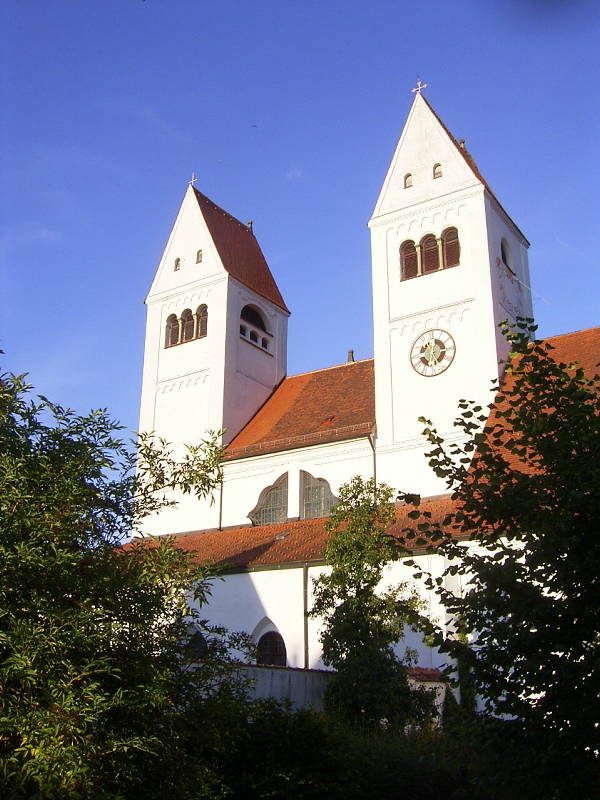
The former Premonstratensian Abbey of Steingaden, a historic monastery in Bavaria, is located in the Weilheim-Schongau district. It is renowned for its Romanesque architecture and is now protected as a historical monument.
History+
The monastery of Steingaden was founded in 1147 by Margrave Welf VI and dedicated to Saint John the Baptist. As a Premonstratensian canonry, it also served as a house monastery and burial place for the Welf family. The first canons and the first abbot came from the Abbey of Rot an der Rot. The Romanesque monastery church was consecrated in 1176. Between 1470 and 1491, the abbey underwent a late Gothic transformation under Abbot Caspar Suiter. In 1525, during the Peasants' War, the monastery was plundered and set on fire. Following destruction during the Thirty Years' War, reconstruction in the early Baroque style took place until 1663 under Abbot Augustin Bonenmayr. From 1740 to 1750, the nave was decorated in Rococo style. Another significant construction project was the erection of the Wieskirche from 1745 onwards under Abbot Marinus Mayer, which developed into an important pilgrimage church but placed a heavy financial burden on the monastery. Despite these difficulties and the Coalition Wars, which led to additional burdens, a new building for the monastery brewery was completed under Abbot Gilbert from 1787 to 1790. The monastery was dissolved in 1803 as part of the secularization. Most of the monastery buildings were demolished in 1819, with only the wing containing the Romanesque cloister remaining.
Location+
The former Steingaden monastery is situated in the municipality of Steingaden in the Weilheim-Schongau district of Bavaria, Germany. It lies at an elevation of approximately 765 meters above sea level.
On site+
The former monastery church of St. John the Baptist, also known as the Welfenmünster, now serves as the parish church of Steingaden. Of the former convent buildings, only the west wing remains, which today houses the rectory. In its ground floor are the last remnants of the Romanesque cloister with nine bays, which were vaulted in the late Gothic style. The cloister opens outwards into arcades framed by Baroque blind arches. The column capitals display various ornaments. A fountain chapel, dedicated to Saint Sylvester, projects from the wall line. The walls are adorned with late Gothic frescoes.
Nearby+
- Former monastery forge (approx. 76 m away)
- Former stable and workshops of the monastery (approx. 87 m away)
- Former monastery judge's house (approx. 109 m away)
- Former monastery mill (approx. 128 m away)
Take Mobile History with you
You are reading this text for free. Premium adds what matters on the road: descriptions read aloud, sites found through your camera, whole regions taken offline.
- Every description, including the ~17,700 Premium sites
- Audio guide: have descriptions read to you on location
- AR finder: see sites through your camera, with distance and bearing
- Unlimited saved sites
14 days free, then from €2.99 a month. Cancel anytime.
Source: Wikipedia · Licence: CC BY-SA 4.0 · Image: Joooo at German Wikipedia / CC BY-SA 3.0 via Wikimedia Commons
This description draws on the facts documented in the linked Wikipedia article; Wikipedia content is licensed under CC BY-SA 4.0. Wording and editing: Mobile History.
Location: 47.7011, 10.8625