Offices Bavarian Premier
ResidenceMunich (München)
Prinz-Carl-Palace
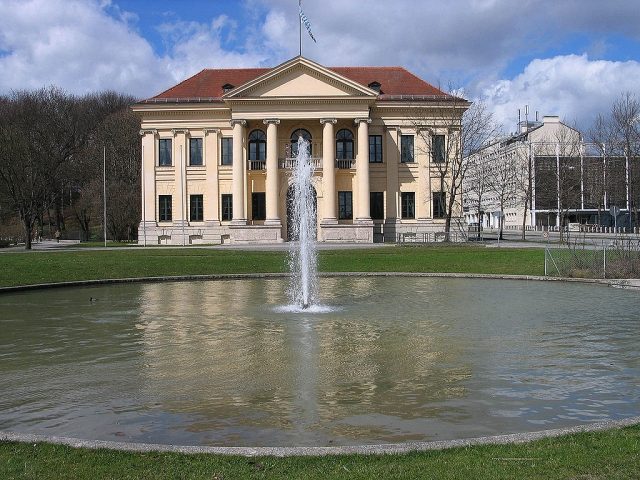
The Prinz-Carl-Palais in Munich is a residence marking the transition from the 18th to the 19th century. It is an example of early Classicism in the Bavarian capital and now serves as the official residence of the Bavarian Minister-President.
History+
The origins of the Palais date back to the early 19th century. In March 1803, architect Karl von Fischer was commissioned to plan the building after Abbé Pierre de Salabert, tutor to the later King Max I Joseph, had acquired land. The original design had to be reduced, and the foundation stone was laid on May 24, 1804. The Palais was occupied in August 1806. After Salabert's death in 1807, the building became the property of King Max I Joseph and was subsequently known as Palais Royal. King Ludwig I transferred it to his brother Prince Carl in 1825, who had it expanded by Jean Baptiste Métivier. The interiors were redesigned between 1827 and 1830 by Métivier and Anton Schwanthaler. After Prince Carl's death, the Palais served as the seat of the Austro-Hungarian Legation from 1876 to 1919 and was designated as the official residence of the Bavarian Minister-President in 1924.
Source: Wikipedia · Licence: CC BY-SA 4.0
This description draws on the facts documented in the linked Wikipedia article; Wikipedia content is licensed under CC BY-SA 4.0. Wording and editing: Mobile History.
Location: 48.1442, 11.5831