CastleDarmstadt-Bessungen

Prinz-Emil-Castle
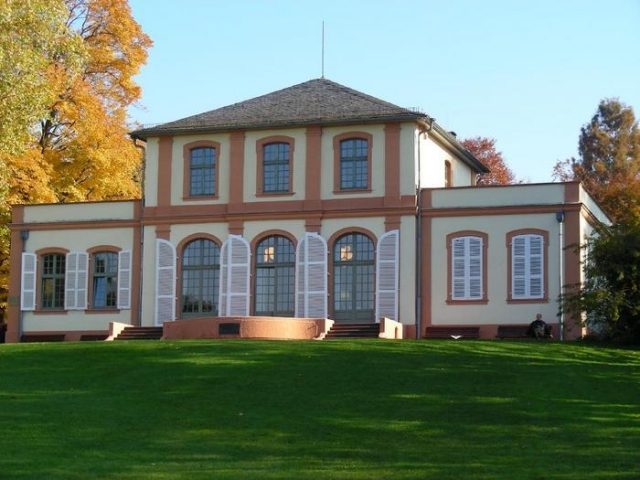
Prinz-Emil-Castle

Nursing home


The Prinz-Emil-Schlösschen (Prince Emil's Little Palace) is a small garden palace in Darmstadt-Bessungen. It was built from 1775 to 1778 on behalf of its first owner, Friedrich Karl von Moser, in a central location within a garden landscape already established in 1772 according to English models, now known as the Prinz-Emil-Garten. After World War II and the bombing of Darmstadt, it burned out but was renovated by 1950 and now serves as a community center, a meeting place for the residents of Bessungen.

The former palace-like garden house was built according to plans by Johann Martin Schuhknecht for the then First Minister and state reformer Friedrich Karl von Moser of the Hessian Landgrave Ludwig IX. of Hessen-Darmstadt, as part of a garden (1772) created by the Dieburg gardener Nikolaus Andreas Siebert in Bessungen. After Moser's downfall in 1779/1780, Hereditary Prince Ludwig X. bought the property in 1780. The park and palace were then named after their next owner, Prince Emil of Hesse and by Rhine, to whom both passed in 1830. Through further changes of ownership and over the centuries, the appearance of the little palace changed only slightly, but that of the park changed significantly. In 1927, the city of Darmstadt finally acquired the property from the Grand Duke. Burned down to a ruin in 1944, it is now, after its renovation, a meeting point and social hub of Bessungen.

Architecture+

The simple three-axis wing building predominantly features Neoclassical characteristics but cannot deny Rococo elements. The necessary renovation after World War II largely altered the interior. The elevated main house with a pyramid roof presents its two-story, three-window main facade towards the pond to the west, flanked by two lower, equally long side wings, topped by balconies as roofs.

The adjoining wings are of more recent date. The northern transverse building is a narrow, single-story wing crowned with a hip roof, to which an eastern side bar, also with a hip roof, adjoins, slightly offset to the south-southeast opposite the main house, thus forming a U-shaped, three-sided courtyard-like complex opening to the south.

The Prinz-Emil-Garten+

The park, conceived and created from 1772 by the Dieburg gardener Nikolaus Andreas Siebert (formerly called Moser's Garden), originally combined elements of French and English garden art. Around the turn of the 20th century, the garden presented itself as a 19th-century landscape garden with features of a bourgeois garden. Statues, temples, a chapel (once serving as a kitchen), a farmhouse built in Russian style, the Chinese pavilion on the pond island, grottoes, and an artificial Gothic ruin have now disappeared. A water-filled ditch ("Aha"), which originally visually enclosed the park on the west side and allowed an unobstructed and undeveloped view of the Rhine plain at the time, also disappeared at the beginning of the 20th century. After the war, significant interventions occurred due to peripheral developments, the pond was filled in after 1945, only the old trees and gently sloping green areas remained, which are used in winter as popular sledding slopes by Bessungen children.

The park now again features a pond in its center (one of originally two), restored between 1987 and 1989, with a small waterfall. In the middle of the park, east of the pond, the Prinz-Emil-Palais presents itself on a small hill.

Current Use+

The building was destroyed by bombs in 1944. The city of Darmstadt rebuilt it with the help of the American Quakers and the American Friends Service Committee (AFSC) and handed it over to the Nachbarschaftsheim association, which established socio-cultural district work in the little palace and its annexes. The park now includes children's playgrounds and sports fields, a mini-golf course, and a retirement home. The building is a listed monument.

Take Mobile History with you

You are reading this text for free. Premium adds what matters on the road: descriptions read aloud, sites found through your camera, whole regions taken offline.

  • Every description, including the ~17,700 Premium sites
  • Audio guide: have descriptions read to you on location
  • AR finder: see sites through your camera, with distance and bearing
  • Unlimited saved sites

14 days free, then from €2.99 a month. Cancel anytime.

Source: Wikipedia · Licence: CC BY-SA 4.0 · Image: http://www.wehrbauten.de/thread.php?threadid=969

This description draws on the facts documented in the linked Wikipedia article; Wikipedia content is licensed under CC BY-SA 4.0. Wording and editing: Mobile History.

Location: 49.8603, 8.6500