Restaurant
ResidenceBerlin-Mitte
Princess palace
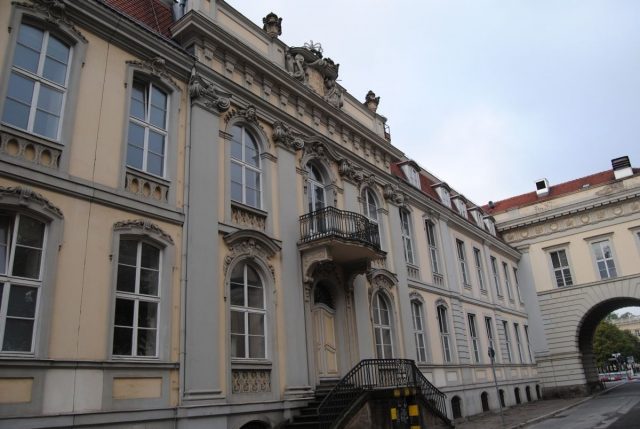
The Princesses' Palace (Prinzessinnenpalais) at Boulevard Unter den Linden 5 in Berlin's Mitte district was a palace of the House of Hohenzollern.
In 1733, Friedrich Wilhelm Diterichs connected two buildings constructed in 1730 on the Berlin fortress moat by inserting a central risalit, creating a new palace situated transversely to Unter den Linden street. Margrave Heinrich Friedrich von Brandenburg-Schwedt acquired the building in 1755. In 1788, the royal house inherited it. In 1811, it was extended to Unter den Linden street with a representative front building according to plans by Heinrich Gentz and connected to the Crown Prince's Palace by Karl Friedrich Schinkel using an archway. Since this renovation for the daughters of King Friedrich Wilhelm III, the name Princesses' Palace has been in use.
Until 1918, various members of the Prussian ruling family, such as the widow of Emperor Friedrich III, as well as officials, lived in the palace. From 1931, the Schinkel Museum was established in its rooms. After being almost completely destroyed in World War II, the palace was reconstructed as the Operncafé between 1960 and 1962 by Richard Paulick as part of the overall restoration of the Friedrichsforum. The interior was modernly restored and, after reunification, was remodeled again in a historicizing style. The Rococo stair railing from Berlin-Buch Palace, installed at that time, is historically valuable. This palace, a work by Dieterichs from 1736, was demolished in 1964.
Source: Wikipedia · Licence: CC BY-SA 4.0 · Image: http://schloesserrundschau.de/berlin/berlin04.html
This description draws on the facts documented in the linked Wikipedia article; Wikipedia content is licensed under CC BY-SA 4.0. Wording and editing: Mobile History.
Location: 52.5169, 13.3961