MonasteryZella

Zella Castle

Zella Castle

Museum
Administration department

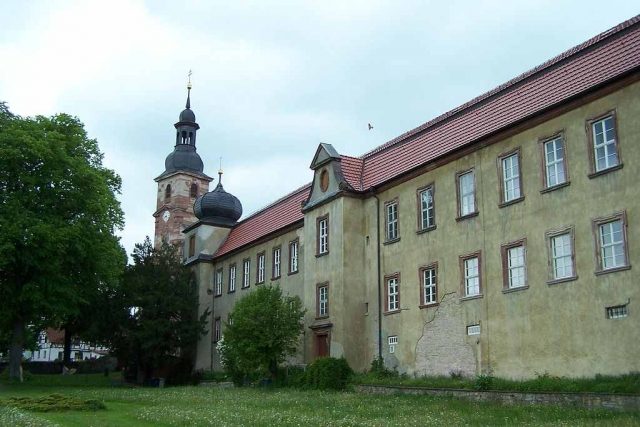
The Zella Provostry is a castle with a Baroque church, originating from a Benedictine convent, located on the eastern edge of the municipality of Zella/Rhön in the Wartburg district in the Thuringian Rhön. This place was initially the official seat of a Fulda provostry, later crown property and domain.

The Zella Provostry is situated in an exposed location on an elongated hill, immediately to the west of which lies the historic village center of Zella. The castle courtyard is at 425 m above sea level – thus still about 50 m above the nearby valley floor of the Felda. Within a radius of only 1,000 m, the villages of Neidhartshausen to the northeast, Empfertshausen to the south, and Brunnhartshausen to the west border the provostry.

The Benedictine convent of Zella was founded in 1136 by Count Erpho of Neidhartshausen. Foundation walls of the original convent building could be identified on the east facade of the present castle. The Thuringian Rhön had belonged to the possessions of the Fulda Abbey for centuries. When it became a princely abbey in 1284, Zella Monastery became an official seat under the leadership of a provost.

During the turmoil of the Peasants' War, the monastery remained intact, but in the 16th century, it was dissolved by the Counts of Henneberg. However, the provostry and the associated settlement remained in Fulda possession. The small community of Zella, along with some farms in the surrounding area, thus formed a Catholic enclave in the Kaltennordheim district.

After the Thirty Years' War, Zella became the starting point for a Counter-Reformation for the neighboring towns of the Thuringian Rhön. However, this failed due to the power relations and the lack of interest from imperial politicians. The test of strength – the so-called Dermbach War – ended with a compromise. At least through architectural evidence, this episode of regional history is still present. In the eleven parishes of the neighboring Fulda district of Geisa, five new churches were built in the 18th century. Provost Adolph von Dalberg had the current Church of St. Mariä Himmelfahrt built at the same time – between 1715 and 1732 – as a masterpiece of Baroque architecture. It impresses above all with its swinging facade with a projecting central risalit, which continues into the tower, saint sculptures, and portal coat of arms. In 1718, the neighboring, already heavily devastated monastery building was converted into the current provostry, a two-story Baroque building.

The main wing has 15 window axes on the east side and two projecting towers with distinctive onion-shaped ogee domes on the sides. On the courtyard side with 13 window axes, the main portal is in the middle with the large coat of arms of the Fulda Prince-Abbot Konstantin von Buttlar (1714–1726). Below it, on the keystone, is the coat of arms of Provost Adolph von Dalberg with the inscription: A*C*V*W*F *V*D*P*Z*Z* 1718 (Adolph, Chamberlain of Worms, Baron of Dalberg, Provost of Zella 1718). In 1726, Dalberg himself was elected Prince-Abbot of Fulda.

With the secularization of the Principality of Fulda, the provostry became a secular domain. The provostry building was now inhabited by domain tenants and the parish priest. The last Fulda provost living in Zella was Alexander Zobel von und zu Giebelstadt. He retired to Fulda and died there around 1830. From 1803 onwards, the House of Orange received the estates of Zella as compensation. In 1806, Napoleon took possession of them and ceded them to Prince-Primate Karl Theodor von Dalberg. In 1815, Prussia received the Principality of Fulda and, in the autumn of the same year, ceded the districts of Dermbach and Geisa to the Grand Duke of Saxe-Weimar. In the 20th century, the provostry was repurposed several times, with the outbuildings in particular being run down.

In the provostry, which has been renovated since 2001, a permanent exhibition on the Rhön Biosphere Reserve was opened in 2002; since 2009, the Thuringian administration of the Biosphere Reserve has been located here.

Usage+

The castle currently houses the rooms of the Tourist Information and also the information center of the Rhön Biosphere Reserve. This is combined with the function of a local history museum with a castle model and other exhibits on local history.

Most of the provostry has already been renovated and now serves as the seat of the Thuringian administrative office of the Rhön Biosphere Reserve.

The tasks and goals of the administrative office are as follows:

  • Regional development
  • Nature conservation and landscape management
  • Public relations and research
  • Landscape planning / interventions
  • Geographic Information System (GIS) / research

Take Mobile History with you

You are reading this text for free. Premium adds what matters on the road: descriptions read aloud, sites found through your camera, whole regions taken offline.

  • Every description, including the ~17,700 Premium sites
  • Audio guide: have descriptions read to you on location
  • AR finder: see sites through your camera, with distance and bearing
  • Unlimited saved sites

14 days free, then from €2.99 a month. Cancel anytime.

Source: Wikipedia · Licence: CC BY-SA 4.0 · Image: http://commons.wikimedia.org/wiki/File:WAK_ZELLA_PROBSTEI03.jpg

This description draws on the facts documented in the linked Wikipedia article; Wikipedia content is licensed under CC BY-SA 4.0. Wording and editing: Mobile History.

Location: 50.6736, 10.1102