CathedralRatzeburg

Ratzeburg Cathedral

Ratzeburg Cathedral

The church can be visited

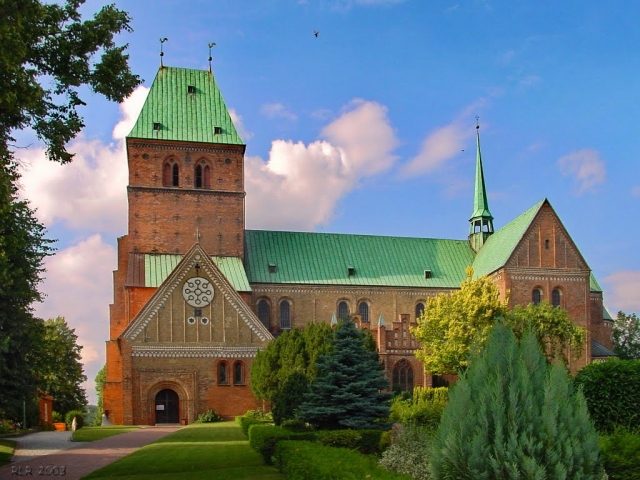
Ratzeburg Cathedral is an outstanding example of Romanesque brick architecture in Northern Germany.

The church, built from 1160 under Bishop Evermod, is located on the highest point of the northern tip of Ratzeburg's old town island. It houses the remains of St. Ansverus, who was killed in the Wendish Uprising in 1066. The cathedral was founded by Henry the Lion as the bishop's church of the Diocese of Ratzeburg. It is therefore one of the four so-called Lion Cathedrals, which also include Schwerin Cathedral, Lübeck Cathedral, and Braunschweig Cathedral. A replica of the Braunschweig Lion stands in the cathedral courtyard.

The foundation stone was laid on August 11, 1154; construction of the choir began after 1160. The church building was completed around 1220 with the south porch. In the second half of the 13th century, the cloister and chapter house of the Premonstratensian canons were added, and in 1380, the so-called "Lauenburg Chapel."

After the death of Bishop Georg von Blumenthal in 1550, Duke Franz I of Saxe-Lauenburg tried in vain to have his nine-year-old son Magnus elected bishop, but Christoph von der Schulenburg was elected instead. Thereupon, the Duke called the mercenary leader Vollrad von Mansfeld with his troops into the country, who plundered the cathedral on May 23, 1552. Mansfeld stayed for two months; for a payment of 4,000 thalers, he did not burn down the cathedral.

In 1554, Bishop Christoph von der Schulenburg, who had converted to Protestantism, sold the diocese for 10,000 thalers to Duke Christoph of Mecklenburg. In 1566, Georg Usler was appointed the first Protestant preacher at the cathedral. After his death, the parish position at the cathedral was initially held by the superintendents of the Prince-Bishopric, including Konrad Schlüsselburg, Nicolaus Peträus, and Hector Mithobius.

Since the secularization of the diocese in the Peace of Westphalia (1648), the Prince-Bishopric and the cathedral courtyard territorially belonged to the Principality of Ratzeburg, which fell to Mecklenburg-Strelitz after 1701, while the city of Ratzeburg belonged to the Duchy of Saxe-Lauenburg. The manor house of the Dukes of Mecklenburg was built in direct proximity to the cathedral for the Mecklenburg Dukes. The cathedral courtyard only came to the then Prussian province of Schleswig-Holstein in 1937 due to a territorial exchange under the Greater Hamburg Act.

The cathedral and its congregation, which also includes Bäk, remained part of the Evangelical Lutheran Church of Mecklenburg, which, however, was hindered in its administration after the founding of the GDR and therefore, by church law in 1954, created the administrative district of Ratzeburg, which also included the parish of Ziethen, and transferred its administration to the Church of Schleswig-Holstein. After the formation of the North Elbian Church, a contract was concluded between the two churches on September 23, 1980, assigning the cathedral congregation and the Ziethen congregation to the North Elbian Church without changing their legal status.

After reunification, this assignment with its financial advantages remained; after years of discussion, the parish of Ziethen was fully separated from Mecklenburg in 1998 under church law and affiliated with the North Elbian Church; for the cathedral and its congregation, however, the status quo has remained to this day, which is seen as an expression of the connection and cooperation of both regional churches, which have found their common focal point in this cathedral.

At the unification of the three North German regional churches to form the Evangelical Lutheran Church in Northern Germany in 2012, the special status of the cathedral (without belonging to a church district) will remain in place for the time being; the introductory law to the constitution of the Evangelical Lutheran Church in Northern Germany states in § 8: "Ratzeburg Cathedral Parish. Until further church legal regulation, the practice will be continued in accordance with the existing legal relations." Due to the "bridge function" of the cathedral, the festive service for the founding of the North Church took place here on Pentecost Sunday, May 27, 2012. Federal President Joachim Gauck was also present.

Architecture+

The impressive building is a three-nave Romanesque basilica in a bound system with a transept, a Gothic cloister of the affiliated Premonstratensian monastery (1251) on the north side, and a massive west tower. The westwork of the cathedral is completed by two transept-like extensions attached to the tower on both sides; originally, a double tower system was planned. On the south side, a lower porch, the South Porch from 1220, is also attached here, which has a magnificent facade with an ornate gable. The tile decoration inside this porch is also noteworthy.

A high roof turret rises above the crossing of the building.

Some elements of the original Romanesque building were adapted during the Gothic period, so that pointed arches sometimes appear in the windows (e.g., on the tower shaft). The vault of the nave was also redesigned in Gothic style, while the arcades to the side aisles retained the Romanesque round arch.

In 1693, the cathedral was only damaged during the bombardment of the city of Ratzeburg by the Danish troops of King Christian V, while the city of Ratzeburg was reduced to rubble and ashes. From 1876 to 1881, a comprehensive restoration of the cathedral took place, during which the Gothic chapel extensions, except for the Lauenburg Chapel, were removed. On August 19, 1893, parts of the building were destroyed by fire. During the last major restorations (1953-1966), the original state was restored. Today, the medieval cathedral is one of the oldest church buildings in Schleswig-Holstein. The entire complex with the cathedral, cloister, and monastery buildings is one of the most completely preserved ensembles of the late Romanesque period in Europe.

Furnishings+

The cathedral has rich interior furnishings. Among other things, it houses the oldest choir stalls in Northern Germany. Also, the high altar by Gebhard Jürgen Titge (1629, now in the south transept) in early Baroque cartilage style, as well as the ducal epitaph of August von Saxe-Lauenburg and his wife Countess Catharina zu Oldenburg and Delmenhorst, also created by Titge in the same style in 1649, the carved winged altar from the late Gothic period with wings from the Lübeck workshop of Hermen Rode (~1490), the backs of the panels painted by Hinrich van Kroghe (1483), the magnificent Renaissance pulpit from 1576, and a triumphal cross group from the 13th century are just a few examples.

In the Lauenburg Chapel on the south aisle is the tomb of Duke Johann of Saxe-Lauenburg and his wife, along with the ducal church pews. The inaccessible hereditary burial place of the Lauenburg Dukes is located below the crossing. The remains of Saint Ansverus are also buried in Ratzeburg Cathedral.

In the inner courtyard of the cloister, a replica of Ernst Barlach's sculpture of the Beggar, one of the sculptures from the frieze of saints on the westwork of Lübeck's St. Catherine's Church, has been located since 1978.

Organs

The history of the organs in Ratzeburg Cathedral can be traced back to 1230; the cathedral then had one of the first instruments in Northern Germany. In 1563, organ builder Jacob Scherer built a new instrument; in 1619, organ builder Albrecht Lewin erected a swallow's nest organ, which had a total of 38 stops.

After the renovation of the cathedral at the end of the 19th century, master organ builder Friedrich Albert Mehmel (Stralsund) built a large cathedral organ on the west gallery. The instrument had 41 stops on three manuals and pedal. In 1902, this instrument was rebuilt by organ builder Barnim Grüneberg (Stettin); this in turn was rebuilt again in 1954 by the organ building company Kemper und Sohn (Lübeck). Already in 1966, the organ building company Kemper built a new instrument for the cathedral, which had been restored in the meantime.

Today, the cathedral has three organs, all of which are of more recent date.

Great Cathedral Organ

The great organ in front of the west wall of the cathedral was built in 1978 by the organ building company Rieger (Vorarlberg) with 60 stops on four manuals and pedal. In 1994, a carillon was added to the swell division. The key and stop actions are mechanical.

Choir Organ

The choir organ was built in 1972 by the organ building company Rieger (Vorarlberg, Austria) and placed on the southern edge of the choir area. The instrument was expanded in 1977 and 1997. It now has 13 stops (with some quite amusing stop names) on two manuals and pedal.

Paradise Organ

The small organ in the cathedral's vestibule, the "Paradise," was built in 1985 by organ builder Michael Becker. The slider chest instrument has 10 stops on two manuals and pedal.

Among the notable organists of the cathedral was Church Music Director Neithard Bethke. His successor since 2007 and current church musician at the cathedral is Christian Skobowsky, who previously worked at Freiberg Cathedral.

Bells

During the cathedral fire in 1893, the four historic bells of the cathedral were destroyed. They had all been cast in Lübeck, namely in 1678 by Albert Benningk, in 1727 by Lorenz Strahlborn, and in 1752 by Johann Hinrich Armowitz. The subsequently newly cast bells were confiscated for armament purposes in World War I in 1917. In 1927, the cathedral received iron bells as a replacement, which were replaced in 2001 by a six-part peal of bronze bells from the Rincker Bell and Art Foundry.

Take Mobile History with you

You are reading this text for free. Premium adds what matters on the road: descriptions read aloud, sites found through your camera, whole regions taken offline.

  • Every description, including the ~17,700 Premium sites
  • Audio guide: have descriptions read to you on location
  • AR finder: see sites through your camera, with distance and bearing
  • Unlimited saved sites

14 days free, then from €2.99 a month. Cancel anytime.

Source: Wikipedia · Licence: CC BY-SA 4.0 · Image: Rainer Gindele

This description draws on the facts documented in the linked Wikipedia article; Wikipedia content is licensed under CC BY-SA 4.0. Wording and editing: Mobile History.

Location: 53.7042, 10.7750