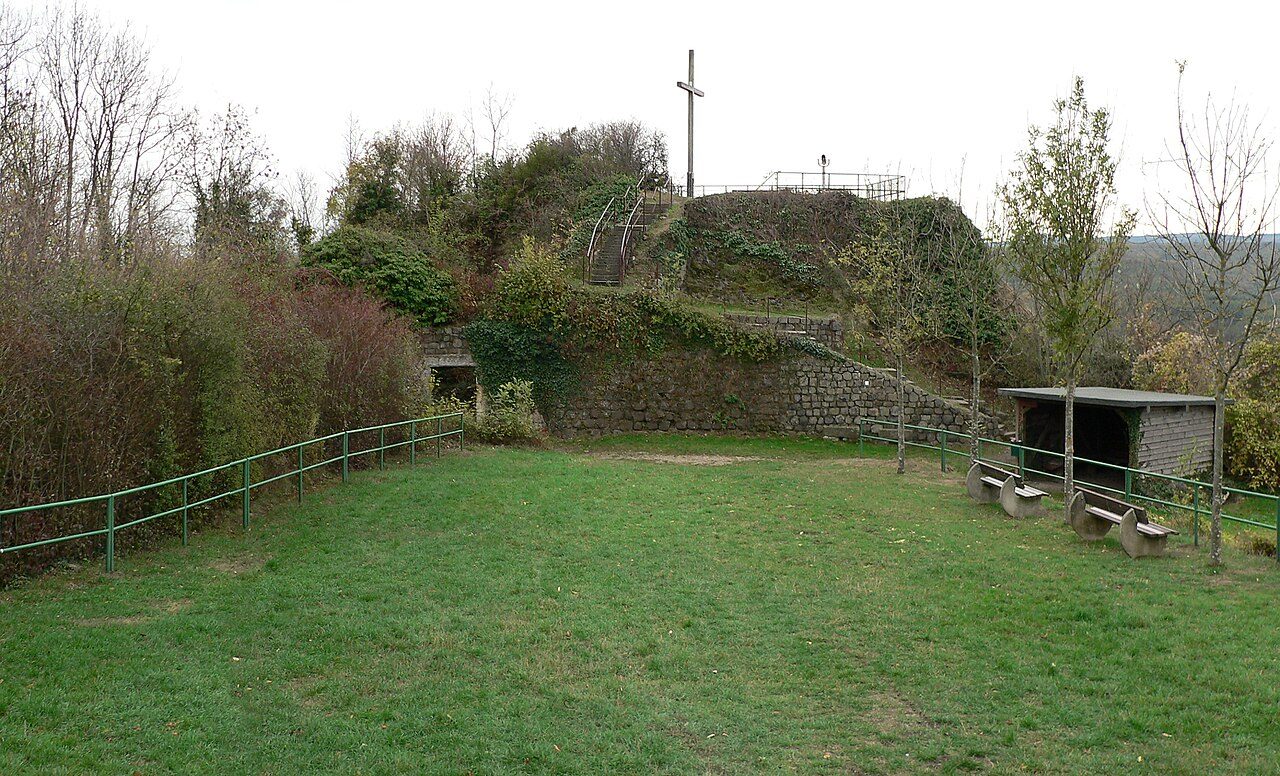
The remains of the Castle can be visited
Landskron Castle

Landskron Castle, also known as Landskrone Ruin, is the ruin of a high medieval hilltop castle near the town of Bad Neuenahr-Ahrweiler in the district of Ahrweiler in Rhineland-Palatinate (Germany). The hilltop castle was the ancestral seat of the Burgraves of Are and played a significant role in the conflicts between the Staufer and Welfen dynasties.
The ruin stands on the widely visible basalt cone Landskrone (271.7 m above sea level), which rises in the lower Ahr valley east of Bad Neuenahr between Gimmigen in the north-northwest, Heppingen in the west, Heimersheim in the south, and Lohrsdorf in the east. The mountain was formerly called "mons Gimiche (Gimmiger Berg)" and is now named "Landskrone" after the former castle.
The Roman Watchtower
After serving as a Germanic Thingstead, the dominant basalt cone was used by the Romans as a watchtower and military base. Due to its proximity to the Rigomagnus fort, it was permanently connected to it. After the fall of the Limes around 300 AD, Landskron was part of a chain of hilltop fortifications to protect the Roman hinterland. Numerous Roman finds were made in 1910 during the construction of a new guesthouse on the ruins of Landskron. This led to excavations and archaeological investigations of the entire lower castle by the State Museum of the Rhine Province in Bonn. The extensive collection of the restaurateur and local historian, Heinrich Josef Möhren, was unfortunately lost due to the destruction of the guesthouse in World War II and a subsequent house fire.
The Medieval Castle
The medieval history of the Imperial Castle Landskron is described in detail by the historian Valentin Ferdinand Gudenus, who had the Landskron archive fully printed in the second volume of his Codex diplomaticus (pp. 929-1368) in 1747.
The Imperial Castle Landiscrone was built in connection with the conflict between the Welfen around Otto IV and the Staufer around Philip of Swabia for dominion in the German Empire. Both were crowned German kings in 1198 after the death of Barbarossa's son Henry VI. On June 21, 1208, Philip was stabbed to death in Bamberg by the Bavarian Count Palatine Otto VIII of Wittelsbach out of personal revenge. In 1206, construction of the Imperial Castle Landskron began on behalf of King Philip of Swabia to secure the most important and busiest road at the time, the Frankfurt-Aachen coronation road. Before the construction of the hilltop castle, the mountain cone had to be flattened. The castle also served as a fortification for the then imperial territory around Sinzig, Remagen, Heimersheim. King Philip of Swabia appointed the Trier ministerialis Gerhard ("Gerischwin") of Sinzig as the first castle administrator; in 1207, Gerhard was first mentioned in the retinue of King Philip. After his assassination, Otto IV, who had taken over the kingship, again entrusted the continuation of construction to Burgrave Gerhard at Christmas 1208. Otto's successor, the Staufer Frederick II, kept Gerhard in his office after Otto's death.
Gerhard I of Sinzig became the progenitor of a burgravial line of Gerhards. Five times in a row from 1202 onwards, the sons of the male burgravial line received the same first name, whereby not the birth years, but only the dates of the respective documented first mentions and the death dates can be determined: Gerhard I 1202-1237, Gerhard II 1238-1273, Gerhard III 1276-1296, Gerhard IV 1298-1369 and Gerhard V 1333-1344. In these decades, the Gerhards were often involved in German imperial and imperial politics. For example, Gerhard IV, as a vassal, maintained feudal relations with four of the seven German electorates, namely with the Rhenish archbishops of Cologne, Mainz, and Trier, as well as with the Count Palatine of the Rhine.
Before 1252, the Count of Neuenahr pledged the village of Gimmigen to Gerhard Burgrave of Landskron. Later, Gimmigen with Kirchdaun appears as joint property of the County of Neuenahr and the Lordship of Landskron, Green near Lohrsdorf was bought by Gerhard of Landskron in 1333. By 1341 at the latest, Lohrsdorf belonged to the Imperial Knighthood of Landskron. Also belonging to the Lordship of Landskron were the villages of Nierendorf and Oedingen, as well as temporarily the Lordship of Königsfeld with Dedenbach and Schalkenbach and Vinxt and Heckenbach in the imperial forests south along the lower Ahr, and furthermore temporarily the Lordship of Oberwinter with Birgel and Bandorf. After the death of Gerhard IV in 1369, the male line of the Imperial Knights of Landskron ended. His son-in-law Friedrich von Tomburg and his wife Kunigunde now inherited the immediate imperial lordship; the widely branched female line subsequently became the heir of Landskron. We encounter the following owners: von Tomburg, von Sombreffe, from 1450 to 1622 the Quadt von Landskron, furthermore the von Eynenburg, von Plettenberg, von Harff, von Eltz-Pyrmont, Waldbott von Bassenheim, von der Leyen, von Forst-Lombeck, von Rheineck, von Manderscheid, von Brempt, von Nesselrode, in 1775 it was the Barons von Clodt. Around 1800, Baron vom Stein was co-owner of the castle, a descendant of the von Quadt. Due to the French foreign rule, he sold his share to Count Boos von Waldeck.
In 1441, the Lordship of Oberwinter was divided. One half went as a dowry to the Lords of Saffenburg, the other half to the Lords Quadt of Landskron. In 1478, Bodendorf, which had initially belonged to the imperial estate of Sinzig and had been an exclave of the Lordship of Saffenburg since 1246, came into the possession of the Lords of the Lordship of Landskron.
In 1659, there was an exchange of rights and territories: Phillip Wilhelm of Palatinate-Neuburg, as Duke of Jülich, with the permission of Emperor Leopold I (HRE) as supreme liege lord, carried out an exchange with the Trier Archbishop Karl Kaspar von der Leyen and the widow Maria Waldbott von Bassenheim zu Gudenau and her son Otto Werner. Jülich received the Waldbott's share of the imperial fief of Landskron and the villages of Vinxt and Schalkenbach with the meadows, forests, the Landskroner Hof with the noble seat in Sinzig, the Gudenau's share of the villages of Lohrsdorf, Lantershofen, and Heppingen. In return, Jülich gave the Archbishop and his peer Baron von der Leyen zu Adendorf his Dingstühle Adendorf and Eckendorf, and the widow Waldbott von Bassenheim and her son zu Gudenau his Dingstuhl Villip, previously in the Jülich office of Neuenahr. Adendorf with Arzdorf and Eckendorf thus became an immediate imperial lordship of the von der Leyen family zu Adendorf. Villip with the moated castle Burg Gudenau also became an immediate imperial lordship. However, Landskron Castle belonged only one-third to the Duke of Jülich, who garrisoned this part, which led to considerable disputes with Baron Johann von Bremt, the owner of the other two-thirds from the Einenberg share. Probably under the influence of Emperor Leopold I, the Duke of Jülich acknowledged the debt to Baron von Bremt. On February 16, 1669, he pledged the Einenberg, now Jülich, share of the house and lordship of Landskron to Baron Wilhelm von Bremt.
Landskron Castle with the Lordship of Landskron thus largely came to the adjacent Duchy of Jülich, which since 1337 had acquired ever greater rights in the previously purely imperial Sinzig and Remagen from Emperors Louis the Bavarian and Charles IV, and since 1546 had been able to incorporate the County of Neuenahr bordering on the other side.
The Jülich Fortress and Garrison
Between 1659 and 1682, Landskron Castle was garrisoned by a troop belonging to a company under the command of Generalwachtmeister and Governor of Jülich, Baron von Pallandt. During this period, there were three commanders at Landskron Castle: Captain Lieutenant Gottfried Grunter (1659–1674), Colonel Sergeant Hans Heinrich de Grane (1674–1676), and Captain Wilhelm Oswald von Pampus (1676–1682). The troop initially consisted of ten soldiers; during the Dutch War in 1672, it was reinforced to 50 men through conscription and recruitment. After the great fire on the night of September 20-21, 1677, caused by a lightning strike, makeshift repairs were made to the outer walls to maintain defensive capability.
The Destruction of the Castle
The new owner Philipp von Pfalz-Neuburg (and as such, since the Jülich-Cleves War of Succession in 1614, also Duke of Jülich) had his Landskron Castle, already damaged by a fire in 1677, razed in 1682. Initially, cost estimates for the repair of Landskron Castle amounted to 973 Reichstalers. While Count Palatine Philipp Wilhelm still insisted on preserving the Imperial Castle Landskron, his son Johann Wilhelm (Jan Wellem), as his successor, issued two orders for the execution of a destruction plan on New Year's Day 1682. The surrounding villages had to provide men with tools for this purpose. On January 8, 17 Jülich skilled workers arrived to blow up the crown tower; the destruction took place within three weeks, and already on January 30, the garrison moved to Düsseldorf. Furthermore, it had probably become more of a threat than a safeguard for the offices of Neuenahr and Remagen-Sinzig belonging to his Duchy of Jülich due to the possible entrenchment of enemy troops. After the razing, Baron von Bremt, as co-owner, filed a claim for damages of 16,000 Reichstalers for the reconstruction of his buildings. In 1693, Duke Johann Wilhelm promised to pay compensation of 6,000 Reichstalers in annual installments of 500 Reichstalers. Shortly thereafter, the War of the Palatine Succession (1688–1697) broke out, during which other castles such as Burgbrohl, Olbrück Castle, Rheineck Castle, and towns such as Sinzig and Ahrweiler in the vicinity were destroyed.
Take Mobile History with you
You are reading this text for free. Premium adds what matters on the road: descriptions read aloud, sites found through your camera, whole regions taken offline.
- Every description, including the ~17,700 Premium sites
- Audio guide: have descriptions read to you on location
- AR finder: see sites through your camera, with distance and bearing
- Unlimited saved sites
14 days free, then from €2.99 a month. Cancel anytime.
Source: Wikipedia · Licence: CC BY-SA 4.0 · Image: Axel Hindemith / CC BY-SA 3.0 via Wikimedia Commons
This description draws on the facts documented in the linked Wikipedia article; Wikipedia content is licensed under CC BY-SA 4.0. Wording and editing: Mobile History.
Location: 50.5514, 7.1723