ResidenceEichstätt

Eichstätt Residence

Eichstätt Residence

Local government

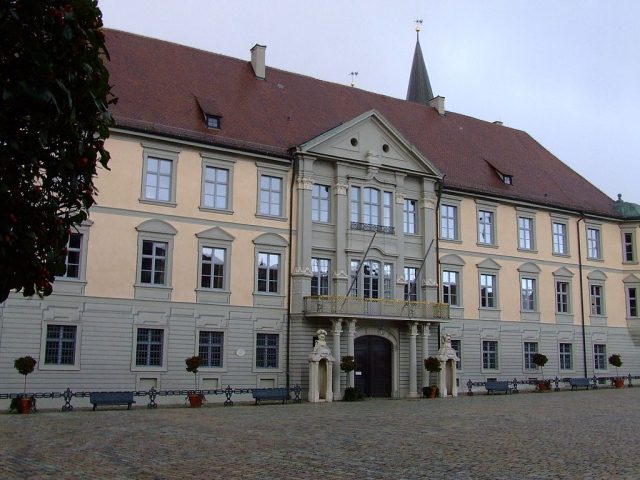
The Eichstätt Residence, the former seat of the Prince-Bishops of Eichstätt on Residenzplatz in Eichstätt, is a three-winged Baroque palace.

Particularly noteworthy are the representative staircase with an artfully forged iron banister and a ceiling fresco by Johann Michael Franz, depicting the Fall of Phaethon, as well as the Hall of Mirrors, which is also adorned with mythological scenes as a ceiling painting in distemper by the same artist.

In the 11th century, under Bishop Heribert, a Bishop's Court, known as the "Alte Hof" (Old Court), was built south of the Romanesque Willibaldsdom, which had been constructed shortly before. Until the first half of the 14th century, this was the Bishop's residence in the city. After its relocation to Willibaldsburg high above the city, the buildings served the cathedral chapter and as the seat of the administration of the Prince-Bishopric of Eichstätt.

During the two devastating city fires on December 17, 1633, and February 12, 1634, with which Swedish troops attempted to completely destroy the city of Eichstätt during the Thirty Years' War, the Alte Hof was also destroyed. After the end of the war, a provisional reconstruction took place until 1684.

Around 1700, court architect Jakob Engel, at the instigation of Prince-Bishop Johann Martin von Eyb, began construction of a new residence building on the site of the Alte Hof. The west wing was completed around 1702. The east wing followed. The south wing and the entire palace complex were completed by Gabriel de Gabrieli, the successor to Jakob Engel, who died in 1714. In front of the south wing of the palace, he also laid out the current Residenzplatz.

The Rococo interior decoration of the Residence, parts of which are still preserved today, was the responsibility of the third important Eichstätt court architect Maurizio Pedetti under Prince-Bishop Raymund Anton Graf von Strasoldo. He finally gave Residenzplatz its current appearance with its Marian column, which forms the center of a fountain surrounded by putti.

After the Napoleonic era, which marked the end of the Prince-Bishopric of Eichstätt and its annexation to the Kingdom of Bavaria, the Residence served as the home for Eugène de Beauharnais, Duke of Leuchtenberg, Napoleon's stepson and son-in-law of Bavarian King Max I Joseph, and his family from 1817 to 1833.

Since 1976, it has housed the District Office of the Eichstätt district. A part of the rooms has been restored and can be visited along with a small gallery of works by the painter C. O. Müller.

Take Mobile History with you

You are reading this text for free. Premium adds what matters on the road: descriptions read aloud, sites found through your camera, whole regions taken offline.

  • Every description, including the ~17,700 Premium sites
  • Audio guide: have descriptions read to you on location
  • AR finder: see sites through your camera, with distance and bearing
  • Unlimited saved sites

14 days free, then from €2.99 a month. Cancel anytime.

Source: Wikipedia · Licence: CC BY-SA 4.0

This description draws on the facts documented in the linked Wikipedia article; Wikipedia content is licensed under CC BY-SA 4.0. Wording and editing: Mobile History.

Location: 48.8914, 11.1830