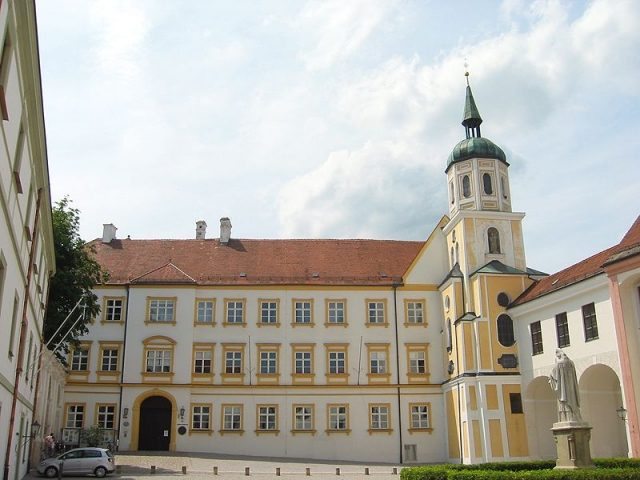
Education Center Cardinal Döpfner-house of the Archdiocese of Munich and Freising
Institute for Theological and Pastoral Education Freising
Residence

The Prince-Bishop's Residence Freising is a building on the Domberg in Freising and was the seat of the Bishops of Freising until the secularization in Bavaria. Today, it houses the Cardinal-Döpfner-Haus educational center of the Archdiocese of Munich and Freising, the Renovabis aid organization, and the Institute for Theological and Pastoral Further Education Freising.
The building is located at the highest point of the Domberg on the west side of the Domhof. To the south, the Domberg slopes steeply down to the Moosach and Isar rivers. To the west are an annex of the educational center and the Dombergmuseum. To the southeast is a terrace, followed by the current building of the Cathedral Library.
Building+
Residence
The Residence is a four-wing complex with a central courtyard. The core of the building dates back to the 14th century. Some rooms from this building are still preserved in the north wing. Under Bishop Philipp von der Pfalz, a redesign began in 1519. The courtyard arcades, whose ornamental columns were designed by Stephan Rottaler until 1519, are still preserved today. The current form of the Residence dates from the years 1607 to about 1622.
Large Residence Tower
At the northwest corner of the Residence stood a tower known as the Residence Tower or Khueturm. In contrast to the other towers on the Domberg, this was not a church tower but a secular tower.
The oldest parts of the tower probably date back to the Middle Ages and were part of the keep of the bishop's residence at that time. This first tower was divided into several floors with only small windows. The floor division did not correspond to that of the adjacent buildings, and the tower clearly stood out from them.
In 1620, the original roof was demolished and replaced by an octagonal structure with a Welsche Haube (Italianate dome). Due to the large footprint of the main tower, it was possible to install a surrounding balcony, which was the highest viewing platform in Freising and the surrounding area.
After a fire in 1743, the Welsche Haube was replaced by an onion dome during restoration. During the reign of Prince-Bishop Ludwig Joseph von Welden (1768-1788), the tower gallery was adorned with vases and figures. Among them was a figure of Archangel Michael, which led to the octagon being called Michaelsburg for several years.
Already in the course of the 18th century, static problems arose, which, however, were not considered alarming by the renowned master builder Johann Michael Fischer in 1755. However, since under Ludwig Joseph von Welden's successor, Maximilian Prokop von Toerring-Jettenbach, no money was available for the maintenance of the tower due to the high indebtedness of the Prince-Bishopric of Freising, the octagon and the gallery were demolished in 1790 and replaced by a mansard roof. When, a few years after the secularization in Bavaria in 1802/03, the building was converted into a seminary, the tower was demolished down to the height of the surrounding buildings. However, most of the building fabric is still preserved and, after the tower was gutted, is now integrated into the other buildings.
Originally, the tower was part of the defensive fortifications of the Residence and thus served purely military purposes. At the latest by the beginning of the 18th century, with the removal of the fortifications, the tower lost this function and primarily served urban-representative purposes. Part of the tower also served as a prison, but from the Middle Ages onwards only for clerics. Reasons for imprisonment here included, for example, negative personal conduct or differing opinions on matters of faith. A well-known inmate was Lorenz von Westenrieder, who had to serve a few days of arrest here in 1775 for a controversial schoolbook. The name Khueturm probably comes from this use, which, according to Johann Andreas Schmeller, goes back to the word "khue" or "kue" for a bishop's prison for delinquent clerics.
To supply the Domberg with water, a pipeline network was established from the 16th century onwards, and the tower was used as a water tower. Groundwater was pumped by a pumping station driven by the Moosach onto the Domberg and into a copper tank located on one of the upper floors of the tower. From there, the extensive water network was distributed. In some sources, the tower is therefore referred to as "Wasser Reserv" (water reservoir).
In the 17th and 18th centuries, the octagon was equipped with a clock. Dials were installed on four sides, and there were also two bells for the clock strike. Parts of the clockwork are preserved and are to be restored.
Small Residence Tower
At the northeast corner of the building is the small Residence Tower. An octagonal structure with a dome sits on a square base. In the lower part of the tower is the Prince-Bishop's private chapel. From the tower, the so-called "Fürstengang" (Prince's Passage) leads over the access roads to the Domhof towards the Cathedral.
Prince-Bishop's Private Chapel
In the Middle Ages, the bishop's personal chapel was located above the vestibule of the cathedral. However, with the construction of the organ loft in 1622, it was cut off from the cathedral and abandoned as a sacred space. Already in 1617, however, a private chapel was established in the Residence. The chapel is located in the lower part of the small Residence Tower on the same floor as the bishop's living quarters in the east wing. The narrow, high chapel is decorated with stucco in the upper part, while the lower part of the walls may have previously been adorned with tapestries. The altar was created by Philipp Dirr between 1617 and 1620 but has been altered several times since. The stucco work was created in 1629.
After the Secularization+
In the course of the secularization in Bavaria, the Prince-Bishopric of Freising was dissolved, and the bishop's seat became vacant. The last Bishop of Freising was Joseph Konrad von Schroffenberg-Mös. The bishop's seat was moved to Munich, and the Archdiocese of Munich and Freising was established.
Seminary
To compensate the city of Freising for the heavy losses of the secularization, Ludwig I founded the seminary in the building of the former Residence in 1826. Between 1900 and 1902, an extension for the seminary was built west of the Residence. This was located on the grounds of the former collegiate church of St. Andrä. The architect was Gabriel von Seidl. In the course of the new construction of this extension, the Martinskapelle (St. Martin's Chapel), which had been spared in the previous building, was demolished in 1959. Already in 1964, there were first rumors about the relocation of the seminary. The seminary was subsequently moved to Munich in 1968.
Cardinal-Döpfner-Haus Educational Center
After the relocation of the seminary to Munich, the building is now used as an educational center by the Diocese of Munich and Freising. The center, named after Bishop Julius Cardinal Döpfner, offers, among other events such as concerts or theater performances, primarily seminars on various topics:
- Meaning and Religion
- Ethics and Politics
- Art and Culture
- Personality Development
In addition to the conference rooms, there are also guest rooms for seminar participants. Two dining halls serve meals, offering fruit from the garden on the south slope of the Domberg. There is also a café and a "Bierstüberl" (small pub). Places of worship available include the Martinskapelle, built in 1965, and the former Prince-Bishop's Palace Chapel (Marienkapelle).
Take Mobile History with you
You are reading this text for free. Premium adds what matters on the road: descriptions read aloud, sites found through your camera, whole regions taken offline.
- Every description, including the ~17,700 Premium sites
- Audio guide: have descriptions read to you on location
- AR finder: see sites through your camera, with distance and bearing
- Unlimited saved sites
14 days free, then from €2.99 a month. Cancel anytime.
Source: Wikipedia · Licence: CC BY-SA 4.0
This description draws on the facts documented in the linked Wikipedia article; Wikipedia content is licensed under CC BY-SA 4.0. Wording and editing: Mobile History.
Location: 48.3986, 11.7450