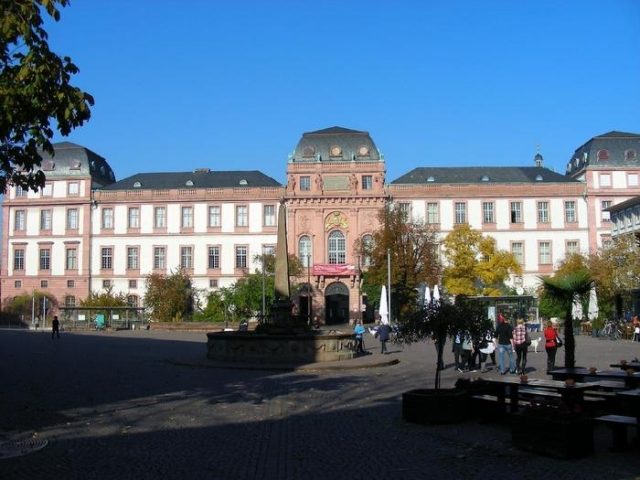
CastleDarmstadt

Royal Palace Darmstadt

Royal Palace Darmstadt

Public library
Museum
University


Darmstadt Residence Palace, often also called City Palace, is the former residence and administrative seat of the Landgraves and from 1806 to 1919 of the Grand Dukes of Hesse-Darmstadt, located in the center of the Hessian city of Darmstadt.

Today, the palace is located in the center of the science city of Darmstadt, at the eastern end of Rheinstraße, which leads into the city from the west.

The origins of the palace lie in the Katzenelnbogen era. In the middle of the 13th century, the Counts of Katzenelnbogen built a moated castle in Darmstadt. In 1330, Darmstadt received city rights, and a year later the castle was first mentioned. In the following two centuries, the Counts of Katzenelnbogen repeatedly expanded and rebuilt the castle. By the middle of the 15th century, the castle was transformed into a representative palace, and Darmstadt became a secondary residence of Katzenelnbogen. What remains of the moated castle are the shape of the central churchyard and the outer walls of the Herrenbau. When the last Count of Katzenelnbogen died in 1479, Darmstadt fell to Landgrave Heinrich III of Hesse. When Philipp the Magnanimous took over the government offices in 1518, the palace was first destroyed in an attack by Franz von Sickingen. The palace was rebuilt in the following years, but with essentially the same defenses. In the Schmalkaldic War in 1547, it was again destroyed by imperial troops. Landgrave Georg I (the Pious) (1547 to 1596) significantly expanded the palace into a Renaissance complex from 1567 and secured it with a moat and bastions. From 1594, he had orphans taught in the palace.

The Wallhäuschen, a gatehouse in the north of the palace complex, was built in 1627 by Jakob Müller. The Glockenbau was built from 1663 to 1671 according to plans by the architect Johann Wilhelm Pfannmüller. In 1693, Darmstadt was attacked by the French. The keep of the palace was destroyed in the process. After the palace chancellery burned down, Landgrave Ernst Ludwig commissioned the French architect Louis Remy de la Fosse in 1715 to plan a new Baroque palace with four large wings. This was to completely replace the old palace. Due to lack of money, however, only two wings were completed by 1726. These were to remain the last major structural changes to the palace. When Hesse-Darmstadt joined the Confederation of the Rhine in 1806, the palace became the seat of the Grand Dukes of Darmstadt.

In the Darmstadt fire night of September 11-12, 1944, the palace burned down to its outer walls. In twenty years of work, the external condition of the pre-war period was largely restored with great attention to detail.

Present+

Today, the palace consists of two perpendicularly intersecting wings with an S-shaped floor plan under a mansard roof. The east wing is single-story, the west wing is two-story.

The palace currently houses:

  • Institutes of the Technical University of Darmstadt
  • The libraries of Department 2 of TU-Darmstadt
  • In the older part of the palace, the Schlossmuseum, founded in 1924, with 22 rooms. It offers an overview of 250 years of court life and the history of the former Landgraviate and later Grand Duchy of Hesse
  • Schlosskeller (Student Cellar)
  • Schlossgarten (Palace Garden)
  • Keller-Klub

The Darmstadt Madonna was located in the Schlossmuseum until 2004.

Future+

Since the relocation of the University and State Library (ULB) to a new building in October 2012, the former rooms and the Schlossmuseum are being renovated. The renovation is expected to be completed in 2015/2016. Afterwards, the Presidium and parts of the Central Administration of the Technical University of Darmstadt will move in. In addition, the Department of History and Social Sciences, along with its book collections, will again find space in the palace. Furthermore, the German-Polish Institute will be moved from Mathildenhöhe to the palace. The renovation measures are estimated at approx. 41 million Euros. The western part of the palace moat is to be repaired by spring 2017.

Take Mobile History with you

You are reading this text for free. Premium adds what matters on the road: descriptions read aloud, sites found through your camera, whole regions taken offline.

  • Every description, including the ~17,700 Premium sites
  • Audio guide: have descriptions read to you on location
  • AR finder: see sites through your camera, with distance and bearing
  • Unlimited saved sites

14 days free, then from €2.99 a month. Cancel anytime.

Source: Wikipedia · Licence: CC BY-SA 4.0 · Image: http://www.wehrbauten.de/thread.php?threadid=969

This description draws on the facts documented in the linked Wikipedia article; Wikipedia content is licensed under CC BY-SA 4.0. Wording and editing: Mobile History.

Location: 49.8736, 8.6553