To be privately owned
Besenhausen Manor
The Besenhausen manor is an agricultural building complex in the municipality of Friedland in the district of Göttingen in Southern Lower Saxony. Today, it lies near the tri-border area of Hesse–Lower Saxony–Thuringia. The oldest building structures of the former manor, with its baroque residential courtyard and park, as well as the estate farm built in the 18th century, date back to the Middle Ages. The entire ensemble is a protected monument. The estate with its surrounding land has been in continuous family ownership for 700 years. Today, Besenhausen is a popular excursion destination.
Besenhausen is one of three parts of the village of Niedergandern, which belongs to the municipality of Friedland in Lower Saxony. It is located about 2.1 kilometers northeast of the tri-border area of Hesse–Lower Saxony–Thuringia, directly northwest of the border to Thuringia, the former inner-German border, on the Leine river. Neighboring places, besides Niedergandern (1.5 km northwest), are the villages of Reckershausen (2.5 km north) and Kirchgandern (1.1 km southeast; in Thuringia).
The state road L 566 runs northeast past Besenhausen, which connects to federal highway B 80 via the Thuringian L 1001 roughly to the south, and to the northwest via connecting roads to the Neu-Eichenberg–Friedland junction of federal highway A 38, located in Hesse near Marzhausen; this leads through the nearby Heidkopf Tunnel. The nearest train station is in Neu-Eichenberg.
The Besenhausen property extends from the Pferdeberg (approx. 300 m above sea level) in the northeast to Hottenrode in the southwest. It is traversed by the Leine river, which is partly integrated into the park of the manor house and separates the districts of Besenhausen and Niedergandern. The Leine-Heide cycle path runs through Besenhausen.
People probably settled in Besenhausen already at the end of the first millennium. Besenhausen, whose name is interpreted as "house of Bezo" or "house of Biso" (a common Old Saxon given name at the time), has always been a border town of today's states of Thuringia, Lower Saxony, and Hesse. Thus, it was subject to the eventful and often warlike history in the Middle Ages and modern times up to the upheavals of the 20th century.
The history of the approximately 700-year-old manor was a constant struggle for existence between the claims of various powers: the Prince-Bishops of Mainz, the Welfs of Brunswick, and the Landgraves of Hesse. The estate was affected by the disputes between Catholics and Lutherans, between Prussia, the Napoleonic Kingdom of Westphalia, and the Kingdom of Hanover, and finally between the victorious powers of the Second World War. The centuries of archiepiscopal rule in Eichsfeld, which belonged to the sphere of influence of Electoral Mainz, were formative. Besenhausen belongs to the "historical Eichsfeld" even though it became part of Lower Saxony, founded in 1946.
Former Village
Although the first documented mention of the village of Besenhausen is found only at the beginning of the 14th century, due to the specific name construction, it can be assumed that the village existed 300 or 400 years earlier. The village, which no longer exists today, was probably located directly north of the present estate between Hottenrode, Niedergandern, and Kirchgandern.
In 1307, Besenhausen is first mentioned in a document as a possession of the von Hanstein family. According to this document, at that time the brothers and knights Heinrich and Lippold von Hanstein held the village as part of a fief of the Archbishops of Mainz, who ruled in Eichsfeld at the time. In the preserved document, the two brothers committed to transferring the great and small tithe to the altar of Saint Stephen in the Martinsstift in Heiligenstadt, then the most important ecclesiastical institution in Eichsfeld. The Hansteins were at that time Vicedomes, i.e., governors of the Mainz lords. As part of the donation, the existence of an allodial estate (Allod) of the Hansteins in Besenhausen was also confirmed. In another contract dated October 4, 1308, the Hanstein brothers were obliged to build a castle for the Mainz archdiocese in Besenhausen. Consequently, a fortified complex must have been built near the present estate. At this time, however, the Besenhausen Hansteins still lived in their ancestral castle, Hanstein.
Around 1360, the village of Besenhausen was abandoned by its inhabitants for the first time – at least largely – it fell into "ruin". The reasons for this are not known; epidemics, crop failures, or warlike influences could have been the cause.
It is certain that the von Hanstein family was able to prevent their own estate in Besenhausen from falling into ruin. In 1522, Johann von Hanstein became the first lord of Besenhausen who also lived there. From the beginning of the 16th century, the Hansteins no longer resided in their increasingly dilapidated ancestral castle, but had settled on their knightly estates – besides Besenhausen, these included Bornhagen, Werleshausen, Wahlhausen, Ershausen, Oberelle, and Henfstädt. At that time, however, the Hansteins had already lost the right to their own estate in Besenhausen, as it now belonged to the Landgraves of Hesse due to forced enfeoffment. With each change of generation, the feudal relationship between the Besenhausen Hansteins and the liege lord had to be renewed.
In a feudal letter from 1362, the property was named "our estate in Beßenhußen", and in feudal letters from 1546 as "Beßenhausen". In the statistical handbook of Landgrave Wilhelm IV, the estate was already referred to as "Besenhausen".
Country Seat of the Hansteins
In 1540, Johann von Hanstein († 1558) had a representative building in Renaissance style constructed. For this purpose, he had acquired additional land in Besenhausen from a Matz Conradt from Kirchgandern through exchange. Today, only a few relics remain of this building, which was surrounded by a rampart and moat.
Since the early 16th century, the Besenhausen estate repeatedly became a point of contention between the Welf office of Friedland and the Mainz chief bailiff in Heiligenstadt. Mainz, Hesse, and Hanover repeatedly tried to bring the stately complex of estate and lands under their respective influence.
Like most of the Eichsfeld nobility, the Hansteins had converted to the Reformation early on. In the subsequent religious wars, Hottenrode, the patron church of the Besenhausen family, played an important role. In the church, which belonged to the Duchy of Brunswick, Protestant Eichsfelders gathered for Lutheran services, thus escaping Mainz's religious supervision. In the course of the Thirty Years' War, the manor and village of Besenhausen were destroyed.
Reconstruction after the Thirty Years' War
The reconstruction of the residential buildings of the estate began under Hans Hermann von Hanstein (1610–1686) at the end of the 17th century. His son Dietrich von Hanstein (1644–1716) completed his father's work. The manor house again received a rectangular moat and rampart system – which no longer exists today. Dietrich von Hanstein's son Carl Friedrich von Hanstein built the farmyard from 1740 onwards. A village, which probably also existed (again) before the war, was not resettled and fell into ruin (again).
Since Carl Friedrich von Hanstein († 1724) died childless, Besenhausen fell to his cousin Liborius Friedrich von Hanstein (* 1678) from the Werleshausen line. The Protestant Friedland bailiff took this inheritance as an opportunity to have about three hundred armed men occupy the estate in 1724. A part of this troop remained there and thus held the estate against the Mainz forces for 20 years. Only in 1743 did the Electoral Government in Hanover and the Mainz Government of Eichsfeld agree on the future course of the border, which assigned the Besenhausen estate to Eichsfeld, but a large part of the agricultural land of the estate to the Hanoverian territory, and thus to the Friedland office. A boundary stone with the Hanoverian Wolfsangel on one side and the Mainz Wheel on the other still bears witness to this today. Even though the Besenhausen residents and the manor house fell back to Mainz, they were allowed to retain the right to the Protestant faith.
The "Zedler", the largest encyclopedia of the 18th century, described Besenhausen in 1751 as: ... a castle, manor and village in Lower Hesse, on the Eichsfeld borders, on the Leine, one hour from Witzenhausen.
Friedrich Ernst von Hanstein (1723–1807) had become the heir of Liborius Friedrich von Hanstein in 1737. In 1802, Eichsfeld fell to Prussia under Friedrich Wilhelm III. At that time, the then 79-year-old Friedrich-Ernst von Hanstein was lord of Besenhausen; he also owned the estates of Rommerode, Wiesenfeld, and the former Grone possessions in Friedland and Reiffenhausen. Hanstein was also the representative of the Eichsfeld knighthood ("Ritterschaftlicher Deputirter der Stände des Fürstenthums Eichsfeld").
In 1896, the grandson of the knightly representative Friedrich von Hanstein died unmarried, and 600 years of Hanstein history in Besenhausen with always male heirs came to an end. Even in his time, the Besenhausen Hansteins' possessions included the estate in Rommerode and half of an estate in Ober-Ellen. The Besenhausen estate now fell to Bertha, the sister of the last Hanstein owner, who was the wife of the scholar Levin Georg Freiherr von Wintzingeroda-Knorr, living in Göttingen. He was also district administrator of the Prussian district of Mühlhausen and thus found himself in a historical dilemma due to the possession of Besenhausen. In 1866, as a Prussian official, he had to pass on what he had learned as a Welf estate owner: the exact marching route of the Hanoverians, who were then defeated in the Battle of Langensalza during the German War.
From the marriage of his grandson Friedrich-Wilhelm Freiherr von Wintzingerode-Knorr (1893–1952) with Ruth, née von Marschall, the next inheriting woman in the history of Besenhausen, Sitta, emerged.
German Division and Reunification
After the Second World War, US military units occupied the estate. The demarcation line between the British and Soviet occupation zones, established according to the Potsdam Agreement of summer 1945, ran directly through the estate grounds: the manor house and courtyard would have fallen into the Russian sector, while the water mill and workers' houses would have fallen into the British sector. Most of the lands would have been in the Western sector. Without its land, the estate would no longer have been viable, and a demolition of the historic complex on the demarcation line would have been likely. On July 1, 1945, Russians and British moved in. However, Wintzingerode-Knorr was able to persuade the Soviet military administration to make an exchange. They shifted the border by several hundred meters to the southeast, and Soviet troops plundered the estate for three days.
Through the daughter of Sitta von Klitzing, née Freiin von Wintzingerode-Knorr, Besenhausen came into the hands of the Flechtner family in the 1960s, descendants of Ferdinand Gottlieb Flechtner from Langenbielau in Silesia – thus, the estate has been inherited three times in the female line after about 600 years of Hanstein family ownership.
Building Ensemble+
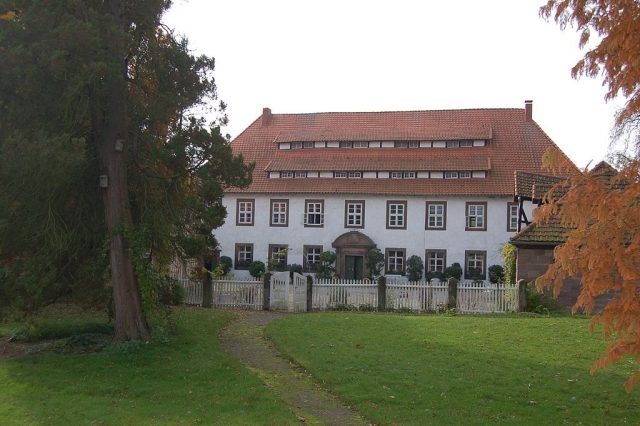
The entire complex consists of a residential inner courtyard made up of four buildings, surrounded on three sides by a tree-lined park. Adjoining the gatehouse on the southeast side of this courtyard is the significantly larger farmyard or estate courtyard, through which the inner courtyard is first accessible. The actual farmyard is formed by three elongated building units and also includes the approximately 10 x 30 meter large courtyard pond.
Adjacent to the farmyard is the former sugar factory and a connecting equipment shed. At the north end of the park are the former workers' houses (with stables) and the former grain mill. The patron church in Hottenrode, 800 meters away, and a former border clearance building 150 meters away are also considered part of Besenhausen.
The Leine river borders the farmyard and the park to the south. An elongated island, formed by the division of the Leine, extends over a length of about 180 meters. It is used as a park and – in the area of the former grain mill – as a kitchen garden.
Inner Courtyard
The buildings in the inner courtyard were built in their current, baroque form from about 1680 onwards. However, the gatehouse contains older building structures in its lower section. Thus, the entire substructure as well as the old defensive wall with its vaulted cellar and its loopholes are of medieval origin and executed in Renaissance style.
In addition to the gatehouse, the inner courtyard group consists of the manor house and the "Christenhaus". Both buildings are two-story and have hip roofs; the manor house has a two-story attic. Furthermore, there is a single-story storage and pantry building with a hip roof and an extended gable. This building leans against the artificially created, approximately four-meter-high "Schneckenberg" (snail hill), and provides access to the vaulted storage rooms located under the hill. All buildings are not cellared.
The inner courtyard ensemble is surrounded on three sides by a 200-year-old park of approximately 7,000 square meters, which ends on its south side at the Leine river, but also integrates part of the river's upper course there.
Farmyard
The most striking building of the farmyard is a stately half-timbered building by the courtyard pond. It was built in 1740, and a tower with a clock is located on its gable roof. The left pillar to the former courtyard gate, which was later walled into the so-called "Wirtschaftsgebäude" (farm building), contains two coats of arms: the Hanstein family coat of arms of Hans-Hermann von Hanstein (1610–1686) and the coat of arms of his wife's family, Ursula von Spiegel. They are considered the first builders of the complex after the Thirty Years' War. In the front part of the "Wirtschaftsgebäude", the offices of the estate inspector (also: estate manager) were formerly located. In the rear part were the pigsties. In a lower, adjoining building, the cow sheds were housed.
The remaining farm buildings had to be renewed after a farm fire in 1907. These include the elongated former sheep and horse stable located on the Leine, used as a tractor shed and workshop in the second half of the 20th century; today, after another renovation, it serves as an exhibition and event hall. Adjoining the sheep stable is the flatter, former forge. The transverse and courtyard-enclosing, brick barn building has contained a grain drying plant and corresponding grain silos, still in use today, since the 1980s.
Sugar Factory
In 1836, the first sugar factory in the Province of Saxony was built on the estate grounds. It was only in operation for five years. After decades of use as a warehouse, garage, and also vacancy, the building now houses the Rosenwinkel hand weaving mill.
While preserving and partially reconstructing the original facades and the static system, two floor levels were largely removed, creating two superimposed, two-story large rooms (today: sales room and weaving workshop). The mezzanine is accessed via a gallery. In addition to the consistently barrier-free design of the usable areas, natural building materials were used and energy-optimizing measures were taken for the listed building. The renovation received the Lower Saxony Savings Bank Foundation's monument preservation award in 2004.
Weirs and Generator
Next to the former estate workers' houses, a grain mill stood directly on the Leine, which was divided into two at that point. This mill has been shut down since the beginning of the 20th century, but in the still existing building, a water-powered turbine has been generating electricity via a generator since 1924. This could ensure the electricity supply for the residents and economy of Besenhausen, even though today the generated energy is first fed into the general power grid for conversion into direct current.
To drive the turbine and regulate the necessary amount of water, part of the Leine must be dammed. For this purpose, the river is divided about 100 meters before the turbine by means of a weir, so that the higher-flowing arm of the river can drive the turbine with a drop of about 2 meters. Approximately 80 meters after the artificially created turbine waterfall, the two arms of the Leine are reunited.
The patron church in Hottenrode, belonging to Besenhausen, is still used today as a burial site for residents of Besenhausen.
Former Inner-German Border+
Above the estate, on the L 566 between Reckershausen and Kirchgandern, lies a former border house, the former clearance point of the former border crossing on the inner-German border.
Due to its proximity to the town of Friedland, the crossing was of great importance between 1945 and 1952. Friedland, with its refugee reception camps and a railway connection, became a focal point for escape and migration routes from the summer of 1945 onwards. People marched from the Soviet occupation zone across the demarcation line into the British occupation zone, which began here. The border crossing was on foot, as the road between Kirchgandern and Niedergandern or Reckershausen had not yet been restored. People also migrated from west to east, especially prisoners of war and forced laborers. On October 12, 1945, a Refugee Exchange Point was established in Besenhausen. Initially, a corrugated iron barracks was erected, where arrivals were cared for by the German Red Cross and church institutions. In 1949, the border house, also called "Zollhaus" (customs house), was built. Later, a small sales stand for refreshments and a wooden luggage handling ramp, which no longer exists today, were added.
More than two million people crossed the border in Besenhausen. On May 27, 1952, the border crossing was closed by the Soviets, and from then on, only isolated special transports were allowed to pass. In 1956, the border was finally closed.
After the closure of the inner-German border and the construction of border installations (which in the Besenhausen area also included self-firing systems and mines), the clearance building was used by the duty-bound border authorities as a support and resting point. In the 1960s, a provisional exhibition room with information material on border issues was set up in the building for the first time. In 1987, the then State Secretary Stefan Diekwisch and the responsible Chief District Director Alexander Engelhardt inaugurated a border information facility now housed here.
After the opening of the inner-German border in November 1989, the building served again – for about six months – as a border clearance building for customs and the Federal Border Guard. Today, it belongs to the building stock of the Besenhausen estate. On October 13, 2005, a memorial stone with the inscription "GATE TO FREEDOM – 1945–1956" was erected to commemorate the significance of the Besenhausen border crossing and on the occasion of the double anniversary "60 years of border transit camp" and "50 years of returnees".
Present Day+
The agricultural and forestry areas belonging to the Besenhausen estate are managed by another operating facility. The farm facilities thus hardly serve their original purpose anymore. Through various cultural and social institutions, the manor has increasingly become a regional excursion destination.
Today, buildings in the farmyard house a farm café (gatehouse) and a rustic banquet hall (former sheep stable). The banquet hall is rented for celebrations and used for wedding receptions, as it has been possible to get married in Besenhausen since 2008. For this purpose, an studio room in the former farm building was declared a branch of the Friedland registry office.
Exhibitions take place in studio rooms in the former pigsty. Readings also take place on the farm premises, such as during the Göttingen Fairy Tale Weeks, the Cultural Festival in Göttingen Land, and the Göttingen Children's and Youth Book Week. The Friedland Cultural Circle organizes concerts in Besenhausen, and the Göttingen aid project Bewegung gave a benefit concert with the band "Seven Up".
Rosenwinkel Hand Weaving Mill
In May 2004, a workplace and exhibition venue for the Handweberei im Rosenwinkel e.V. association was opened in the former sugar factory. The non-profit association was founded in 1992. Its goal is to offer jobs and training opportunities to people with disabilities. In addition, the traditional craft of weaving is to be cultivated. The social craft business of the same name, supported by the association, moved from Reckershausen to Besenhausen in 2004. Woven textiles are produced and offered for sale in the premises. In the weaving hall, products made from natural materials are created on 20 looms; the production of the fabrics can be observed. Guided tours explain the most important steps of the weaving craft in the demonstration workshop. Many yarns and fabrics are hand-dyed.
Expo Theme Path Water
Since Besenhausen has its own spring, a water turbine, and a plant-based wastewater treatment plant, making the estate independent of municipal water supply and disposal, it was part of the Expo 2000 Theme Path Water in Hanover. It was one of 280 projects selected by independent expert panels to answer future questions for the 21st century. Parts of the theme path can still be visited today.
Notable Personalities+
Hermann von Christen was born in Besenhausen in 1841. In 1925, Theo Harych worked here briefly as a driver before being dismissed without notice after 5 months for election propaganda for the KPD. In 1944, General of the Infantry Otto von Below died in Besenhausen.
In Literature and Film+
In 1955, Fontane's Effi Briest (as Roses in Autumn) was filmed in Besenhausen by director Rudolf Jugert, starring the then 31-year-old Ruth Leuwerik. In the novel "Nirgendwo ist Poenichen", also filmed in 1980, the second part of Christine Brückner's Poenichen trilogy, published by Ullstein in 1977, the Besenhausen pigsty is described as an emergency shelter (when crossing the border) for the novel character Maximiliane von Quindt.
Take Mobile History with you
You are reading this text for free. Premium adds what matters on the road: descriptions read aloud, sites found through your camera, whole regions taken offline.
- Every description, including the ~17,700 Premium sites
- Audio guide: have descriptions read to you on location
- AR finder: see sites through your camera, with distance and bearing
- Unlimited saved sites
14 days free, then from €2.99 a month. Cancel anytime.
Source: Wikipedia · Licence: CC BY-SA 4.0 · Image: http://de.wikipedia.org/wiki/Datei:Besenhausen,_Herrenhaus,_Hifseite,_31.10.2009.JPG
This description draws on the facts documented in the linked Wikipedia article; Wikipedia content is licensed under CC BY-SA 4.0. Wording and editing: Mobile History.
Location: 51.3893, 9.9501