ManorBösenbrunn

Bösenbrunn Manor

Bösenbrunn Manor

Cultural center

The 625th-anniversary celebration of Bösenbrunn, held in 2003, referred to the first documented mention of the village in 1378. It is considered certain that the settlement is of significantly older origin, but corresponding evidence is lacking.

The place name can be interpreted from Middle High German as a bad, low-yielding spring (= "böser Brunnen"). Administratively, the village belonged to the Voigtsberg district, although particular affiliations with the Plauen district cannot be ruled out.

The center and origin of the settlement is the area just above the confluence of the Dorfbach and Triebelbach streams. In this side valley, the so-called Weberbachgrund, there was an early German defensive structure, rediscovered in 1937 by archaeologist Amandus Haase (1886–1947) (today the Bösenbrunn festival grounds). Since this ring wall island was located on the manor's land, a protective function for a long-standing fortified house here can be assumed.

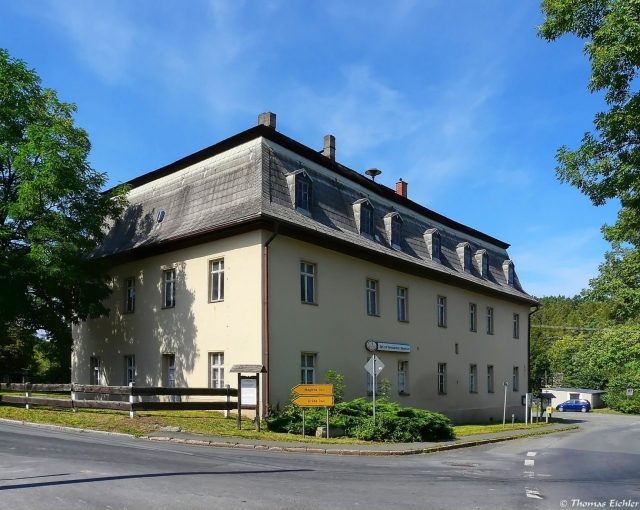
The Bösenbrunn manor first appeared in 1440 as an outwork of the von Sack zu Geilsdorf family and was explicitly referred to as a manor in 1536. At least since 1560, it was also the permanent residence of the noble family, as in that year a Hans Sack zu Geilsdorf was documented with the addition "auf Bösenbrunn". In the following centuries, the manor was owned by the noble families Tettau, Neidberg, Trützschler, and Brandenstein.

The current building, as evidenced by the alliance coat of arms above the entrance, was erected in 1727 by Philipp Ferdinand von Neidberg. From 1783, the manor was bourgeois property, first of the Seydel family, later Schaumberg, Wauer, and Naumann. The last owner of the castle-like estate (U-shaped complex open to the north with stables, distillery, and servants' quarters) until his expropriation and expulsion by the communists in 1945 was Wilhelm Koch from the Oelsnitz carpet dynasty. Later, the house served as a school, seat of the municipal administration, home for associations, and an inn.

In ancient times, mining particularly shaped Bösenbrunn. Copper, tin, and iron, and occasionally nickel, were extracted from almost 30 mines. Pearl fishing was significant in the Triebelbach, for which the Oelsnitz family Schmirler held the monopoly. Pitch boiling was carried out in Bösenbrunn until 1885 under manor owner Karl Friedrich Wauer (1806 to 1890). Two crackling hearths and the former pitch hut (brewery) still bear witness to this today.

After 1945, the former manor served as a school, which meant its salvation. The Soviet occupiers had actually intended it for demolition due to its stately character. Since 1966, Bösenbrunn children have been taught in Bobenneukirchen or Oelsnitz.

Take Mobile History with you

You are reading this text for free. Premium adds what matters on the road: descriptions read aloud, sites found through your camera, whole regions taken offline.

  • Every description, including the ~17,700 Premium sites
  • Audio guide: have descriptions read to you on location
  • AR finder: see sites through your camera, with distance and bearing
  • Unlimited saved sites

14 days free, then from €2.99 a month. Cancel anytime.

Location: 50.3975, 12.1001