ManorEschweiler - Dürwiß

Drimbornshof Manor
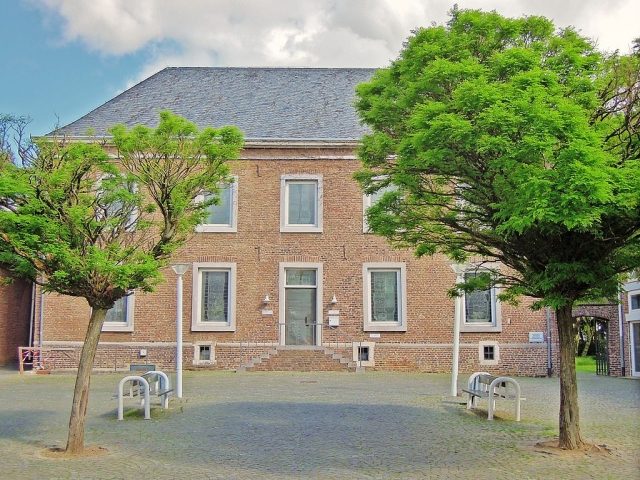
Drimbornshof Manor

Museum
Offices

The Drimbornshof is a former knightly and noble seat of the Lords of Drimborn, who were first mentioned as owners of the estate in 1585. It is located in the northern Eschweiler district of Dürwiß and is, along with the Broicher Hof, one of the landmarks of the town.

The von Drimborns originate from Aachen, but their origins are apparently in the village of Dreiborn (since 1972 a district of Schleiden, Eifel). The Eiflia illustrata by Johann Friedrich Schannat already showed the connection between Drimborn, Trimborn and Dreiborn in 1829.

Drim means three, Born means well or spring.

Owners+

In 1585, Wilhelm von Drimborn and in 1610, Alexander von Drimborn were admitted to the Jülich knightly roll. Around 1670, the family had no more male descendants, and the Drimbornshof came to Bernhard Everhard von Bottlenberg through marriage. In 1823, it was acquired by Wilhelm Steffens through purchase, who bequeathed it to his son in 1867. Further owners: 1890 von Papen (family of the later Chancellor Franz von Papen), later von Pastor, 1950 BIAG Zukunft.

Building History and Use+

The estate was built in the 14th or 15th century, extended in 1719, destroyed in 1945, and rebuilt from 1962 to 1963 by the then municipality of Dürwiß (Jülich district) as an administrative building. Today, the Drimbornshof is home to several doctor's offices, a pharmacy, and the local history museum, and until 1999, also the local radio station Antenne AC. It is assumed that the knight's seat was the earliest settlement of Dürwiß in Frankish times.

Structure+

The former manor consists of a square farmyard with the manor house as the central building and the farm buildings as side wings. The buildings are constructed of bricks, and the manor house bears the year 1719. A square defensive tower rises at the rear of the manor house. The open side of the courtyard faces Jülicher Straße and is enclosed by a wall with an archway. The keystone above the archway shows the coats of arms of the Drimborn and Bawer (actually von Bawyr / Buer) families, united in a shield with the inscription DRIMBORN BAWER, now barely legible. The background for this alliance coat of arms was the marriage between Heinrich von Drimborn zu Dürwiß and Hellenberg von Bawyr, daughter of Adam von Bawyr zu Rommeljans and Dorothea von Eller from the House of Laubach.

Coat of Arms+

The coat of arms of the von Drimborn family consists of three diagonally running roses in the escutcheon and above it a helmet with a cap, at the tip of which is another rose. This coat of arms was used to create the coat of arms of Dürwiß, which also contains three roses, but arranged differently.

The village of Dreiborn in the Eifel still bears this coat of arms today.

Greenskuhl and the Legend of the Maiden of Drimbornshof+

The Greenskuhl was a pond system overgrown with green plants in front of the Drimbornshof. The name probably derives from the many green plants that grew there; mostly roses. A 17th-century legend tells of the ghost of the Maiden of Drimbornshof, who is said to inhabit the Greenskuhl:

“Young Agnes Bavur zu Drimborn was walking by the Greenskuhl one beautiful day when she suddenly slipped, fell into the water, and was in danger of drowning. A young nail smith, returning from Jülich after selling a load of nails there, happened to be passing the Drimbornshof and observed the situation. He jumped into the water and saved the life of young Agnes. This led to a secret love between the two, which, however, did not escape a young officer from Jülich. This young officer, in turn, had set his sights on young Agnes. One beautiful day, a driven hunt took place between Dürwiß and Lohn, in which the young nail smith was a beat driver and the young officer was one of the hunters. It is said that the young nail smith was hit by a bullet from the young officer in an accident and died. It is further said that young Agnes died a short time later – of a broken heart.”

If you stand in front of the Drimbornshof today, you will see a small stagnant water puddle. In the 1970s, this was still a pond with fish and underwater lighting. In the 1980s, a school project came up with the idea of draining the pond and creating a wetland biotope.

Take Mobile History with you

You are reading this text for free. Premium adds what matters on the road: descriptions read aloud, sites found through your camera, whole regions taken offline.

  • Every description, including the ~17,700 Premium sites
  • Audio guide: have descriptions read to you on location
  • AR finder: see sites through your camera, with distance and bearing
  • Unlimited saved sites

14 days free, then from €2.99 a month. Cancel anytime.

Source: Wikipedia · Licence: CC BY-SA 4.0 · Image: http://www.wehrbauten.de/thread.php?threadid=845

This description draws on the facts documented in the linked Wikipedia article; Wikipedia content is licensed under CC BY-SA 4.0. Wording and editing: Mobile History.

Location: 50.8412, 6.2752