Museum
Ingersleben Manor

+
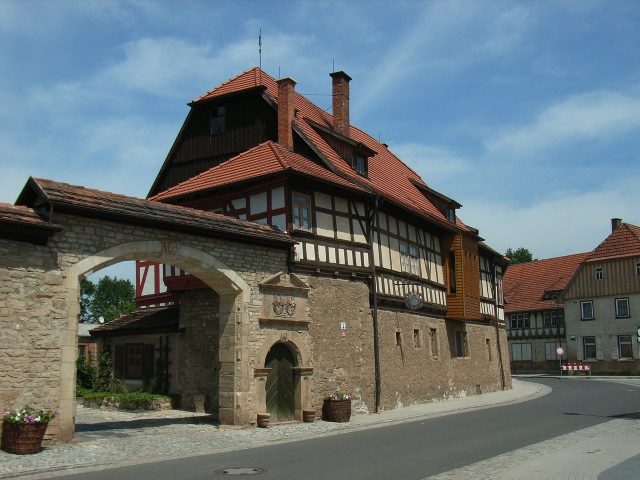
Since 1979, the local history museum has been located in the manor house of the knight's estate in the center of the village. As early as the 14th century, the fortified complex with a moat was mentioned. The property belonged to numerous noble families (including von Ingersleben and von Gleichen).
The property, acquired by the Erfurt woad merchant Hans von Ziegler, was built by him in 1609 with a large manor house. Otto Heinrich von Ziegler, also a woad merchant from Erfurt, enriched it in 1622 on the occasion of his marriage to Maria von Wangenheim with a magnificent late Renaissance portal, coat of arms panel, and archway.
Baron Adolf Otto Freiherr von Münchhausen, who owned the estate from 1786 to 1883, was well acquainted with the writer Gustav Freytag, who chose Ingersleben as the setting for his novel "Die Ahnen" and authentically described the knight's estate and the Ingersleben area. In 1837, it belonged to Thankmar Freiherr von Münchhausen, who served as travel marshal to the Duke of Württemberg and as Saxon-Meiningen court marshal. In 1883, it was acquired by the regional economist Robert Wagner (founder of the first sugar factory in Straußfurt), who in 1894 had the existing "villa" in the castle park extended by a generous wing, thereby creating a representative castle-like residential building with a hall and reception rooms. Until the beginning of the 19th century, the estate served as the residence of its respective owner. In 1942, the knight's estate passed to Horst and Siegismund von Zakrzewski. The estate-owning family was dispossessed without compensation in 1946 as part of the land reform in the Soviet Occupation Zone and expelled from the district. In 1947/48, the villa, outbuildings, and the archway with the adjacent milk house were demolished. The park with "exquisite old trees" was cleared, the park area leveled, parceled out, and new farmsteads were built on it. In the economic area, the technical department of the LPG (Agricultural Production Cooperative) was established. The manor house remained as a remnant of the former knight's estate, although its demolition was also planned. Since 1979, the local history museum has been located in this building. Today, the museum is considered the central museum of the municipality of Nesse-Apfelstädt.
Interior
Numerous interior rooms are adorned with wall and ceiling paintings, which have been carefully uncovered and restored. These include the functional "Black Kitchen," the Rococo Room, the "Striped Room" with a design from before 1780, and the "Münchhausen Room" decorated with strapwork painting. An exhibition on the life and work of the writers Frieda and Margarethe von Bülow is presented there. They spent their childhood and youth with their grandparents, Baron von Münchhausen. Other living rooms include the bedroom (around 1800), the Biedermeier room, or the administrator's study in the "Tower Room." In the exhibition on the history of Neudietendorf, a Moravian Brethren settlement, the focus is on its industries, including the Liliendahl sealing wax manufactory (founded in 1778), the history of pharmacy, Aromatique production (stomach bitters), and the candle factory.
Take Mobile History with you
You are reading this text for free. Premium adds what matters on the road: descriptions read aloud, sites found through your camera, whole regions taken offline.
- Every description, including the ~17,700 Premium sites
- Audio guide: have descriptions read to you on location
- AR finder: see sites through your camera, with distance and bearing
- Unlimited saved sites
14 days free, then from €2.99 a month. Cancel anytime.
Source: Wikipedia · Licence: CC BY-SA 4.0
This description draws on the facts documented in the linked Wikipedia article; Wikipedia content is licensed under CC BY-SA 4.0. Wording and editing: Mobile History.
Location: 50.9209, 10.9359