ManorGera - Liebschwitz

Liebschwitz Manor
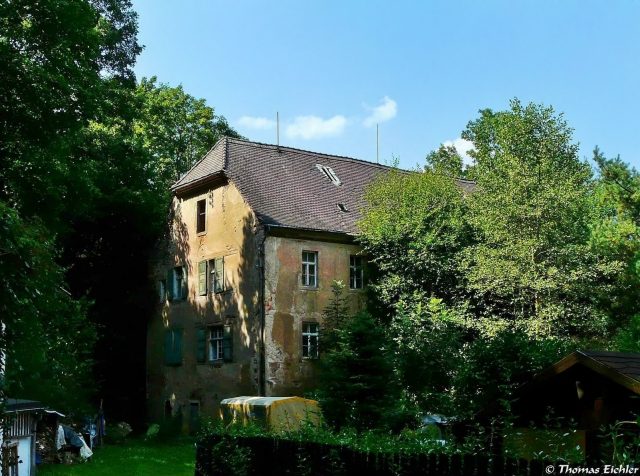
Liebschwitz Manor

Uninhabited


The Liebschwitz Manor, known colloquially as "the Estate," was first mentioned on November 4, 1209, as the Lordship of Lüschwitz. From the mid-15th century, the von Ende family resided on the estate, and in 1473, Erfort von Ende granted his wife Elisabeth the following as a dower. She received half of the castle, village, and mill in Lüschwitz, along with upper and lower courts, and half of all other outworks, villages, rents, and appurtenances.

The outworks are the later manors of Loitsch and Lichtenberg. The noble von Ende family, whose traces date back to the early 13th century in West Saxony, most likely fell into economic hardship due to the turmoil of the Thirty Years' War and sold their property in 1630 to the von Raschau family. In 1640, their son-in-law, Herr von Carlowitz, became the owner of Liebschwitz.

In April 1654, a devastating flood caused such extensive damage that the property became untenable and had to be sold in 1673 to the wealthy Baron Meusbach. Baron Meusbach had a new church built in 1677, as the previous one, along with the adjacent cemetery, had been destroyed by the flood. Later, the Leipzig merchant David Fletzscher became the successor to the Liebschwitz Manor.

The next feudal lord was not a nobleman. Gottfried Leyser received all rights in 1722. Although he held the title of tax advisor, he did not seem to have had a lucky hand, as his property came under sequestration (forced administration or seizure by a sequestrator) around 1740. On July 20, 1745, Johann Georg von Ziegenhierd acquired the property, and after his death in 1762, his son Ferdinand August took it over.

On October 13, 1806, severe clashes occurred at the manor due to plundering French soldiers. As this resulted in the death of four Frenchmen, a few days later, in an "act of revenge," the rectory and the forge were burned down, and the manor was plundered.

Between 1772 and 1883, the manor was expanded to its present-day appearance.

On February 27, 1854, Friedrich Theodor von Ziegenhierd passed away, and his son Hugo Werner died in 1874, at only 54 years old, in Loitsch. In 1877, it was sold to Ernst Keil of Pforten, Gera, which ended its affiliation with Liebschwitz.

Hugo Werner Ziegenhierd's widow, Marie Luise (1840 - 1911), had already leased the estate to Hermann Querengässer in 1875. 30 years later, his son Arthur succeeded him. Dr. jur. Friedrich Alfred Werner von Ziegenhierd, Marie Luise's only son, managed his property until 1937.

After 1945, the manor was expropriated by the communists and approximately 60% demolished. From its demolition material, 3 "new farmer's homesteads" were built (these were subordinated to the LPG (Agricultural Production Cooperative) in the GDR).

Take Mobile History with you

You are reading this text for free. Premium adds what matters on the road: descriptions read aloud, sites found through your camera, whole regions taken offline.

  • Every description, including the ~17,700 Premium sites
  • Audio guide: have descriptions read to you on location
  • AR finder: see sites through your camera, with distance and bearing
  • Unlimited saved sites

14 days free, then from €2.99 a month. Cancel anytime.

Source: Wikipedia · Licence: CC BY-SA 4.0 · Image: Thomas Eichler

This description draws on the facts documented in the linked Wikipedia article; Wikipedia content is licensed under CC BY-SA 4.0. Wording and editing: Mobile History.

Location: 50.8281, 12.0983