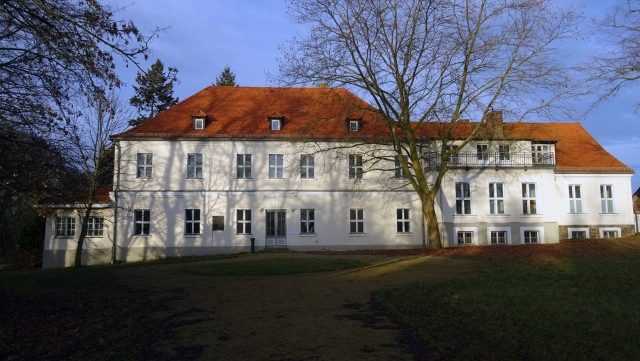
ManorReichenow-Möglin

Möglin Manor

Möglin Manor

Museum
To be privately owned

Möglin is the name of a manor near Wriezen in the former district of Oberbarnim in the March of Brandenburg. Today, Möglin belongs to the municipality of Reichenow-Möglin in the district of Märkisch-Oderland and is part of the Barnim-Oderbruch administrative collective. It became known as the model estate of the agricultural scientist Thaer.

The complex "with its farmyard, manor house, inspector's house, and park is completely under monument protection."

1300–1600

Mogylina (likely Slavic: hill place) is first mentioned in 1343 as the seat of the von Eichendorff family, originating from Magdeburg. In Charles IV's land register of 1375, Mogelyn is listed with 20 hides, of which Otto Pul (Otto von Pfuel, mentioned 1375–1420) from the long-time wealthiest Oberbarnim family of Pfuel owns 8 hides and his cousins 16 hides; 4 hides belong to the parish.

The Eichendorffs again took over Möglin from 1448–1483, though only half, as the von Barfus family had also settled there, initially ruling over a part from 1463–1484, and later over all of Möglin. The Barfus family replaced the Pfuels in their social standing and owned the majority of the manors in Oberbarnim. Their main lines were Praedikow and Möglin, which belonged to them for over 300 years. Lords of Möglin during this time were the Brandenburg councilor Kuno von Barfus (lived around 1435), his son Heinrich (lived around 1480), also a Brandenburg councilor, whose son Valentin (1492–1557), and finally his son, the imperial cavalry captain Heinrich von Barfus (1534–1601), who built the manor house in 1592. Almost simultaneously (1598), the small church, built of fieldstone and brick, was constructed as a daughter church of Reichenow.

1600–1700

Previously, a coat of arms in the church commemorated "Alexander v. Barfus, born December 11, 1580, died December 19, 1647". Field Marshal Hans Albrecht von Barfus (1635–1704), a general under Frederick I, also came from Möglin. During the Thirty Years' War, Möglin was completely destroyed; by 1652, no one lived there anymore.

1700–1800

In 1765, Friedrich Ludwig von Barfus had to sell the completely dilapidated estate to the court councilor Carl Friedrich Menzel. Further owners were Privy Councilor Wilhelm von Wolff from 1778–1794, Chamber Court Referendary Ernst Friedrich von Clermont from the Aachen patriciate from 1794–1804, and Chamber Councilor von Noeldecken.

1800–1900

The Thaer era from 1804 to 1873: Albrecht Daniel Thaer (1752 to 1828) worked as a physician in Celle until 1804 and increasingly focused on agricultural issues. In 1804, at the invitation of King Frederick William III of Prussia, he moved to Brandenburg. He gave up his medical profession, bought the Möglin manor, and demonstrated his views on rational agriculture there until his death, especially for the Brandenburg-Prussian region. As an advisory state councilor, he directly and indirectly participated in the Prussian agrarian reforms. In 1806, he founded the first academic institution for agriculture in the German-speaking world in Möglin. From 1819, it was called the "Royal Prussian Academy of Agriculture". Between 1810 and 1819, he simultaneously taught as a professor of cameralism at the newly founded University of Berlin. The institution, from 1819 the Royal Prussian Academy of Agriculture, was continued by his son-in-law Körte, his son Albrecht Philipp, and his grandson Albrecht Conrad until 1861. 773 graduates from all over Europe can be traced. Theodor Fontane also wrote extensively about this in his "Wanderungen durch die Mark Brandenburg – Das Oderland". Thaer's grandson, Prof. Dr. Albrecht Conrad Thaer, taught agriculture at the University of Giessen from 1871. He leased the estate in 1870 and sold it in 1873 to Auguste von Schmieden, née Kuschke (1832–1901), widow since 1867 of the Prussian captain Adolph von Schmieden (1822–1867) and mother-in-law of the later General Paul Baron von Collas (1841–1910), who married her daughter Ottilie von Schmieden (1856–1883) at Möglin Manor in 1875.

1900–1945

Until 1914, Möglin remained in the possession of her children Adolf von Schmieden and Martha Bertha von Sperling, or rather her granddaughters Auguste von Lueder and Klara von Sperling (from 1904). In 1911, the granddaughters then sold the estate to Ferdinand Schultze, from whom the estate passed to Captain (ret.) Waldemar Knust in 1914. His son managed the estate until its expropriation by the communists in 1945; however, the estate was registered in the name of Anna Marie Knust from 1936 to 1948. According to the communists' plan, the manor house, like all "Junker" property, was to be demolished. Small farmers' buildings were to be constructed from the stone. This plan was only prevented by the billeting of many refugee families in the manor house.

1945–1990

The estate, expropriated as part of the land reform, comprised 466 hectares of arable land, 15 hectares of grassland, and 75 hectares of forest. 13 farm laborers and 28 resettlers/refugees received 252 hectares of arable land. The remainder of the former "manor" with 214 hectares of agricultural land remained in public ownership and was managed until 1995 by a local agricultural enterprise, various agricultural production cooperatives, and an agricultural teaching and demonstration farm e.V. The former Thaer farmyard was preserved. The manor house served at various stages as accommodation for resettlers/refugees, as a cultural and community center, and for many years housed agricultural apprentices. There was a Thaer room in the building. Events and exhibitions about Thaer took place on important occasions. The manor park was used for village festivals. From 1978, the A. D. Thaer working group, based in the old Thaer manor house, was active. This led to the establishment of the Fördergesellschaft as a registered, non-profit association on June 22, 1991.

since 1990

With the reunification, the agricultural land and real estate remaining from the land reform passed to the Bodenverwertungs- und -verwaltungs GmbH (BVVG). In 1992/1994, the Fördergesellschaft Albrecht Daniel Thaer e.V. received federal and state funding for the preservation of Thaer's legacy and the establishment of an exhibition in the inspector's house. The exhibition on his life and work was set up and opened in 1992.

Since 1996, the manor house and manor park have been privately owned.

In 2008, the permanent exhibition "Albrecht Daniel Thaer," showcasing his work in relation to his predecessors, his students, and in the current context, moved to a new modern museum building in the center of the village. The exhibition and library house not only agricultural equipment he developed but also a large number of original editions of his works and writings. There is also a small secondary exhibition in the village church.

In the manor park, near the village church, is the burial site of Albrecht Daniel Thaer. A circular path leads to the Thaer bust and a large memorial stone with a bronze relief. The manor park is open to visitors.

Take Mobile History with you

You are reading this text for free. Premium adds what matters on the road: descriptions read aloud, sites found through your camera, whole regions taken offline.

  • Every description, including the ~17,700 Premium sites
  • Audio guide: have descriptions read to you on location
  • AR finder: see sites through your camera, with distance and bearing
  • Unlimited saved sites

14 days free, then from €2.99 a month. Cancel anytime.

Source: Wikipedia · Licence: CC BY-SA 4.0 · Image: Jörg Heldt

This description draws on the facts documented in the linked Wikipedia article; Wikipedia content is licensed under CC BY-SA 4.0. Wording and editing: Mobile History.

Location: 52.6663, 14.1073