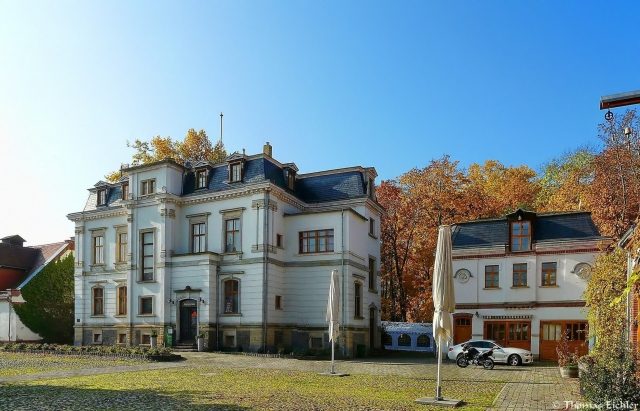
ManorLeipzig - Mölkau

Mölkau Manor

Mölkau Manor

To be privately owned

The first documented mention of the villages in the Leipzig district occurred in 1335. In the Register Marchionum, under Nos. 24 and 25, the village is listed as "Kellners-Nuwendorf" and "Gotschalges-Nuwendorf". In a feudal letter from 1432, the Schultz brothers and their cousins are named, who acquired an estate in the village of Nuwendorf (Unterdorf), along with jurisdiction in the village. In 1506, the Pflugk family of Frauenhain enfeoffed Jeronimus Walter Lintacher with a court and estate in Unternawendorf. The Lintachers were Leipzig citizens, mostly councilors and mayors. In 1588, the Pflugk family enfeoffed the estate to the Scipio family, whose members often sat on the Leipzig council; they were councilors and master builders of the city.

The Scipio brothers sold the feudal estate, also known as a manor, in 1726 to Dr. Thomas Wagner, a commission councilor and merchant in Leipzig. Under the direction of Dr. Thomas Wagner and later his son Dr. Andreas Wagner, the remaining floodplain forest north of the estate was transformed into a park-like area in the style of an English garden between 1730 and 1760. In 1765, Andreas Wagner, Electoral Saxon Privy Councilor, sold the feudal estate to Dr. Rudolf August Schubarth, Electoral Saxon Court and Justice Councilor in Leipzig. After the death of Dr. Rudolf August Schubarth in 1770, the estate passed to the Hommel family, to his daughter Amalie Sophie and her husband Dr. Karl Ferdinand Hommel. Her husband died in 1781. Schubarth's widow died in 1783, and the estate passed to their daughter Amalie Sophie Hommel, née Schubarth. The manor house and the park grounds were largely destroyed in the Battle of Leipzig on October 18, 1813. In 1817, Councilor David Anger of Eytra bought the estate. The estate and manor house were rebuilt. On June 16, 1839, David Anger died; a subsequent owner is not traceable.

In 1842, the owner of the estate, Postmaster Heinrich Robert Moltrecht, applied for the consolidation of properties in the Zweinaundorf district. Moltrecht's heirs sold the estate in 1854 to the Leipzig merchant Friedrich Wilhelm Kelbe, co-owner of the Leipzig banking and forwarding company Ottens. He had most of the dilapidated stable buildings replaced by solid stone buildings. The ruined farms of the lower village were bought up and added to the manor. In 1869, Friedrich Wilhelm Kelbe had the manor house rebuilt. It served as a residence until 1945. In 1872, the "Hirschgruppe" (Deer Group) was erected on the site of the old manor house. Based on models by an unknown master from Alsace-Lorraine, 15 sculptures were produced in the "Harzer Werke" between 1852 and 1890. Wilhelm Kelbe died on January 21, 1895, and his widow inherited the estate. Wilhelm Kelbe's widow died on June 11, 1906. As the heir of their prematurely deceased daughter, Elisabeth Seeger née Kelbe, her son, Dr. Wilhelm Adolf Seeger-Kelbe, became the successor in possession of the estate and the church patronage. In 1906, the Bernhard Zachariä company manufactured a tower clock movement for the estate. Dr. Wilhelm Seeger-Kelbe died on August 29, 1939, and his son Dr. Christian Seeger-Kelbe inherited the estate. In 1945, the owners were forcibly expropriated and expelled by the communists. The former owners left the estate. Dr. Christian Seeger-Kelbe was arrested on October 9, 1945, and on December 21, 1945, he managed to escape from the Leipzig remand prison.

In 1946, the manor house briefly served as accommodation for displaced persons, later as a girls' home. In 1950, the manor house was assigned to the Mölkau school, which used it until 1968. The manor park was placed under nature protection, later declared a landscape protection area. The manor house was listed as a historical monument in 1951. In 1952, pig pens were installed in the old barn, now a horse stable, due to specialization in livestock farming. In 1968, the manor house was used as a further education center for educators.

In 1991, the Treuhandanstalt transferred the estate from public ownership to the ownership of the City of Leipzig. In September 1993, 20 employees of the ABM company began clean-up work and structural safety measures, with the aim of developing it into an Ecological City Estate. In 1994, the City of Leipzig transferred the estate to the special assets of the BfB support point. In 1995, the outdoor facilities and existing buildings were renovated by 300 employees. The ceremonial opening of the Mölkau Ecological Estate took place on July 9, 1998, by the then Federal Minister of Labor Norbert Blüm, the President of the Federal Employment Agency Bernhard Jagoda, and the Saxon Minister of Economic Affairs Kajo Schommer, as well as BfB operations manager Mattias von Hermanni. The privatization of the Mölkau estate took place in 2002. The owner became Stadtgut Mölkau GmbH with managing director Carola Moddemann.

Take Mobile History with you

You are reading this text for free. Premium adds what matters on the road: descriptions read aloud, sites found through your camera, whole regions taken offline.

  • Every description, including the ~17,700 Premium sites
  • Audio guide: have descriptions read to you on location
  • AR finder: see sites through your camera, with distance and bearing
  • Unlimited saved sites

14 days free, then from €2.99 a month. Cancel anytime.

Source: Wikipedia · Licence: CC BY-SA 4.0 · Image: Thomas Eichler

This description draws on the facts documented in the linked Wikipedia article; Wikipedia content is licensed under CC BY-SA 4.0. Wording and editing: Mobile History.

Location: 51.3269, 12.4516